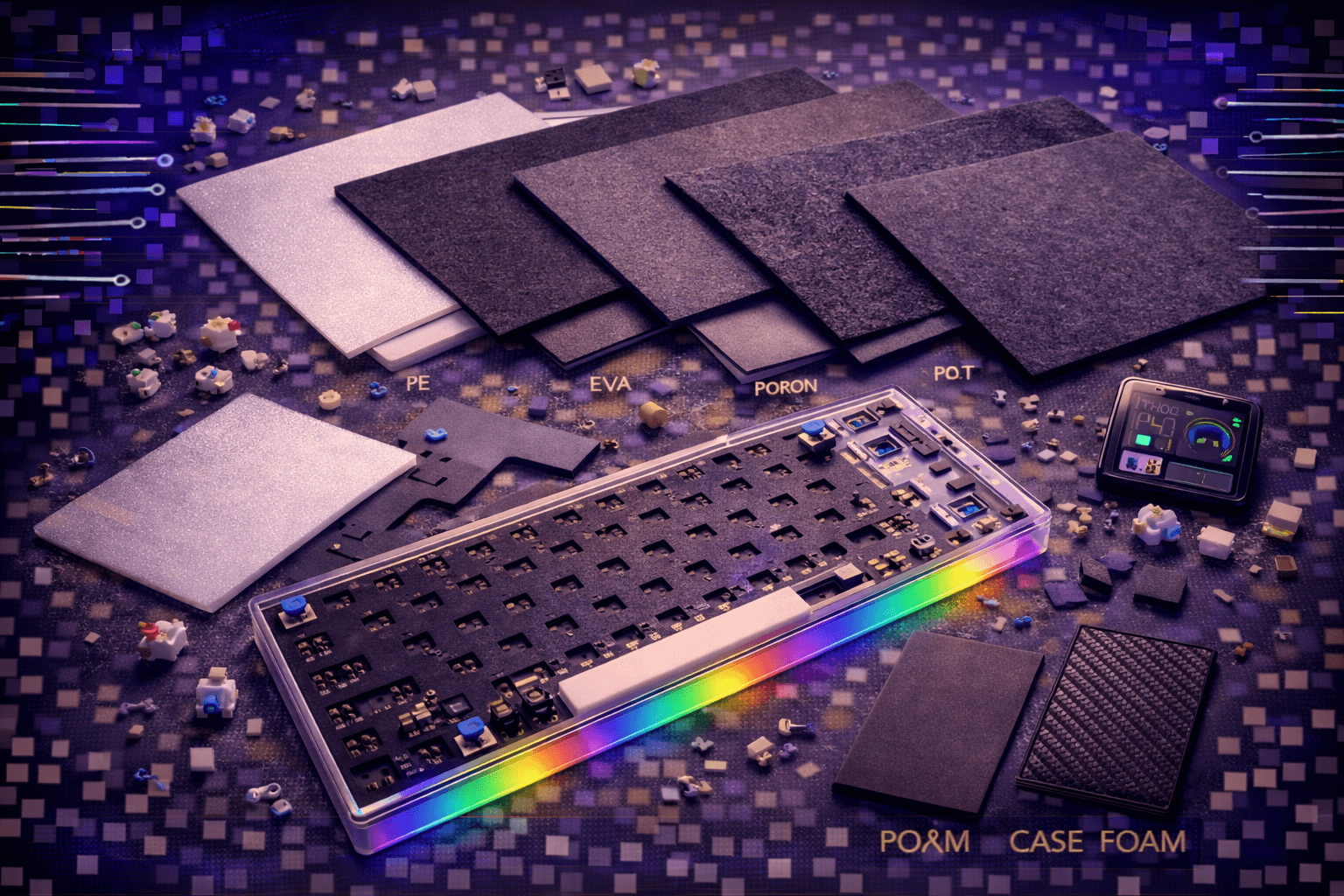
Keyboard foam transforms acoustic characteristics through strategic dampening materials placed throughout keyboard construction, reducing hollowness, controlling resonance, and refining sound signature. Understanding foam types—from budget EVA case foam to premium Poron plate foam—enables targeted acoustic improvements matching sound preferences and budgets.
Foam serves multiple purposes in mechanical keyboards: acoustic dampening absorbing unwanted vibrations and resonance, hollowness reduction filling empty case cavities, ping elimination dampening metallic ringing, typing noise reduction muting harsh bottom-out sounds, and vibration isolation preventing sound transmission between components.
This comprehensive guide explores foam material types (EVA, Poron, neoprene, PE, Sorbothane) analyzing acoustic properties and durability, explains foam placement locations (case, plate, PCB) and their effects, discusses thickness selection and compression characteristics, covers DIY foam cutting and installation, compares pre-cut vs custom foam options, and helps match foam selection to keyboard types and sound goals.
Whether seeking budget sound improvements, refining premium keyboard acoustics, or eliminating specific sound issues, understanding foam fundamentals enables informed material selection and placement creating desired acoustic signature.
Note: This guide contains affiliate links. If you purchase through our links, we may earn a commission at no extra cost to you. This helps support our testing and content creation.
Keyboard Foam Material Types
EVA Foam (Ethylene-Vinyl Acetate - Budget Standard)
Material Properties:
- Closed-cell foam structure preventing water absorption
- Soft and easily compressible material
- Lightweight and easy to handle
- Water-resistant properties excellent for durability
- Good long-term durability resisting degradation
- Very budget-friendly ($5-15 per sheet)
Thickness Range: 2-5mm most common. Larger sheets available for case coverage.
Density Variations: Low to medium density depending on grade. Higher density versions available at slightly higher cost.
Acoustic Characteristics: Good general dampening across frequency spectrum. Reduces hollowness effectively through material absorption. Slightly dampens mid-high frequencies creating fuller balanced sound. Creates noticeably deeper tone than stock keyboard.
Compression Behavior: Compresses noticeably under pressure. Recovers reasonably well after compression. Maintains properties adequately over years of use. Some permanent compression possible with extended heavy use.
Best Applications: Case foam application most common. Budget dampening priority. General hollowness reduction. Most popular foam choice due to cost-effectiveness.
Common Uses: Case cavity filling (primary use), basic plate foam, PCB bottom foam, stabilizer dampening.
Practical Considerations: Thicker EVA (5mm) better than thin (2mm) for noticeable effect. Material grade varies between manufacturers—quality varies.
Poron (Polyurethane - Premium)
Material Properties:
- Closed-cell polyurethane structure
- Premium dampening material with superior properties
- Excellent compression resistance and consistency
- Resists permanent deformation over time
- Superior long-term durability (doesn't degrade)
- Expensive ($15-40 per sheet)
Thickness Range: 1-4mm typical. Premium quality available.
Density Options: High density options available for maximum dampening. Standard density sufficient for most applications.
Acoustic Characteristics: Excellent dampening across full frequency spectrum. Very controlled resonance with minimal ringing. Creates refined smooth acoustic signature. Premium sound quality noticeably better than EVA.
Compression Behavior: Minimal permanent compression even under heavy prolonged use. Springs back reliably to original thickness. Maintains exact compression properties even after years. Highly consistent.
Best Applications: Plate foam (between plate and PCB). Premium gasket-mount systems. High-end case foam for refined results. Professional builds prioritizing acoustic consistency.
Common Uses: Gasket-mount systems, between plate and PCB (optimal location), premium case foam, premium builds.
Value Proposition: Higher cost justified by superior consistency and durability. Ideal investment for expensive builds where longevity matters.
Neoprene Foam (Rubber-Based Dampening)
Material Properties:
- Closed-cell rubber-based foam structure
- Dense heavy material with strong absorption
- Excellent sound absorption properties
- Very durable resistant to degradation
- Water and oil resistant characteristics
- Moderate cost ($10-25 per sheet)
Thickness Range: 2-6mm common. Thicker sheets available for maximum dampening.
Density: Medium to high density. Heavier than EVA providing superior absorption.
Acoustic Characteristics: Deep sound profile emphasizing bass frequencies. Excellent bass absorption reducing deep resonance. Significantly reduces harshness and brightness. Creates very muted controlled sound profile.
Compression Behavior: Moderate compression under pressure. Good recovery characteristics. Very stable over extended time. Maintains properties reliably.
Best Applications: Maximum sound dampening desired. Deep muted sound preference. Long-term durability priority. Budget-conscious premium option.
Common Uses: Case foam for heavy dampening, stabilizer dampening, aggressive sound control, keyboard modification.
Best For: Users wanting deep muted typing. Office/quiet environments. Extreme dampening priority.
PE Foam (Polyethylene - Specialized)
Material Properties:
- Closed-cell polyethylene structure
- Lightweight flexible sheets
- Good basic durability
- Inexpensive widely available ($3-8)
- Non-toxic safe for electronic contact
- Available in extremely thin sheets (0.3mm)
Thickness Range: 0.3-2mm typical. Thinner than other foam types.
Density: Low density lightweight material.
Acoustic Characteristics: Creates distinctive "poppy" acoustic character when placed between switches and PCB. Different from general dampening—alters switch sound profile. Less general hollowness reduction, more specific acoustic tuning.
Compression Behavior: Compresses relatively easily. Adequate recovery for most uses. Maintains basic properties adequately.
Best Applications: PE foam mod specifically (between PCB and switches). Budget case foam layers. Specific acoustic character tuning rather than general dampening.
Common Uses: PE foam mod (primary use), thin budget case foam, acoustic experimentation.
Special Note: PE foam between switches and PCB creates "poppy" sound distinct from general dampening. Popular modification for specific sound preference.
Sorbothane (Premium Visco-Elastic)
Material Properties:
- Proprietary visco-elastic polymer material
- Superior vibration dampening properties
- Very dense and heavy material
- Extremely durable lasting decades
- Sticky tacky surface texture
- Expensive premium material ($20-50)
Thickness Range: 1-5mm typical. Small sheets common due to cost.
Density: Very high density. Heaviest dampening material available.
Acoustic Characteristics: Maximum vibration dampening possible. Absorbs vibrations exceptionally across spectrum. Can over-dampen creating "dead" sound if used excessively. Creates extremely controlled muted profile.
Compression Behavior: Excellent energy absorption through visco-elastic compression. Recovers slowly (visco-elastic property). Maintains dampening properties indefinitely.
Best Applications: Extreme dampening needs. Vibration isolation critical. Small targeted applications rather than full coverage. Foot dampening. Strategic vibration control.
Common Uses: Keyboard feet dampening, stabilizer dampening, vibration isolation, targeted weight dampening, extreme sound control.
Practical Limitation: High cost and dense properties make full keyboard coverage impractical. Best for targeted applications.
Foam Placement Locations and Effects
Case Foam (Most Important Location)
Location: Bottom of keyboard case. Between PCB and case bottom surface. Fills empty cavity space.
Primary Purposes:
- Hollowness Reduction: Most significant improvement. Eliminates hollow echo.
- Case Resonance Dampening: Controls case vibrations and ringing.
- Echo Absorption: Fills empty air space preventing sound reflection.
- Ping Elimination: Reduces metallic pinging from aluminum cases.
Acoustic Effect: Deeper fuller sound immediately noticeable. Reduces hollow character significantly. More controlled overall resonance. Sound quality improvement especially dramatic on budget keyboards.
Installation Process:
- Measure case cavity depth and dimensions
- Cut foam to fit case bottom shape
- Place foam on case bottom
- Install PCB assembly on top
- Foam compresses slightly under PCB weight
Standard Thickness: 3-5mm typical. Thicker (5mm) for very hollow cases. Thinner (2mm) for space-constrained keyboards.
Material Selection: EVA most popular (budget). Neoprene for maximum dampening. Poron for premium consistency.
Impact Percentage: Case foam delivers approximately 70% of total acoustic improvement. Most important foam application.
Plate Foam (Refinement)
Location: Between keyboard plate and PCB. Surrounds switch holes.
Primary Purposes:
- Plate Vibration Dampening: Controls plate vibrations independent of case.
- Switch Sound Refinement: Alters individual switch acoustic characteristics.
- Plate Ping Reduction: Reduces metallic ring from metal plates.
- Smooth Acoustic Profile: Creates smoother refined sound.
Acoustic Effect: More controlled switch-level sounds. Less metallic ring especially with aluminum plates. Softer typing acoustics. Subtle but noticeable refinement.
Installation Process:
- Remove all switches from keyboard
- Measure plate dimensions
- Cut foam to plate size
- Cut or punch holes for each switch location
- Place between plate and PCB
- Reinstall switches
Standard Thickness: 1.5-3mm typical. Must not interfere with switch installation. Thinner than case foam due to tight space.
Material Selection: Poron ideal (consistent compression without interference). EVA acceptable. PE foam for specific acoustic character.
Hole Positioning Critical: Switch holes must align precisely with switch mounting points. Misalignment prevents proper switch seating.
PCB Foam (Subtle Enhancement)
Location: Under PCB on solder-side. Between PCB and case bottom/plate.
Primary Purposes:
- Additional Dampening Layer: Minor additional vibration control.
- PCB Protection: Protects from case shorts or physical contact.
- Subtle Sound Refinement: Minor acoustic improvement.
Acoustic Effect: Very subtle. Adds minor dampening. Not as dramatic as case or plate foam. Noticeable mainly on high-sensitivity listeners.
Installation Process:
- Place thin foam under PCB before assembly
- Ensures PCB sits on foam layer
- Generally not removed for repairs
Standard Thickness: 1-3mm very thin. Must not prevent component clearance or assembly.
Material Selection: Thin EVA or PE foam. Space constraints limit options.
Reality Check: PCB foam less critical than case or plate. Skip if space constrained.
Stabilizer Foam (Targeted Dampening)
Location: Under stabilizer housings or around stabilizer wire. Targeted precise placement.
Primary Purposes:
- Stabilizer Rattle Reduction: Dampens hollow sound from stabilizer rattling.
- Stabilizer Bottom-Out Dampening: Softens spacebar/shift bottom-out.
- Complements Lubrication: Works with lube for maximum stabilizer control.
Acoustic Effect: Quieter spacebar and large keys. Reduces hollow sound on stabilized keys. Subtle but appreciated improvement.
Installation Process:
- Small foam pieces under stabilizer housings
- Or thin foam around stabilizer wire contact points
- Careful not to prevent stabilizer function
- Can be added after assembly easily
Standard Thickness: 1-2mm very thin. Must not interfere with switch movement.
Material Selection: Thin EVA, Poron, or band-aid mod (fabric band-aids on stabilizer wire).
Band-Aid Mod Alternative: Fabric band-aid on stabilizer wire underneath housing. Cheap effective alternative to foam.
Foam Thickness and Density Selection
Thickness Guidelines
Thin Foam (1-2mm):
- Subtle acoustic effect
- Suitable for tight spaces
- Plate foam applications where space critical
- Minimal compression concerns
- Least impactful on sound
Medium Foam (3-4mm):
- Good balance between effect and practical concerns
- Standard case foam recommendation
- Noticeable dampening without over-muting
- Most common choice
- Best value
Thick Foam (5mm+):
- Maximum acoustic dampening possible
- For very hollow budget keyboards needing aggressive treatment
- Risk of over-dampening creating "dead" muted sound
- Assembly clearance concerns
- Can reduce keyboard flex
Thickness Measurement: Measure case cavity depth precisely. Choose foam thickness using ~80% of available depth. Leaves some compression room.
Density Impact on Sound
Low Density (Soft):
- Compresses easily and significantly
- Creates softer more muted sound profile
- Less aggressive overall dampening
- Cheaper typically
- Good for subtle acoustic changes
Medium Density:
- Balanced compression and dampening properties
- Maintains effect over years of use
- Most versatile choice
- Standard recommendation
- Best overall value
High Density (Firm):
- Minimal permanent compression
- Maximum dampening per thickness unit
- More expensive
- Premium materials (high-grade Poron, neoprene)
- Maintains consistency long-term
Matching Foam Selection to Goals
Maximum Silence Goal: High-density neoprene 5mm case foam + Poron 2mm plate foam. Creates extremely muted controlled profile.
Balanced Improvement Goal: Medium-density EVA 3-4mm case foam. Noticeable improvement without over-muting. Best value approach.
Subtle Refinement Goal: Low-density EVA 2mm case foam. Gentle sound improvement. Preserves more natural character.
Poppy Acoustic Character: PE foam 0.5mm between PCB and switches specifically. Creates distinctive sound profile.
Budget Optimization: EVA 3-4mm case foam only. Delivers 70% improvement at lowest cost. Best return on investment.
DIY Foam Cutting vs Pre-Cut Options
Pre-Cut Keyboard Foam
Advantages:
- Perfect fit guaranteed for specific keyboard
- Switch holes pre-cut for plate foam (eliminates tedious cutting)
- Saves significant time (eliminates 1-2 hours work)
- Professional quality manufacturing
- Correct thickness for target keyboard
Disadvantages:
- Limited keyboard compatibility (only popular models)
- More expensive ($15-40 per kit vs $5-10 DIY material)
- Single material option offered
- Inflexible if preferences change
- Requires correct model match
Best For: Popular keyboards (Keychron, GMMK, etc.). Users valuing convenience. Those with limited time or tools.
Examples: Many custom keyboard vendors offer pre-cut foam kits. Increasing availability.
Custom DIY Foam Cutting
Advantages:
- Works with any keyboard design
- Complete material choice freedom
- Significantly cheaper ($5-10 vs $20-40)
- Can experiment with different materials
- Satisfaction of custom installation
Disadvantages:
- Time-consuming installation (1-2 hours typical)
- Risk of cutting errors or misalignment
- Requires basic tools (scissors, craft knife)
- Skill and patience needed
- Less perfect fit than pre-cut
Best For: Uncommon keyboards unsupported by pre-cut vendors. Budget-conscious builders. DIY enthusiasts. Experimentation minded users.
Tools Needed: Sharp scissors, craft knife, ruler, cutting mat, marker for marking.
DIY Cutting Tips
Case Foam: Measure case cavity. Cut foam slightly larger than needed. Trimming easier than adding material.
Plate Foam: Use switch position markers. Measure switch locations precisely. Drill hole punch or careful knife work for holes.
Test First: Cut slightly oversized initially. Test fit. Trim as needed. Better than too small.
Quality Matters: Better to spend 30 minutes perfecting cut than assembly. Proper fit critical.
FAQ
Q: What keyboard foam is best overall?
A: EVA foam best budget all-around choice. Poron best premium option for consistency. Neoprene for maximum deepest dampening. Case foam placement most important. See materials section above.
Q: Does keyboard foam actually make noticeable difference?
A: Yes, dramatically especially for hollow budget keyboards. Reduces hollowness significantly, controls resonance effectively. Biggest acoustic improvement on sub-$100 keyboards. See placement section above.
Q: How thick should keyboard case foam be?
A: 3-4mm ideal for most keyboards. 5mm maximum for very hollow cases. Measure case cavity depth first. 80% of depth good rule of thumb. See thickness section above.
Q: Can I use any foam for mechanical keyboards?
A: Closed-cell foam works (EVA, neoprene, PE). Avoid open-cell foam (absorbs water, degrades). Purpose-made keyboard foam best but any closed-cell works. See materials section above.
Q: Where should I put foam in mechanical keyboard?
A: Case bottom most important (70% improvement). Between plate and PCB optional but beneficial. Start with case foam. See placement section above.
Conclusion
Keyboard foam dramatically improves acoustic characteristics through strategic dampening material placement eliminating hollowness and refining sound quality. EVA foam provides excellent budget dampening. Poron delivers premium consistency and reliability. Neoprene maximizes absorption for deep muted sound.
Case foam location delivers approximately 70% of total acoustic improvement—essential starting point for any acoustic enhancement project. Once foam is dialed in, our advanced keyboard modding guide covers the next-level techniques like force break, tempest mod, and switch film stacking. Plate foam adds refinement and controlled switch sound. Thickness selection balances dampening effect with maintaining acoustic liveliness—3-4mm case foam standard optimal.
DIY foam cutting provides economical approach for case foam on any keyboard. Pre-cut foam options worth premium for tedious plate foam installation. Material selection matches specific goals—EVA balanced versatile, neoprene maximum deepest dampening, Poron premium consistency.
Understanding foam types, optimal placement locations, and appropriate thickness enables targeted acoustic improvements transforming hollow budget keyboards into refined satisfying typing experiences matching personal sound preferences and acoustic goals.