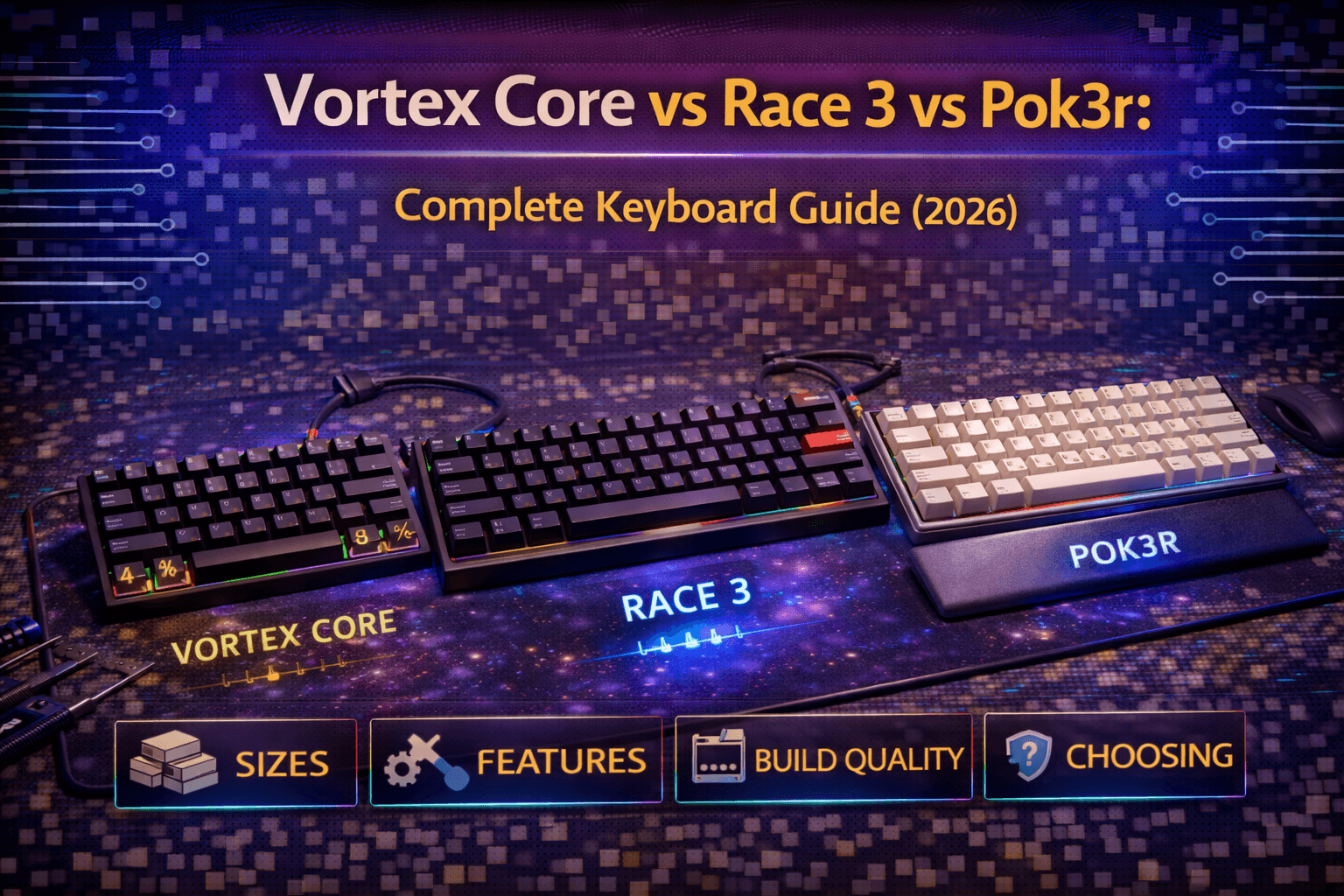
Vortex keyboards occupy a unique niche in the mechanical keyboard market—a boutique Taiwanese manufacturer focusing exclusively on compact layouts with quality construction and unique features. While mainstream brands chase RGB lighting and gaming aesthetics, Vortex quietly produces programmable compact keyboards that appeal to enthusiasts valuing function over flash. They don't make TKL or full-size keyboards—only 40%, 60%, and 75% layouts. They don't chase trends or mass market appeal. They make quality compact keyboards for people who specifically want compact quality.
Understanding Vortex requires appreciating their compact focus and boutique positioning. The Vortex lineup centers on three main models: Pok3r (60%, their legendary flagship launched 2015), Race 3 (75%, compact with function row and distinctive bezel), and Core (40%, ultra-compact for enthusiasts committed to extreme minimalism). Each represents refined execution of compact layouts with features like programmable layers without software, quality PBT keycaps standard, and solid aluminum construction throughout.
Vortex keyboards aren't for everyone. They're compact-only, relatively expensive ($100-150 range), and have limited availability through boutique distribution. But for enthusiasts wanting quality compact keyboards with unique features and proven reliability, Vortex delivers options unavailable elsewhere. This guide covers what makes Vortex special, detailed breakdowns of each model, comparisons helping you choose, and helps you determine if Vortex keyboards suit your needs and preferences.
Note: This guide contains affiliate links. If you purchase through our links, we may earn a commission at no extra cost to you. This helps support our in-depth testing and content creation.
What Makes Vortex Special
Compact Focus
Vortex exclusively makes compact keyboards—40%, 60%, and 75%. This specialization enables deep refinement of compact layouts rather than compromising across multiple sizes. Philosophy is straightforward: be excellent at compact keyboards rather than mediocre at everything. This focus means Vortex understands compact-specific design considerations that generalist brands miss. Compact keyboards require different ergonomics, different workflow adaptation, different programming philosophy than full-size. Vortex's exclusive focus means perfected compact layouts.
Quality Construction
Vortex maintains consistent quality standards across their lineup. Aluminum cases are standard on most models—CNC-machined, cast aluminum with excellent anodization. Quality PBT keycaps included standard on every keyboard (aftermarket PBT keycap sets typically cost $50+). Cherry MX switches available in variety. Solid construction throughout. Quality construction at reasonable prices ($100-150 typical) without chasing premium pricing for premium materials.
Programmability Without Software
Vortex keyboards feature programmable layers enabling extensive customization without software dependency. On-board programming via keyboard shortcuts means creating custom layers, remapping keys, programming macros happens directly on keyboard. This approach's strength is profound: keyboard programming carries between computers. Move Pok3r to different computer, all customization works immediately without software re-installation. Most modern keyboards require software on each computer. Vortex's on-board approach is portable, reliable, future-proof.
PBT Keycaps Standard
All Vortex keyboards include thick PBT keycaps with dye-sublimated legends. This is significant. PBT keycaps are premium feature often requiring $50+ aftermarket purchase. Most pre-builts include cheap ABS keycaps. Vortex includes quality PBT standard, communicating respect for keyboard quality. Dye-sublimated legends resist wearing off. Textured PBT resists shine (plastic polish from hand oils). This attention means Vortex keyboards feel premium even at modest prices.
Unique Layouts
Vortex offers layouts unavailable elsewhere. Pok3r refined 60% with proven reliability. Race 3 distinctive 75% with memorable bezel. Core extreme 40% designed for specific use cases. These aren't generic—they have character. Race 3's prominent bezel makes immediate design statement. Pok3r's legendary reputation stems from years of proven excellence. Core's specific key arrangement (semicolon for Dvorak users, double Shift, multiple Ctrl/Alt) shows thoughtful design.
Boutique Positioning
Vortex is boutique brand—smaller production runs, limited distribution, enthusiast focus rather than mass market. They're not mainstream like Corsair or Razer. They're niche brand serving compact keyboard enthusiasts specifically. This positioning enables quality focus without mass-production compromises. Limited availability sometimes creates scarcity, but availability through MechanicalKeyboards.com, specialty retailers, and direct store.
Vortex Appeal
Choose Vortex if you want compact keyboards, value programmability without software, appreciate PBT keycaps included, want aluminum construction, enjoy boutique brand appeal. Skip Vortex if you want TKL or full-size, need mainstream wide availability, prefer gaming brands, want RGB excess. Vortex serves specific market—compact enthusiasts—excellently.
Vortex Pok3r (Legendary 60%)
Overview
Pok3r is Vortex's flagship and most famous keyboard. Launched in 2015, it became legendary 60% keyboard through quality execution and refinement over years. It earned reputation as benchmark quality 60% at accessible price. Even today, with increased competition, Pok3r remains respected choice for 60% enthusiasts.
Specifications
Layout is 60% compact with 61 keys. Size approximately 11.4 inches wide by 4.0 inches deep by 1.2 inches tall—extremely compact. Weight around 850g in aluminum version. Case available in aluminum (CNC-machined cast aluminum with excellent anodization) or plastic. Aluminum versions deliver premium feel; plastic versions adequate but less impressive. Steel plate provides firm typing platform. Cherry MX switches available in Red, Brown, Blue, Black, Clear, Silent Red varieties—choose at purchase. Stabilizers are cherry-style plate-mount, adequate quality, functional. Keycaps are thick PBT doubleshot or dye-sublimated in multiple color options. Programming includes 3 programmable layers accessible via Fn combinations—remap any key, create custom layouts, program macros. DIP switches enable hardware remapping without programming. Detachable cable (now USB-C on newer models, mini-USB on older). White LED backlighting on standard versions, RGB on specialty versions. Price $120-140.
Build Quality
Build quality is phenomenal. Aluminum case (on aluminum versions) is heavy cast aluminum, CNC-machined with excellent anodization. Described as "most sturdy keyboard out-of-the-box I've ever used." Aluminum weight creates solid landing feeling on each keystroke rather than hollow feel from plastic keyboards. Around 3 pounds fully assembled (aluminum version). Professional construction throughout. Detachable cable is quality. Keycaps are thick PBT—durable, resist shine. Stabilizers adequate, functional, though benefit from owner tuning for perfection.
Overall: Excellent build quality justifying reputation. Construction rivals keyboards costing significantly more.
Features
Programmability is straightforward and powerful. 3 programmable layers accessible via Fn combinations. All keys are remappable. Hardware DIP switches enable common remapping (Caps Lock to Fn, swap Alt/Win) without programming. Macro support enables each key to execute up to 32 keystrokes with timed delays between keystrokes. Native Colemak support included. No software required—all programming on-board through keyboard shortcuts. This means programmable settings carry between computers seamlessly.
QMK firmware on newer versions enables advanced customization beyond standard layers. Keycaps included are thick PBT quality. Multiple color options. Switch selection at purchase. Detachable cable. LED backlighting, customizable.
Typing Experience
Solid, refined 60% typing experience. Aluminum construction creates firm platform with good acoustics. Described as "one of the most comfortable keyboards" with no wrist strain after 13-14 hour coding sessions. PBT keycaps provide textured typing surface. Programming enables comfortable 60% workflow once layers configured properly.
Adaptation required: 60% layout means learning layer access for function keys, arrows, symbols. This requires weeks of adaptation. Users report comfort after commitment to learning curve. Typing speed not reduced after adaptation—professional review showed speed increase from 60 WPM normal to 80+ WPM after adaptation.
Strengths
Legendary reputation earned through quality and proven reliability over 11 years. Excellent build quality for price—aluminum case standard, thick PBT keycaps included. Wide Cherry MX switch selection. Programmable without software—settings portable between computers. Proven reliable design with strong community support. Detachable cable, modern USB-C on newer models. Excellent desk space savings. Portable despite weight.
Weaknesses
Paint consistency issues on older models (can flake slightly over time). Heavy weight makes travel challenging despite portability. 60% layout requires adaptation (steep learning curve for first weeks). Requires Fn key for basic functions (function keys, arrows, symbols). Some older models lack tilt adjustment. Mini-USB on older models (outdated vs modern USB-C). Limited availability sometimes—Vortex is boutique with production constraints.
Best For
60% enthusiasts wanting proven legendary quality. Programmers valuing compact with full programmability. People willing to adapt to 60% layout. Buyers wanting aluminum construction and PBT keycaps standard. Enthusiasts valuing reliable proven design over bleeding-edge features.
Verdict
Still excellent 60% keyboard justifying $120-140 price through phenomenal build quality and proven reliability. Legendary reputation earned through years of quality execution. More competition today (Anne Pro 2, RK61) but Pok3r's aluminum construction and no-software programming remain advantages. Best choice for quality-focused 60% enthusiasts.
Vortex Race 3 (Distinctive 75%)
Overview
Race 3 is Vortex's 75% keyboard featuring distinctive design and unique layout. Compact layout keeps function row unlike 60%, but more compact than traditional TKL. Prominent beveled front bezel creates memorable design—not subtle or generic. It makes design statement. Quality construction matches Pok3r in larger form factor.
Specifications
Layout is 75% with 83 keys including distinctive arrangement. Size approximately 12.8 inches wide by 4.0 inches deep by 1.3 inches tall. Weight around 900g. Case is CNC-machined aluminum with distinctive beveled design, anodized finish. Aluminum case standard (no plastic option). Steel plate. Cherry MX switches in Red, Brown, Blue, Black, Clear, Speed Silver—choose at purchase. Stabilizers are cherry-style, heavily lubricated reducing rattle and clack significantly. Keycaps are thick PBT dye-sublimated, DSA profile (flat, uniform height across keys). Programming includes 3 programmable layers. Detachable USB cable (mini-USB on older, USB-C on newer). Macro support (each key up to 32 keystrokes). DIP switches for hardware configuration. Price $130-150.
Design & Layout
Distinctive beveled design with prominent front bezel creates unique aesthetic. Layout compresses keys intelligently: function row uncompressed (unlike Race v1), navigation cluster stacked on right side (Page Up, Page Down, Home, End vertically arranged). Delete in top right. Bottom row pruned to accommodate arrow keys. Escape key larger than standard (minor compatibility issue for keycap replacement). Design philosophy "all keys, no space" creates striking, compact layout. Layout is perfect middle ground between 60% and TKL—retains function row while saving more space than TKL.
Build Quality
Case is cast aluminum, machined and anodized. Excellent finish quality. No flex, no creaking. Case bounces slightly under pressure (desirable in aluminum). Aluminum feet with rubber bumpers (though can cause finish wear on metal—users should add plastic buffer). Stabilizers heavily lubricated—significant rattle and clack reduction. Overall: Premium build quality with distinctive appearance. Race 3 looks unlike other keyboards.
Features
Programmability matches Pok3r: 3 programmable layers, macro support up to 32 keystrokes per key with timed delays. DIP switches for hardware configuration. Keycaps are thick PBT dyesub, DSA profile (different feel from standard profiles). Secondary keycap bag includes RGB modifiers and Apple-compatible keys. LED backlighting (white LED under space bar showing Caps Lock and layer indicators—no RGB on standard versions).
Typing Experience
Solid 75% typing with unique character. Aluminum construction creates firm platform. Distinctive bezel affects typing ergonomics slightly—hands rest higher. Some prefer this positioning, others find it odd adjustment. DSA profile keycaps provide different feel than cherry or OEM profiles. Compact layout saves space while retaining function row. After adaptation, described as "excellent graduation point" from TKL for moving toward smaller layouts.
Keycaps Quality
Great keycaps—thick PBT plastic resisting shine and yellowing. Dye-sublimated legends won't wear off with heavy use. DSA profile (flat, uniform height) creates consistent typing experience. Multiple color options. Extra keycap bag with modifiers and Apple keys.
Strengths
Unique, distinctive design immediately recognizable and memorable. Excellent aluminum construction. 75% layout retains function row (minimal adaptation needed). Quality PBT keycaps included. Programmable layers and macro support. Wide Cherry MX switch selection. Well-lubricated stabilizers reduce rattle. Compact saves desk space while staying functional. Excellent value proposition—keycaps alone worth $50+ aftermarket.
Weaknesses
Distinctive bezel design polarizing—love it or hate it, not subtle. Unique escape key limits keycap compatibility for replacement—aftermarket keycap sets rarely include oversized Escape. More expensive than mainstream alternatives. Unique layout requires specific keycap compatibility planning. Mini-USB on older versions. Metal feet can cause finish wear without buffer.
Best For
75% enthusiasts wanting unique aesthetic not found elsewhere. People wanting compact with function row (minimal adaptation). Buyers valuing distinctive designs and proven quality. Enthusiasts appreciating Vortex's boutique positioning. Users wanting excellent value in premium keyboard.
Verdict
Excellent 75% option delivering unique design and premium quality. Distinctive bezel creates memorable keyboard unlike generic competitors. Excellent value package—keycaps alone worth $50+. Perfect for buyers wanting something distinctive while retaining function row. Strong choice for buyers valuing craftsmanship over mainstream popularity.
Vortex Core (Extreme 40%)
Overview
Core is Vortex's 40% keyboard—ultra-compact for enthusiasts wanting absolute minimalism and portability. Extreme learning curve, maximum portability. Most portable mechanical keyboard available. Specialist keyboard for 40% enthusiasts, not practical for most users. Requires complete workflow restructuring and months of commitment.
Specifications
Layout is 40% ultra-compact with 47 keys. Size approximately 9.5 inches wide by 3.5 inches deep by 1.2 inches tall—tiny. Weight around 500g—lightweight. Case is aluminum. Cherry MX switches (limited selection options). Stabilizers minimal (space bar, maybe shift). Keycaps are PBT DSA profile (flat, uniform height). Programming includes multiple programmable layers with Layer 0 default, Layers 1-3+ customizable. On-board programming—no software required. Micro-USB on older, USB-C on newer Core Plus model. Price $100-120.
Design & Layout
Ultra-minimalist design with thoughtful key arrangements. Includes dedicated semicolon key (for Dvorak users), Caps Lock, double Shift keys, multiple Ctrl/Alt keys. These specific choices show designer consideration—the Core wasn't designed generically but for specific use cases. Layout forces efficient typing—every keystroke counts, no wasted motion. DSA keycaps (uniform height, flat profile) facilitate layout exploration and customization.
Build Quality
Build quality good for price and size. Aluminum casing, sturdy. "Surprisingly heavy and robust" for tiny size. PCB and case quality decent. Some keycaps may appear slightly misaligned but function perfectly. Overall: Quality construction in ultra-compact package—impressive engineering.
Features & Programmability
Programmability is impressive and essential. Multiple programmable layers (Layer 0 default, Layers 1-3 customizable). Each key programmable with multiple functions:
- Base key function
- Shift + key = different function
- Fn + key = another function
- Fn1 + key = yet another function
Example: Semicolon key can produce 5+ different outputs depending on key combinations. Each key supports up to 32 keystrokes with timed delays. This enables using 47 keys for everything—numbers, functions, navigation, symbols all accessible through layers.
On-board programming means settings carry between computers. No software installation required on new machines. Crucial advantage for portable keyboard.
Typing Experience
Requires complete adaptation—30 minutes to months depending on commitment. Not simple learning curve but fundamental workflow restructuring. Professional review: typing speed 60 WPM normal → high 50s WPM initially → back to 60+ WPM after weeks of practice. Another user: 80 WPM after adaptation (comfortable typing speed). Corrections more challenging due to layout sensitivity.
DSA keycaps (flat profile, shorter height) take adjustment. Spacebar feels taller than expected (due to no incline). "Incredibly portable" enables gaming with maximal mouse space. Typing feels "fluid" once adapted. Users report no speed reduction after adaptation period.
Strengths
Ultimate portability—smallest mechanical keyboard enabling portability anywhere. Premium build in tiny package—aluminum, PBT keycaps. Impressive programmability forcing efficient workflow. "Fantastic for gaming" after adaptation (maximal mouse space). Portable between locations—everything you need in pocket-sized package. On-board programming means settings portable. Good starter 40% at accessible price. Unique challenge for enthusiasts enjoying adaptation difficulty.
Weaknesses
Extreme learning curve—weeks to months for mastery, not days. Not practical for most users—niche appeal. Limited switch options (fewer choices than Pok3r/Race 3). Requires serious commitment to adaptation. Relearning full-size keyboards after using Core (reverse adaptation). Correcting typos more challenging. Mistakes more noticeable. Not for casual users.
Best For
40% enthusiasts committed to extreme compact lifestyle. Minimalism extremists wanting smallest mechanical keyboard. People valuing ultimate portability over practicality. Enthusiasts enjoying adaptation challenges. Gamers wanting maximum mouse space. Power users already comfortable with heavily programmed keyboards.
Verdict
Fantastic keyboard for right buyer but not for everyone. Core reality: This isn't practical for most people. It's enthusiast challenge—can you adapt to 40%? It's extremely portable. It's unique. But mastery takes commitment. Best treated as specialist tool for committed enthusiasts, not everyday keyboard for casual users.
Vortex Model Comparison
Size Progression
Most compact: Core (40%, 9.5" width, 47 keys)
Balanced compact: Pok3r (60%, 11.4" width, 61 keys)
Functional compact: Race 3 (75%, 12.8" width, 83 keys)
Build Quality
All three deliver excellent construction. Race 3 slightly most substantial due to size. Core most impressive given extreme size constraints. Pok3r balanced quality. Aluminum standard on all (no plastic except Pok3r options).
Learning Curve
Easiest: Race 3—75% layout retains function row, minimal adaptation
Moderate: Pok3r—60% requires learning layers for functions/arrows
Extreme: Core—40% requires complete workflow restructuring
Programming Capabilities
Core: Multiple layers, extensive programming
Race 3: 3 programmable layers, macro support
Pok3r: 3 programmable layers, macro support
All three: On-board programming, no software required, macros up to 32 keystrokes.
Versatility
Race 3 most versatile—75% works for most uses immediately
Pok3r moderate—60% works after adaptation
Core least versatile—40% specialist use only
Value Assessment
Pok3r: Best value 60% at $120-140 (aluminum + PBT standard)
Race 3: Premium value 75% at $130-150 (unique design + quality)
Core: Affordable 40% at $100-120 (good starter for committed enthusiasts)
| Aspect | Pok3r | Race 3 | Core |
|---|---|---|---|
| Layout | 60% | 75% | 40% |
| Keys | 61 | 83 | 47 |
| Size | 11.4" | 12.8" | 9.5" |
| Ease of use | Moderate | Easy | Extreme |
| Price | $120-140 | $130-150 | $100-120 |
| Build | Excellent | Excellent | Good |
| Uniqueness | Proven | Distinctive | Specialist |
Which Vortex Keyboard to Buy?
Buy Pok3r If
You want proven legendary 60% keyboard. Need compact with quality construction. Value programmability without software. Budget $120-140. Want wide switch selection. Comfortable adapting to 60% layout. Appreciate legendary reputation and community backing.
Pok3r Best For: Most compact enthusiasts. Proven quality seekers. Programmers. Proven choice.
Buy Race 3 If
You want distinctive 75% design. Appreciate unique aesthetics not found elsewhere. Need function row in compact board. Budget $130-150. Value excellent build quality. Want compact without extreme adaptation. Prefer memorable design.
Race 3 Best For: 75% enthusiasts. Unique design lovers. Buyers wanting function row. Distinctive keyboard seekers.
Buy Core If
You want ultimate portability challenge. Need extreme compact for specific workflow. Budget $100-120. Committed to 40% mastery. Value maximum mouse space. Enjoy adaptation challenges. Minimalism appeals.
Core Best For: 40% enthusiasts. Minimalism extremists. Committed gamers. Portable specialists.
The Verdict
Most buyers: Pok3r—proven quality 60% or Race 3—distinctive 75%
Unique taste: Race 3—memorable design sets you apart
Enthusiast challenge: Core—extreme compact for committed adaptation
For first Vortex keyboard: Choose Pok3r (proven, familiar 60%) or Race 3 (easier 75% with distinctive design). Avoid Core unless committed to 40% challenge.
Vortex vs Alternatives
Vortex Pok3r ($120-140) vs Anne Pro 2 ($90)
Pok3r advantages: Better build quality, aluminum case standard, legendary reputation, no-software programming.
Anne Pro 2 advantages: Wireless (2.4GHz + Bluetooth), cheaper, RGB, easier software customization.
Verdict: Anne Pro 2 better value and features. Pok3r for build quality purists and no-software programming preference.
Vortex Race 3 ($130-150) vs Keychron K2 ($80)
Race 3 advantages: Aluminum standard, unique distinctive design, PBT keycaps, proven build.
K2 advantages: Much cheaper, wireless, hot-swap, more features, better value.
Verdict: K2 better value and features. Race 3 for unique aesthetic and aluminum quality.
Vortex Core ($100-120) vs Anne Pro 2 ($90) for 60%
Core advantages: Ultra-compact (40% vs 60%), premium build for size, force efficient workflow.
Anne Pro 2 advantages: More practical 60% size, wireless, cheaper, easier adaptation.
Verdict: Anne Pro 2 for practical 60%. Core for committed 40% enthusiasts.
Vortex Market Position
Vortex keyboards were groundbreaking 5-10 years ago. Today, better value exists from modern brands (Keychron, Royal Kludge, Anne Pro) delivering wireless, hot-swap, and competitive features at lower prices. Vortex still wins on build quality, no-software programmability, and unique designs (Race 3). But pure value advantage diminished.
Choose Vortex for: Proven designs (Pok3r), unique aesthetics (Race 3), boutique appeal, no-software programming, aluminum standard.
Choose alternatives for: Better value, wireless features, hot-swap, mainstream availability, RGB.
Frequently Asked Questions
Q: Are Vortex keyboards worth buying in 2026?
A: Depends on priorities. Build quality excellent, but better value exists elsewhere (Keychron, Anne Pro). Buy Vortex for proven designs, quality construction, and boutique appeal. Skip for pure value or cutting-edge features. See alternatives comparison above.
Q: Is Vortex Pok3r still good or outdated?
A: Still good quality but no longer standout value. Anne Pro 2, RK61 offer more features cheaper. Pok3r worth it for aluminum build, legendary reliability, and no-software programming. Not outdated, just facing better competition. See Pok3r section above.
Q: Which Vortex keyboard is best for beginners?
A: Race 3—75% layout easiest adaptation while staying compact. Minimal learning curve due to retained function row. Pok3r second choice if comfortable with 60% commitment. Avoid Core unless committed to 40% challenge. See learning curve comparison above.
Q: Where can I buy Vortex keyboards?
A: MechanicalKeyboards.com, Amazon (limited), specialty retailers, Vortex direct store. Availability variable—boutique brand with limited distribution. Sometimes out of stock for extended periods. Check stock before committing.
Q: Should I buy Vortex or save for custom keyboard?
A: Vortex for compact quality without custom building. Customs offer more customization but require $300-500+ investment and building knowledge. Vortex good middle ground—quality construction at accessible prices without custom complexity. See our custom building guides for custom comparison.
Conclusion
Vortex keyboards represent boutique quality in compact layouts—Pok3r (legendary 60%), Race 3 (distinctive 75%), Core (extreme 40%). All three deliver aluminum construction, PBT keycaps included standard, and on-board programmability at accessible prices ($100-150).
Pok3r remains solid choice for quality 60% enthusiasts despite facing more competition. Its legendary reputation stems from 11 years of proven reliability and consistent quality execution. Race 3 offers unique aesthetic in 75% layout appealing to enthusiasts wanting something distinctive and memorable. Core targets 40% enthusiasts comfortable with extreme adaptation and portability priority.
However, modern alternatives like Keychron, Anne Pro, and Royal Kludge offer better value with wireless, hot-swap, and lower prices. Vortex's advantages—build quality, PBT keycaps standard, no-software programming, proven designs—justify prices for enthusiasts prioritizing these factors over features or cutting-edge capabilities.
Choose Vortex for boutique compact keyboards with proven reliability, on-board programmability, and quality construction. Choose alternatives for better features, value, and modern conveniences. Vortex serves niche excellently—compact enthusiasts wanting quality over mainstream appeal. They're not for everyone, but for right buyers appreciating compact excellence, Vortex keyboards deliver.