Introduction
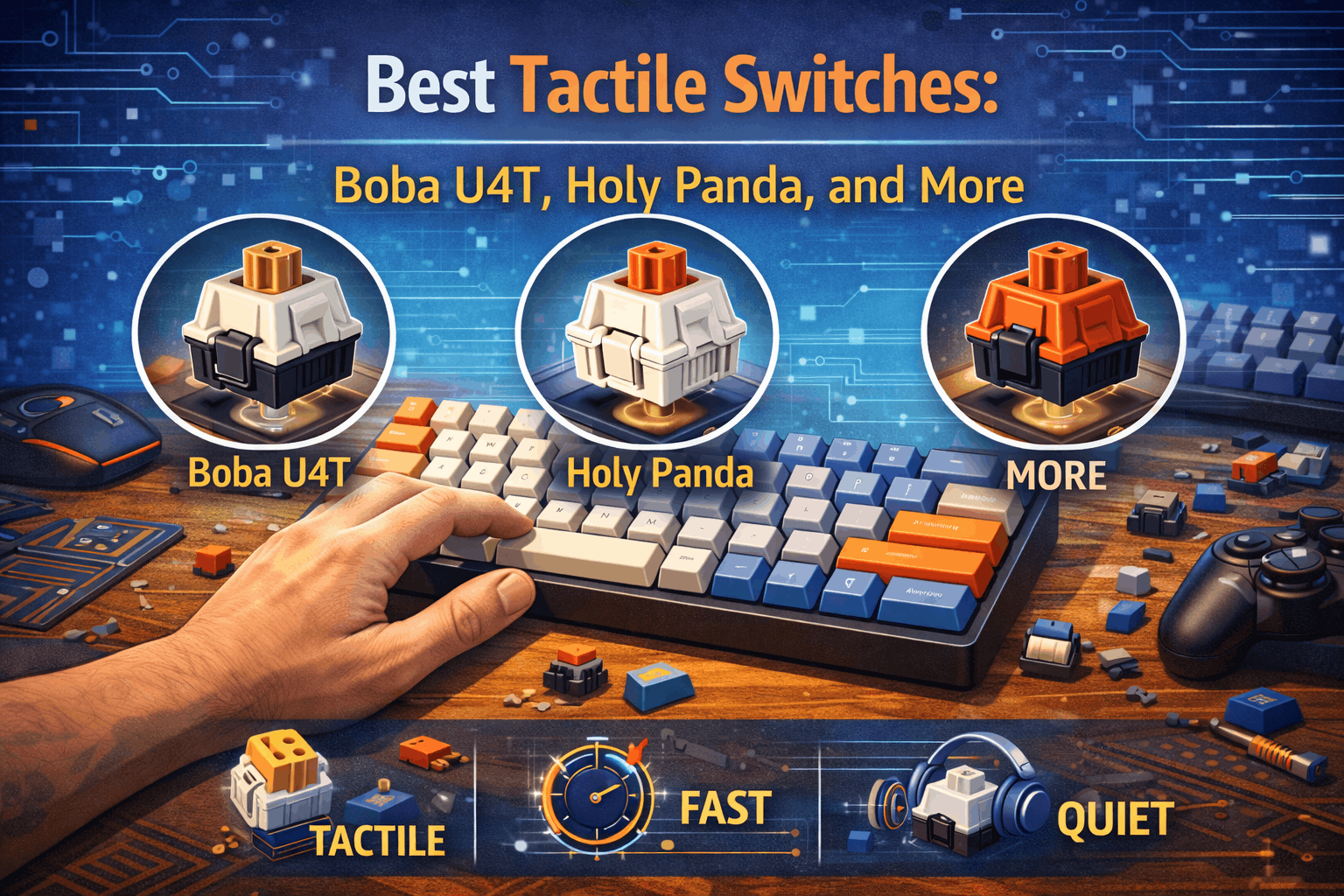
Tactile switches are the goldilocks of mechanical switches—feedback without the noise.
For decades, mechanical keyboards forced a choice: either you got precise linear switches for speed, or loud clicky switches for satisfying feedback. Tactile switches solved this dilemma by introducing a noticeable bump at actuation without any audible click. If office noise is a concern, our silent switches guide covers tactile and linear options that keep things quiet. The moment you press down, you feel exactly when the switch registers, but your office doesn't hear a thing.
This makes tactile switches the most versatile mechanical switch type. They work excellently for typing, perform adequately for gaming, and maintain office-appropriate noise levels. They're the reason many first-time mechanical keyboard buyers choose tactiles—and why they remain the most popular switch category in 2026.
But not all tactile switches are created equal. The difference between a weak Gateron Brown bump and a sharp Boba U4T bump can make typing either frustrating or euphoric. This guide ranks the best tactile switches from budget to premium, explains what separates good tactiles from mediocre ones, and helps you choose based on your specific bump intensity preference.
Note: This guide contains affiliate links. If you purchase through our links, we may earn a commission at no extra cost to you. This helps support our testing and content creation.
Quick Overview
The best overall tactile switch is Boba U4T at roughly $0.65 per switch, delivering sharp bump, buttery smooth feel, and exceptional sound quality. Budget builders should choose Gateron Brown at $0.25 per switch for light tactile feel, wide availability, and good entry point. Premium seekers love Holy Panda at $0.80 per switch for iconic rounded bump, deep thock sound, and enthusiast status. The sharpest bump comes from Zealios V2 67g at $0.95 per switch with the most pronounced tactile feedback available. Reality check: bump intensity matters more than brand name, so test before buying full sets, and hot-swappable keyboards come highly recommended.
What Are Tactile Switches?
Tactile switches deliver a noticeable bump during the keypress that signals actuation, but they produce no audible click sound. The tactile experience follows this pattern: press down and you feel smooth resistance, then roughly 2mm into travel you encounter the bump (the tactile event), followed by continued smooth travel to bottom-out.
Unlike linear switches that feel smooth throughout their entire travel, tactile switches have a deliberate "click" feeling—but it's purely tactile, not acoustic. You feel it clearly. Nobody else hears anything.
What Creates the Tactile Bump
Internal mechanics create the bump through a tactile leaf spring inside the housing combined with stem design featuring tactical legs or bumps. The bump geometry varies significantly between different switch designs, creating the wide range of tactile experiences available.
The bump serves multiple purposes: providing physical feedback indicating key actuation, reducing finger fatigue by making bottoming out less necessary, and building typing confidence through improved accuracy.
Types of Tactile Bumps
| Bump Type | Feel | Intensity | Examples |
|---|---|---|---|
| Light/Rounded | Gentle, subtle | Barely noticeable | Gateron Brown, Cherry MX Brown |
| Medium/Sharp | Clear, noticeable | Satisfying | Boba U4T, Durock T1 |
| Heavy/Pronounced | Strong, intense | Overwhelming | Holy Panda, Zealios V2 |
Why Choose Tactile Switches?
Typing feedback without noise defines the primary advantage. You know exactly when each key actuates, which reduces accidental bottoming out significantly. The result: more satisfying typing experience overall with better accuracy for office work where precision matters.
Versatile all-around choice makes tactiles work for multiple scenarios. They excel for typing as their primary use case, perform adequately for casual gaming, handle all-around use without compromise, and maintain office-appropriate noise levels that won't disturb coworkers.
The perfect middle ground position means more feedback than linear switches provide, quieter operation than clicky switches demand, and the best of both worlds for most users seeking balance.
Gaming disadvantage emerges from the bump creating slight resistance versus linear smoothness. Competitive gamers consistently prefer linear switches for pure speed advantage. The bump remains subjective in preference—some users find it annoying while preferring smooth linear or crisp clicky alternatives. Variability between switches means bump intensity varies significantly, so finding YOUR perfect tactile requires hands-on testing.
Ideal candidates for tactile switches include typists (writers, programmers, office workers), all-around users seeking typing plus casual gaming balance, first mechanical keyboard buyers making the safest choice, and people wanting feedback without generating noise.
What Makes a Tactile Switch "Good"?
1. Tactile Bump Character (Most Important)
The bump is everything in tactile switches. Everything else represents details around that fundamental characteristic.
Bump sharpness divides into categories. Rounded bumps provide gentle progression into the tactile event, exemplified by Holy Panda style. Sharp bumps deliver clear, distinct sensation like Boba U4T style. Very sharp bumps create aggressive, intense feedback in Zealios style.
Personal preference determines which category counts as "best." Sharp bump enthusiasts find rounded bumps underwhelming and unsatisfying. Rounded bump fans find sharp bumps tiring over long typing sessions. Neither position holds objective correctness—it's purely subjective.
Bump positioning affects feel dramatically. Early bumps at the top of travel create more noticeable sensation that affects typing rhythm. Middle bumps provide balanced feel throughout the keystroke. Late bumps deeper in travel produce subtle sensation that some typists prefer.
Consistency makes the difference between good and great switches. The bump should feel identical on every single keypress without mushiness or scratchiness during the bump event. Premium switches deliver this consistency naturally. Budget switches often fail this test.
2. Smoothness (Pre-bump and Post-bump)
Smoothness separates budget switches from premium offerings more than any other factor except bump quality itself.
Travel quality matters throughout the keystroke. Before the bump, you should experience smooth resistance building gradually. During the bump itself, expect crisp tactile event without scratchiness interfering. After the bump, smooth glide to bottom-out completes the experience.
Scratchiness factor divides switches clearly. Budget tactiles often feel scratchy, especially during the bump event itself — though our best budget tactile switches guide highlights the few options that deliver acceptable smoothness without the premium price tag. Premium tactiles deliver buttery smooth travel throughout every phase. Lubing helps budget switches dramatically (link to lubing guide for process details).
3. Sound Profile
Tactile switches produce distinct audio characteristics that matter to many builders. Typical tactile sounds include "thock" on bottom-out (deeper and more satisfying), "snap" or "crack" during the bump event itself, and overall volume quieter than clicky switches but louder than silent variants.
Sound gets affected by multiple factors: housing material (nylon versus polycarbonate creates different acoustics), keycap material (PBT versus ABS affects sound signature), lubing (dampens and changes character), and stabilizer quality (rattling ruins everything).
4. Spring Weight (45g–78g Range)
Weight dramatically affects the typing experience in ways most beginners underestimate. Lighter springs from 45–55g reduce fatigue and enable easier rapid typing, though accidental presses become possible. Medium weight from 62–67g hits the sweet spot for most users seeking balance. Heavy springs at 78g+ require more effort per keypress but create strong bump sensation while preventing accidental actuations.
Popular weights include 62g as most common with good balance, 67g as slightly heavier with more bump prominence, and 78g exclusively for heavy-press enthusiasts who specifically want that resistance.
5. Price-to-Value Ratio
Not all premium prices translate to premium experience, making value assessment critical. Budget tier under $0.30 per switch provides acceptable tactility with noticeable scratchiness, working well for trying tactiles and improving significantly with lubing. Mid-tier from $0.40–$0.70 per switch delivers clean tactile bump with smooth travel stock, representing the best value tier with minimal benefit from additional lubing. Premium tier from $0.70–$1.00+ per switch offers exceptional bump quality with marginal smoothness improvement versus mid-tier, appealing mainly to enthusiasts and perfectionists.
Top 8 Tactile Switches Ranked
Ranking criteria include bump quality, smoothness, sound profile, consistency, and overall value proposition.
1: Boba U4T — $0.65/switch ⭐ BEST OVERALL
Boba U4T specifications show 62g actuation force, sharp and pronounced early-stage tactile bump, Boba proprietary housing design, and 4.0mm total travel.
Boba U4T represents the sweet spot of tactile excellence in 2026. The bump feels exceptionally sharp and clean—you experience it decisively at roughly 2mm into travel. The pre-bump and post-bump travel delivers buttery smooth feel with zero scratchiness straight from stock. The acoustics rank among the best of any tactile switch, delivering very deep and satisfying "thock" that sounds premium without being loud.
Most critically, Boba U4T requires zero modification out of the box. No lubing needed for smooth operation. No stabilizer adjustments required. The switch simply works perfectly for typing immediately upon installation.
Sound comes through as very deep "thock" with crisp bump snap, creating one of the best-sounding tactile experiences available. These switches work best for enthusiasts wanting premium tactile typing experience without Holy Panda's prestige tax, and serious typists prioritizing feel over aesthetics.
Compared to competitors, Boba U4T delivers sharper bump than Gateron Brown, smoother feel than Durock T1, better value than Holy Panda at $0.15 cheaper, and cleaner execution than Zealios V2. The bump description: sharp D-shaped profile at top of travel that feels like decisive "click" without sound.
Lubing proves optional since they arrive already smooth, though enhancement remains possible with Tribosys 3203 for those chasing perfection.
👉 Check Current Price on Amazon
2: Holy Panda — $0.80/switch 🏆 ICONIC TACTILE
Holy Panda specifications include 67g actuation force, rounded but strong smooth tactile bump, Drop/Invyr housing design, and 4.0mm total travel.
Holy Panda stands as THE tactile switch the mechanical keyboard community references universally. When enthusiasts say "perfect tactile," they often mean Holy Panda's rounded, smooth bump sensation specifically. The feel becomes instantly recognizable and remains wildly beloved years after introduction.
The bump differs fundamentally from sharp tactiles—it's a smooth arc rather than a sharp peak. During the roughly 2mm travel, you feel pronounced but gentle bump that feels authoritative without being harsh. The sound signature runs deep and satisfying throughout.
Holy Panda's prestige comes from rarity history. Originally, getting true Holy Pandas required combining Invyr stems with Halo housings, both very rare components. Drop's 2019 collaboration made them widely available, and community consensus proved unanimous—they deserved every bit of the hype.
Sound delivers very deep "thock" with satisfying "snap" during bump, creating refined acoustics throughout. These switches work best for enthusiasts, custom builds, and anyone wanting THE iconic tactile switch where prestige matters.
The hype gets explained through history: originally expensive and rare, then Drop made them accessible, and they lived up to their reputation completely. Compared to Boba U4T, Holy Panda offers rounder bump (less sharp, more progressive), slightly more expensive at $0.15 premium, more community prestige and recognition, comparable smoothness overall, with "better" depending entirely on bump preference.
👉 Check Current Price on Amazon
3: Durock T1 — $0.50/switch 💰 BEST VALUE
Durock T1 specifications show 67g actuation force, medium-sharp tactile bump, Durock housing design, and 4.0mm total travel.
Durock T1 represents 85% of Holy Panda's typing experience at 63% of the price, creating exceptional value proposition. The bump reads clear and noticeable—sharper than Gateron Brown but rounder than Boba U4T. Stock smoothness ranks excellent, and sound satisfies without being exceptional.
For budget-conscious builders wanting premium tactile feel, Durock T1 presents the obvious choice. Full 87-key set costs roughly $43 versus $70 for Holy Pandas. That $27 savings can redirect toward better keycaps or premium stabilizers.
Sound comes through as medium-deep "thock" with good bump clarity throughout. These switches work best for budget-conscious builders wanting premium feel without premium price tag.
The reality check: most typists cannot distinguish Durock T1 from Holy Panda in blind testing scenarios. The bump character proves that similar in practical use.
👉 Check Current Price on Amazon
4: Zealios V2 67g — $0.95/switch 📈 SHARPEST BUMP
Zealios V2 specifications include 67g actuation force (also available in 62g, 65g, and 78g variants), very sharp, pronounced, and aggressive tactile bump, Zeal PC quality housing, and 4.0mm total travel.
Zealios V2 delivers the most aggressive tactile bump available in mainstream switches. If you want maximum tactile feedback possible, this switch provides it. The bump feels sharp, decisive, and genuinely intense. Zeal PC's manufacturing reputation ensures consistency and ultra-smooth travel across every switch.
The downside emerges clearly: this bump polarizes users dramatically. Some typists love the intensity completely. Others find it overwhelming and fatiguing over extended sessions. The bump intensity registers as genuinely intense—definitely not for everyone.
Sound runs higher pitch than Boba or Panda alternatives, with crisp character during bump events. These switches work best for heavy tactile enthusiasts wanting maximum feedback possible, and typists who've used tactiles extensively and want MORE intensity.
Critical warning: Zealios V2 bump intensity proves very sharp and potentially overwhelming. Try a switch tester before committing to full keyboard set. Weight variants come in 62g, 65g, 67g, and 78g options for customization.
👉 Check Current Price on Amazon
5: Gateron Brown — $0.25/switch 🎯 BEST BUDGET
Gateron Brown specifications show 55g actuation force, light and gentle subtle tactile bump, Gateron housing design, and 4.0mm total travel.
Gateron Brown wins ranking based on price and availability rather than bump quality. At just $0.25 per switch, outfitting 87-key keyboard costs only $22 total. Wide availability everywhere (Amazon, boutique retailers, international suppliers) makes purchasing easy.
The bump runs light—some users describe it as "barely tactile." For users new to mechanical keyboards, this feels great initially. For tactile enthusiasts, the sensation disappoints as underwhelming. The key understanding: Gateron Brown serves as STARTING POINT, not ending destination.
Stock smoothness proves decent for the price point. Lubing transforms Gateron Browns dramatically (see lubing section for details).
Sound produces moderate "thock" without particular depth or character. These switches work best for first mechanical keyboard purchases, budget builds, and trying tactiles before spending more money.
The catch: light bump means less typing feedback overall. Many users graduate to sharper tactiles after experiencing what stronger bumps provide.
Compared to Cherry MX Brown, the Gateron version runs smoother stock with less scratchiness, provides better value at $0.25 versus $0.40, and delivers nearly identical bump sensation—making Gateron the objectively better purchase in 2026 (see our Cherry MX vs Gateron comparison).
👉 Check Current Price on Amazon
6: Glorious Panda — $0.60/switch 🐼 HOLY PANDA ALTERNATIVE
Glorious Panda specifications include 67g actuation force, rounded Holy Panda-inspired tactile bump, Glorious housing design, and 4.0mm total travel.
Glorious Panda offers Holy Panda's rounded bump character at $0.20 cheaper per switch. For full 87-key set, that savings totals roughly $17. The bump feel runs similar—smooth, rounded, authoritative. Sound registers nearly identical to the original.
Glorious Panda exists specifically to make Holy Panda's typing experience accessible to budget-conscious enthusiasts. The execution succeeds admirably.
Sound comes through similar to Holy Panda with slightly less refined character overall. These switches work best for anyone wanting Holy Panda typing experience while saving $17 on 87-key set.
Honest assessment: delivers 90% of Holy Panda's bump quality at 75% of the cost. Worth serious consideration if budget matters at all in your decision.
👉 Check Current Price on Amazon
7: Durock Medium Tactile — $0.50/switch
Durock Medium Tactile specifications show 65g actuation force, medium intensity balanced tactile bump, Durock housing design, and 4.0mm total travel.
Durock Medium Tactile offers reliable, predictable tactile performance without standout characteristics. The bump reads not sharp, not light—purely medium. Smoothness stays consistent, quality proves reliable, and sound registers as good throughout.
This switch has no standout characteristic except reliability. It's the switch you purchase when you want guaranteed decent tactile performance without surprises or risks.
Best use cases include medium tactile preference specifically, wanting balanced bump that's not too light or too sharp.
👉 Check Current Price on Amazon
8: Akko CS Lavender Purple — $0.30/switch 🎨 BUDGET SURPRISE
Akko CS Lavender Purple specifications include 50g actuation force, light-medium tactile bump, Akko housing design, and 4.0mm total travel.
Akko CS Lavender Purple punches above its weight class at just $0.30 per switch. The tactile bump registers surprisingly clear for this price point. Stock smoothness proves decent out of box. Sound quality works well, especially when paired with aftermarket keycaps.
This switch proves that budget pricing doesn't always mean poor quality execution. Akko's manufacturing has improved significantly in recent years, and this switch demonstrates that progress clearly.
Best use cases include budget builders, exploring tactiles without major investment, and wanting affordability without sacrificing all quality.
👉 Check Current Price on Amazon
Tactile Switch Comparison Table
| Switch | Price | Actuation | Bump Type | Smoothness | Sound | Best For |
|---|---|---|---|---|---|---|
| Boba U4T | $0.65 | 62g | Sharp | ⭐⭐⭐⭐⭐ | Very deep | Overall best |
| Holy Panda | $0.80 | 67g | Rounded-strong | ⭐⭐⭐⭐⭐ | Deep thock | Iconic enthusiast |
| Durock T1 | $0.50 | 67g | Medium-sharp | ⭐⭐⭐⭐ | Med-deep | Best value |
| Zealios V2 67g | $0.95 | 67g | Very sharp | ⭐⭐⭐⭐⭐ | Crisp | Maximum feedback |
| Gateron Brown | $0.25 | 55g | Light | ⭐⭐⭐ | Moderate | Budget entry |
| Glorious Panda | $0.60 | 67g | Rounded | ⭐⭐⭐⭐ | Deep | HP alternative |
| Durock Medium | $0.50 | 65g | Medium | ⭐⭐⭐⭐ | Good | Balanced feel |
| Akko Lavender | $0.30 | 50g | Light-med | ⭐⭐⭐ | Good | Budget surprise |
Key Observations
Bump intensity hierarchy ranks from strongest to lightest: Zealios V2 (sharpest and most aggressive), Boba U4T (sharp and decisive), Holy Panda (medium-strong and rounded), Durock T1 (medium-sharp and balanced), Durock Medium (medium and mild), Akko Lavender (light-medium and subtle), and Gateron Brown (light and barely tactile).
Price-to-performance ranking shows Durock T1 at $0.50 delivering 85% of Holy Panda experience as best value. Boba U4T at $0.65 provides premium feel at reasonable price as best overall. Holy Panda at $0.80 offers status and community recognition as best prestige. Gateron Brown at $0.25 serves as cheapest learning entry point.
Smoothness comparison divides clearly: premium tactiles (Boba, Panda, Zealios) all deliver excellent stock performance, while budget tactiles (Gateron, Akko) benefit significantly from hand lubing.
How to Choose Your Perfect Tactile Switch
Determining your bump intensity preference starts the selection process. Light and gentle tactility suits Gateron Brown at $0.25 or Akko Lavender Purple at $0.30, working best for first tactile experience, office use, easy on fingers, and less noticeable feedback. Medium tactility points toward Durock T1 at $0.50, Durock Medium Tactile at $0.50, or Glorious Panda at $0.60, working best for all-around typing, balanced bump, and versatile use. Sharp and pronounced tactility demands Boba U4T at $0.65 as BEST CHOICE or Zealios V2 67g at $0.95 if you want MAXIMUM bump, working best for typing enthusiasts, wanting decisive feedback, and satisfaction priority. Iconic rounded tactility leads to Holy Panda at $0.80 or Glorious Panda at $0.60 as alternative, working best for enthusiasts, custom builds, and wanting legendary feel.
Setting your budget creates practical constraints. Under $30 for full 87-key set allows Gateron Brown (87 switches equals $22) or Akko Lavender Purple (87 switches equals $26). The $30–$60 range opens Durock T1 (87 switches equals $43), Durock Medium Tactile (87 switches equals $43), or Glorious Panda (87 switches equals $52). The $60–$90 range enables Boba U4T (87 switches equals $57), Holy Panda (87 switches equals $70), or Zealios V2 (87 switches equals $83).
Considering your primary use case guides the decision further. Pure typing focus for writers and programmers suggests Boba U4T or Holy Panda because sharp feedback improves accuracy and satisfies during long sessions, working best for professional writers and code enthusiasts. All-around use combining typing plus casual gaming points toward Durock T1 or Medium Tactile because balanced bump doesn't slow gaming while maintaining good typing feel, working best for general users balancing office plus gaming. Office and quiet environments call for Gateron Brown or lighter tactiles because quieter than sharp tactiles with less intrusive sound, though consider silent tactiles if available. Gaming priority actually recommends considering linear switches instead because tactile bump adds resistance versus linear pure speed—see our linear switches guide for gaming focus.
Sound preference affects selection when you want deep, satisfying "thock" character. Choose Boba U4T for deepest sound, Holy Panda for iconic acoustics, or Durock T1 for good depth. Tip: pair with PBT keycaps for enhanced acoustics. If you don't care much about sound, focus entirely on bump quality since any switch works acoustically.
Lubing Tactile Switches (Critical Information)
The Lubing Warning
Over-lubing tactile switches can reduce or completely eliminate the tactile bump. Extreme caution required when lubing tactiles.
The tactile bump exists because of physical contact between stem and housing at a specific point in the travel. Apply lube to that exact contact point, and you smooth away the bump sensation entirely. Many enthusiasts have ruined expensive tactile switches through improper lubing technique.
Correct Lubing Approach for Tactiles
What to lube safely: housing rails with light application, stem sides away from bump area, and springs to eliminate ping noise. What to absolutely avoid: tactile legs, which will kill the bump completely if lubed.
Lube recommendation points specifically to Tribosys 3203 as thinner than standard 205g0. Thinner consistency preserves tactility better than thick lube. Apply very light amounts—don't over-apply at any point. Just 2–3 drops per switch proves sufficient for proper lubing.
Results by Switch Type
Budget tactiles like Gateron Brown transform dramatically. Before lubing: 6/10 typing experience with noticeable scratchiness. After lubing: 8.5/10 typing experience with scratchiness eliminated and bump preserved. The transformation proves dramatic and worth the time investment.
Premium tactiles like Boba U4T improve marginally. Before lubing: 9/10 typing experience already excellent. After lubing: 9.5/10 typing experience with marginal gains. Result: marginal improvement only—consider if patient, skip if not interested in minor gains.
Alternative: Buy Premium Stock
Best strategy: buy Boba U4T or Holy Panda stock without lubing plans. Already smooth performance, no risk of killing bump through improper technique. Time saved versus cost difference proves minimal in total keyboard cost.
Full lubing guide: See our complete how to lube mechanical keyboard switches guide for detailed procedures and techniques.
Tactile vs Linear Switches
When to Choose Tactile
Choose tactile switches when typing serves as primary use case. Want actuation feedback and confirmation through physical sensation. Need all-around use combining typing plus casual gaming. Making first mechanical keyboard purchase as safest choice. Working in office environment requiring quieter than clicky operation. Appreciate bump sensation during typing.
When to Choose Linear Instead
Choose linear switches when gaming takes priority over typing. Prefer smooth, uninterrupted travel without bump resistance. Want fast typing without any tactile interruption. Play competitive FPS or MOBA games seriously. Want lowest possible latency for inputs. See our best linear switches guide for details.
Common Myths Debunked
Myth: "Tactiles are always better for typing." Reality: many fast typists prefer linear's smooth rhythm without bump interruption.
Myth: "Tactiles are bad for gaming." Reality: fine for casual gaming with only slight disadvantage in competitive FPS scenarios.
Myth: "You need tactile feedback to type accurately." Reality: linear users achieve identical accuracy after brief adaptation period.
Myth: "All tactile bumps feel the same." Reality: massive variation exists from light Gateron Brown to aggressive Zealios V2.
Common Tactile Switch Mistakes
Mistake 1: Buying Cherry/Gateron Brown and Assuming All Tactiles Feel Like This
The problem: experiencing light bump leads to assuming all tactiles feel this weak. Reality: Brown switches have the weakest commercial tactile bump available. Fix: if Brown feels "barely tactile," try Boba U4T or Zealios V2 for real tactile experience.
Mistake 2: Over-Lubing Tactile Legs
The problem: applying lube to tactile bump contact points during lubing process. Result: tactile bump completely disappears, turning switch into scratchy linear. Fix: avoid tactile leg area entirely when lubing switches.
Mistake 3: Buying Zealios V2 Without Testing First
The problem: purchasing full keyboard set based solely on online reviews. Reality: Zealios V2 bump intensity proves very sharp and polarizing in actual use. Fix: buy 10-switch sampler or use switch tester before committing money to full set.
Mistake 4: Expecting Clicky-Level Feedback from Tactiles
The problem: disappointment that tactiles aren't "clicky enough" after purchase. Reality: tactile equals silent bump while clicky equals audible click—completely different mechanisms. Fix: if you want noise, buy clicky switches instead (not covered in this guide).
Mistake 5: Not Considering Weight
The problem: ordering 78g springs without testing first. Reality: heavy switches cause finger fatigue for many users over extended sessions. Fix: start with 62–67g as sweet spot, only go heavier if intentional choice.
Where to Buy Tactile Switches
Recommended retailers in United States include Divinikey.com with largest tactile selection and fast shipping, Ringerkeys.com with enthusiast focus and quality filters, Amazon carrying Gateron Brown and some premium options with fast Prime shipping, and Drop.com as Holy Panda exclusive with community group buys.
International options include Keychron.fr for France and European availability, Mech.land for Asia-Pacific region, and Ashkeebs.com for Canada.
Price comparison strategy suggests shopping around since prices vary $5–10 per set between retailers. Watch for sales especially on Drop and during limited runs. Bulk discounts become available for 5+ sets. International shipping can prove competitive for bulk orders despite distance.
What to buy with switches: purchase 10–20 extra switches as spares for failures and experimentation, consider switch tester costing $15–20 before committing to full set, and strongly consider hot-swap keyboard (see our hot-swap guide) for testing easily without soldering.
Group buy culture matters for some switches. Holy Panda variants periodically run in group buys. Monitor r/MechanicalKeyboards for announcements. Group buy prices often deliver best value but require patience during fulfillment.
FAQ: Common Questions
What's the single best tactile switch for typing?
Boba U4T at $0.65 per switch. Sharp bump provides clear actuation feedback, stock smoothness ranks excellent, and sound quality reaches premium tier. Holy Panda at $0.80 also performs outstanding if you prefer rounded bump character. Both excel specifically for typing use cases.
Are tactile switches good for gaming?
They work fine for casual gaming but aren't optimal for competitive play. The tactile bump adds slight resistance compared to linear switches. Linear switches get preferred for competitive gaming in FPS and MOBA genres. Tactile switches work best for all-around use combining typing plus casual gaming mix.
Should I lube tactile switches?
Budget tactiles like Gateron Brown and Akko benefit enormously—transformation proves dramatic and worth effort. Premium tactiles like Boba U4T and Holy Panda remain optional—already smooth with marginal benefit. Critical warning: avoid lubing tactile legs (destroys bump completely). Use thin lube like Tribosys 3203 if lubing. See our complete lubing guide for details.
What's the actual difference between Holy Panda and Boba U4T?
Holy Panda delivers smooth, rounded bump with strong community prestige. Boba U4T provides sharper, more pronounced bump with better value at $0.15 cheaper. Both perform excellently—difference comes down to bump character preference. Try both if possible before deciding.
Are Cherry MX Browns worth buying in 2026?
No, not for value proposition. Gateron Brown at $0.25 offers virtually identical feel for 40% less money. For premium tactile experience, spend slightly more on Durock T1 at $0.50 or Boba U4T at $0.65. Cherry MX Brown represents outdated choice in 2026 market.
Conclusion: Finding Your Perfect Tactile Bump
Tactile switches represent the mechanical keyboard's most versatile switch type. They deliver typing feedback without office-disruptive noise pollution. They work adequately for gaming without requiring optimization. They represent the safest first mechanical switch purchase for newcomers.
But "tactile" encompasses huge range of experiences: from barely-noticeable Gateron Brown bumps to aggressive Zealios V2 intensity. The wrong bump intensity for your personal preference makes typing frustrating rather than satisfying.
Key Takeaways
Overall best switch: Boba U4T combining sharp bump, smooth feel, and affordable premium pricing. Best budget option: Gateron Brown serving as entry point at very affordable cost. For a wider lineup of value picks under $0.30 per switch, see our best budget tactile switches guide. Best prestige choice: Holy Panda offering iconic feel and community status. Sharpest bump: Zealios V2 delivering maximum feedback intensity.
Critical principles to remember: bump intensity matters more than brand name or price point alone. Don't judge all tactiles by weak Cherry or Gateron Brown experience. Lubing requires extreme care to avoid tactile legs completely. Testing before committing to full keyboard set prevents expensive mistakes. Hot-swap keyboards make testing completely risk-free. Preference remains intensely personal—no "objectively perfect" tactile exists for everyone.
Most important insight: the best tactile switch becomes the one with YOUR preferred bump intensity specifically. This varies dramatically person-to-person based on hand size, typing style, and personal preference. Testing matters more than reading reviews online.
Next Steps
Determine your bump preference through categories: light, medium, or sharp. Set your budget clearly: under $30, $30–60, or $60+. Consider your primary use case: typing-focused, all-around, or gaming. Buy a switch tester if uncertain about preference—eliminates expensive buying mistakes. Get a hot-swappable keyboard for future-proofing against switch buyer's remorse.
Ready to build your tactile keyboard? Learn about hot-swappable keyboards that make testing and changing switches effortless without any soldering required. Compare your choices with our keyboard layout guide and switch comparison tools.
Your perfect tactile bump is waiting. Start testing today.