Introduction
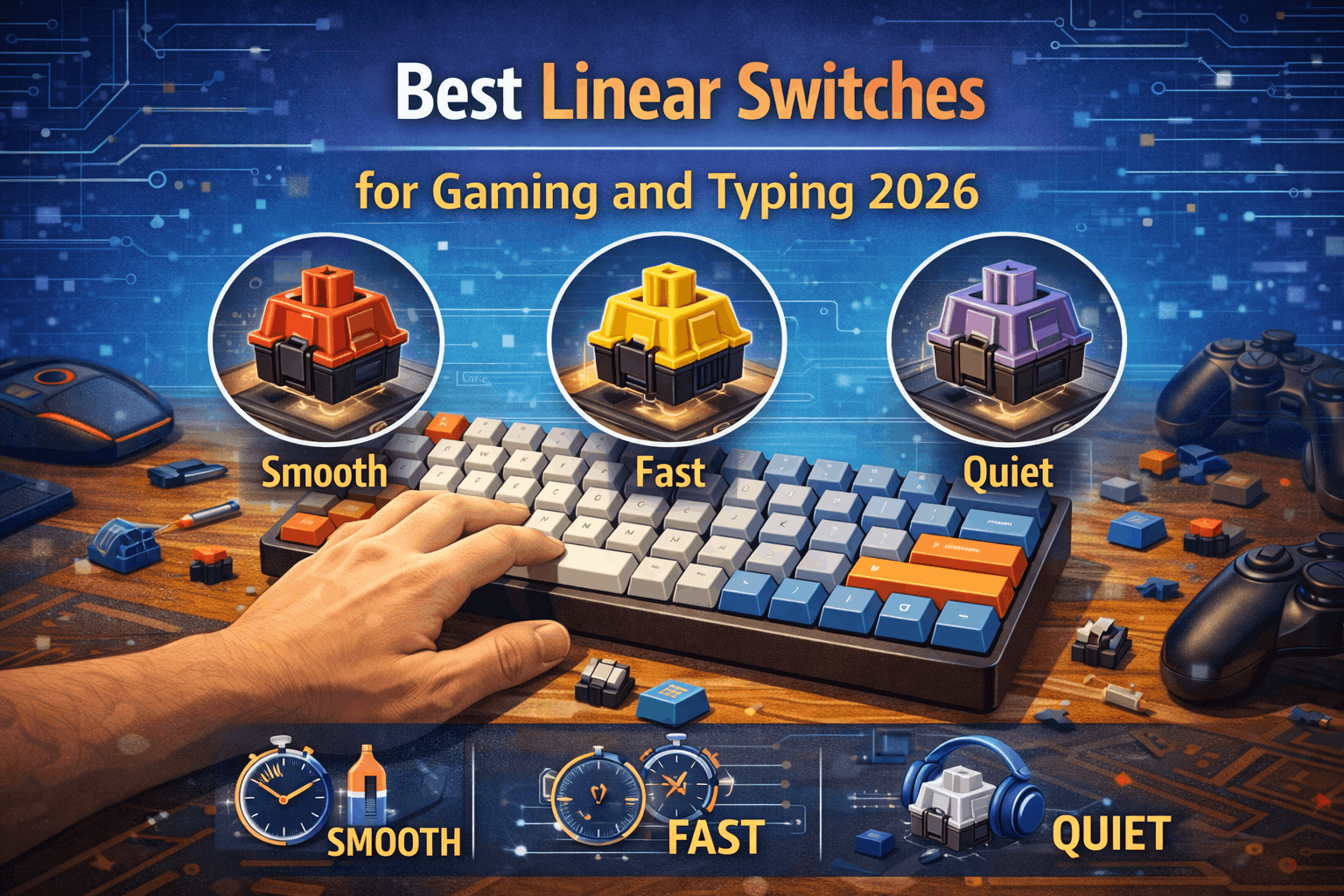
Linear switches dominate gaming keyboards. Here’s why—and which ones reign supreme.
For gamers, mechanical keyboards are all about speed, consistency, and feel. Among the three switch types—linear, tactile, and clicky—linear switches are the gaming standard. No tactile bump to overcome. No audible click to distract. Just smooth, straight-line travel from top to bottom. If you want the bump without the noise, see our best tactile switches; if sound is also part of the experience you want, our best clicky switches guide covers those.
But not all linear switches are created equal.
The mechanical keyboard market exploded from 2020-2026. What started with Cherry MX Red as the only serious option now includes hundreds of alternatives (see our Cherry MX vs Gateron comparison). Gateron Yellow Pro outperforms Cherry MX Red while costing half as much. Gateron Ink Black V2 offers buttery smoothness at premium price points. Budget options from Akko and Glorious deliver 80% of premium smoothness for 30% of the cost.
For newcomers, the choices are overwhelming. This guide ranks the top 10 linear switches, explains what makes them great, and helps you choose based on budget, gaming style, and typing preference.
Note: This guide contains affiliate links. If you purchase through our links, we may earn a commission at no extra cost to you. This helps support our testing and content creation.
Quick Overview
The best overall linear switch is Gateron Yellow Pro at roughly $0.35 per switch, delivering exceptional smoothness, perfect weight, and unbeatable value. For budget builders, Gateron Milky Yellow at $0.20 per switch offers absurd value with surprisingly smooth feel and deep sound. Premium seekers should choose Gateron Ink Black V2 at $0.70 per switch for buttery smooth stock performance, beautiful sound, and luxury typing feel. Typists benefit most from Cherry MX Black at $0.65 per switch with heavier 60g weight providing more control and reduced typos. If you're choosing between these two specifically, our Cherry MX Red vs Black comparison breaks down the differences in detail. Gamers still love Cherry MX Red at $0.60 per switch as the gaming classic with lighter 45g weight and universal availability.
What Are Linear Switches?
Linear switches have no tactile bump or audible click mechanism. The keystroke feels smooth and consistent from top to bottom without interruption. When you press a key, you experience smooth and even resistance throughout the travel. No feedback bump exists at the actuation point. The feeling resembles pushing a spring directly downward with constant force. Bottoming out feels softer than tactile switches because there’s no bump to overcome before reaching the bottom.
Comparison to Other Switch Types
| Switch Type | Feel | Sound | Best For |
|---|---|---|---|
| Linear | Smooth, no bump | Quiet-moderate | Gaming, fast typing |
| Tactile | Bump at actuation | Moderate | Typing, all-around |
| Clicky | Bump + click | Loud | Typing enthusiasts |
Why Linear Switches for Gaming
Faster actuation defines the primary gaming advantage. With no bump to overcome, the straight-line travel path creates milliseconds quicker response than tactile alternatives. This speed advantage compounds across thousands of keypresses during gaming sessions.
Consistent response makes linear switches predictable every single keystroke. No variation in feel exists between presses. Muscle memory develops easier when every keypress feels identical. Your fingers learn the exact force required without adapting to tactile feedback variations.
Double-tapping becomes easier and smoother. Rapid presses flow without bump interruption. Counter-strafing in FPS games executes faster because each direction change happens smoothly without tactile resistance fighting your inputs.
Quieter operation helps during streaming and voice chat. No click mechanism means less disruptive sound for team communication. Your microphone picks up less keyboard noise, keeping voice channels cleaner.
Why NOT Linear for Everyone
Less typing feedback creates challenges for some users. No tactile confirmation of actuation point means you can’t feel when the key registers. This can lead to bottoming out harder than necessary. Some typists genuinely prefer tactile guidance to know when they’ve pressed far enough.
Easier accidental presses emerge from lack of bump resistance. Resting your fingers lightly on keys can activate them unintentionally without the bump providing safety margin against accidental inputs.
Who should choose linear switches: gamers (especially FPS, MOBA, rhythm games), fast typists who don’t need tactile feedback, people building hot-swap keyboards for testing different options, and those preferring quiet, smooth keyboard experiences.
What Makes a Linear Switch “Good”?
Key Evaluation Criteria
Smoothness
Smoothness stands as the most important factor in linear switch quality. This means lack of scratchiness during the full travel range, consistent and predictable feel throughout every keypress, no binding or catching at any point, and quality factory lubrication. Smoothness determines typing satisfaction, affects comfort during long sessions, and represents the most critical factor for enthusiasts evaluating switches.
Sound profile
Sound profile contributes significantly to the overall experience. Components include frequency (high pitch “clack” versus low “thock”), volume (quiet versus loud), character (punchy, muted, or resonant), and housing material impact.
Spring weight
Spring weight determines the force required to actuate keys. Categories span actuation force from 35g to 70g range, bottom-out force representing total pressure needed to fully depress, spring quality affecting ping resistance, and fatigue factor during long typing or gaming sessions. Light springs around 45g enable fast gaming with reduced fatigue. Medium springs at 50-55g balance gaming and typing needs. Heavy springs at 60g+ provide typing control and prevent accidental presses.
Build quality
Build quality encompasses housing material choices (POM, Nylon, Polycarbonate), stem wobble where less equals better, tolerance consistency across all switches in a batch, and durability ratings spanning 50-100 million actuations.
Price and value
Price and value create the final consideration. Cost per switch, performance versus price ratio, availability and shipping logistics, and bang-for-buck assessment all factor into switch selection decisions.
The Smoothness Hierarchy
Budget tier switches under $0.30 per switch show noticeable scratchiness when stock. They see significant improvement when lubed and work well enough for most users who aren’t switch connoisseurs.
Mid-tier switches from $0.30-0.50 per switch arrive smooth out of the box. Lubing provides marginal improvement rather than transformation. This tier represents the sweet spot for value-focused builders who want good experience without premium pricing.
Premium tier switches costing $0.50-1.00+ per switch deliver buttery smooth stock performance. Lubing provides minimal benefit beyond the already excellent feel. Diminishing returns on investment become apparent at this price level.
Top 10 Linear Switches Ranked
#1: Gateron Yellow Pro — $0.35/switch ⭐ BEST OVERALL
Gateron Yellow Pro specs include 50g actuation force, 62g bottom-out force, 4.0mm total travel, 2.0mm actuation point, and clear POM housing material.
Gateron Yellow Pro stands as the consensus champion of linear switches in 2026. Exceptional smoothness straight from the factory makes these switches feel premium despite mid-range pricing. The perfect 50g weight works brilliantly for all-around use, balancing gaming speed with typing control. Minimal wobble creates stable feel during rapid inputs. The incredible value proposition delivers 87 switches for just $30 total.
Compared directly to Cherry MX Red, the Yellow Pro feels noticeably smoother with better factory lubrication. The weight runs slightly lighter at 50g versus Cherry’s 45g, hitting a better balance for mixed use. Price comparison shows Yellow Pro costing roughly half what Cherry charges. Compared to budget Gateron options, the Pro variant uses tighter manufacturing tolerances and delivers more refined consistency across every switch in the batch.
Sound comes through as medium pitch with pleasant “thock” character and clarity that works well with most keycap sets. These switches work best for all-around use, making them ideal for first linear purchases, hot-swap build experimentation, and competitive gaming where reliability matters.
Lubing proves optional since they arrive already smooth, but hand-lubing elevates them to true premium territory if you want maximum smoothness. Availability remains excellent with multiple retailers stocking them consistently.
👉 Check Current Price on Amazon
#2: Gateron Milky Yellow — $0.20/switch 💰 BEST VALUE
Gateron Milky Yellow specs show 50g actuation force, milky opaque white housing, and 4.0mm travel distance.
Gateron Milky Yellow represents the best bang-for-buck available in mechanical keyboards today. At just $0.20 per switch, outfitting an 87-key keyboard costs only $17 total. The smoothness rivals switches priced 2-3x higher, creating absurd value proposition.
The milky housing material produces noticeably deeper sound than clear housing alternatives. This makes these switches surprisingly premium-feeling despite their budget pricing. The sound signature delivers deep “thock” that sounds pleasant and resonant, not cheap or hollow.
These switches work best for budget builds where cost matters, beginners exploring mechanical keyboards without major investment, bulk purchases for multiple keyboards, and DIY lube projects where you’ll hand-lube anyway.
The reality includes slightly more stem wobble than Yellow Pro, though the difference remains negligible in practical typing. Some quality inconsistency can occur across manufacturing batches, typical for this price tier but rarely problematic.
Lubing creates huge improvement potential, transforming these $0.20 switches into performance matching $0.60 alternatives. The value proposition stuns: 87 switches for $17 creates absurdly low-risk experimentation. Even if you’re unsure about linear switches, Milky Yellow costs so little that trying them makes sense.
👉 Check Current Price on Amazon
#3: Gateron Ink Black V2 — $0.70/switch 🏆 PREMIUM CHAMPION
Gateron Ink Black V2 specifications include heavier 60g actuation force, 70g bottom-out force, smokey Ink transparent dark housing, coated spring for reduced ping, and 4.0mm travel.
Gateron Ink Black V2 claims the title of smoothest stock linear switch available on the market. Buttery keystroke feel stays consistent across every press. Minimal wobble creates stable typing experience. Beautiful aesthetics from the smokey housing appeal to builders focused on looks. Exceptional sound quality delivers premium acoustics.
The heavier 60g actuation creates deliberate typing feel where every keypress feels intentional. Coated springs reduce metallic ping that plagues cheaper alternatives. The combined result: luxury keyboard experience that justifies the premium pricing.
Sound comes through very deep, muted, and premium “thock” character—not high-pitched at all, purely deep resonance. These switches work best for enthusiast builds prioritizing quality, sound-focused setups, premium typing experiences, and office or streaming environments where acoustics matter.
Comparison to alternatives shows Ink Black V2 competing with switches costing twice as much. They outperform Alpaca and Durock switches at similar price points. Lubing provides minimal improvement since they arrive already butter-smooth. You can lube for marginal gains if chasing perfection, but most users find them perfect stock.
The reality: these switches feel noticeably better than “good” switches, but the difference versus Gateron Yellow Pro for pure gaming remains subtle. The premium pricing buys you superior sound quality and typing luxury rather than dramatic gaming performance advantage.
👉 Check Current Price on Amazon
#4: Cherry MX Black — $0.65/switch 📝 BEST FOR TYPING
Cherry MX Black specifications show 60g actuation force (heavier weight), 80g bottom-out force, 4.0mm travel, and very high manufacturing consistency.
Cherry MX Black serves as the heavier linear option designed for typists. The 60g actuation reduces accidental presses dramatically compared to lighter alternatives. Deliberate keypresses feel controlled and intentional rather than hair-trigger sensitive.
For writers, coders, and serious typists who tend to bottom-out keys, the heavier weight feels superior to lighter options. Less finger fatigue develops over long sessions because the resistance prevents sloppy technique. More control emerges naturally from the weight.
Sound produces higher pitch “clack” characteristic of Cherry switches rather than deep thock. These switches excel for typists, writers, programmers, slower-paced gamers, and MOBA players where precision matters more than raw speed.
Gaming performance note: the weight proves too heavy for rapid FPS tapping where speed matters most, but works excellently for MOBA and strategy games where precise, deliberate inputs prevent costly mistakes.
The classic factor matters—Cherry MX Black represents THE original linear switch design from 1984. Over 30 years of reliability and consistency have proven this design works. Gateron Yellow Pro outperforms in pure smoothness, but Cherry Black excels in build consistency and proven long-term reliability.
👉 Check Current Price on Amazon
#5: Cherry MX Red — $0.60/switch 🎮 GAMING CLASSIC
Cherry MX Red specifications include lighter 45g actuation force, 60g bottom-out force, 4.0mm travel, and standard Cherry construction quality.
Cherry MX Red has dominated gaming keyboards as the standard for over 30 years. Lighter weight than Black creates faster response. Predictable behavior builds muscle memory quickly. Wide availability in pre-built keyboards makes them accessible. Consistent feel across every switch in production runs creates reliability.
Sound comes through as moderate pitch with crisp “clack” character. These switches work best for gaming (FPS, MOBA), fast typing, all-around use, and streaming where you need reliable performance.
The reality check: Gateron Yellow Pro at $0.35 outperforms Cherry Red at $0.60 in both smoothness and value proposition. But Cherry MX Red’s name recognition and proven 30+ year track record carry significant weight for many buyers. Stock feel shows slight scratchiness that improves significantly when lubed.
The ranking at #5 reflects that superior alternatives exist in performance and value, yet Cherry Red remains excellent and ubiquitous. Many pre-built gaming keyboards ship with MX Red, making them the default linear experience for millions of users.
👉 Check Current Price on Amazon
#6: Gateron Oil King — $0.70/switch 🛢️ BEST PRE-LUBED
Gateron Oil King specifications show 55g actuation force, factory pre-lubed from manufacturer (no hand-lubing needed), premium housing materials, and 4.0mm travel.
Oil King arrives smooth directly from the box. No lube job gets required, saving you 3+ hours of hand-lubing work. Consistent factory lube quality across all switches eliminates variability from DIY lubing. Sound delivers deep, muted, satisfying acoustics.
These switches work best for people wanting premium feel without lubing work investment, enthusiasts who value convenience over DIY satisfaction, and busy builders who lack time for hand-lubing but want smooth results.
The trade-off becomes clear in cost analysis: buying budget switches ($17) plus lube ($10) totals $27 versus $52 for pre-lubed Oil King. You’re paying $25 premium for convenience, but saving significant time investment and avoiding the learning curve.
Availability stays good though not as ubiquitous as Yellow Pro. Most specialty mechanical keyboard retailers stock them consistently.
👉 Check Current Price on Amazon
#7: JWK/Durock Linear — $0.50/switch 🔧 ENTHUSIAST FAVORITE
JWK and Durock linear variants include Alpaca, Lavender, Banana Split, and numerous other colorways. Specifications vary with actuation weights from 45g to 67g, excellent stock smoothness, JWK factory manufacturing, and premium housing options.
Enthusiasts love these switches for smooth stock feel right from the factory. Excellent sound character varies by specific variant. Unique colorways create aesthetic appeal. Strong community following provides support and modification ideas.
Sound varies significantly by variant with some delivering deep thock while others provide crisp character. These switches work best for custom builds, enthusiast projects, and group buy participants who enjoy the community aspect.
Availability remains the challenge—limited production runs occur commonly, group buys represent typical purchasing method, and stock availability fluctuates constantly. The reality: these represent fantastic switches, but inconsistent availability makes them less practical for most builders who want switches now rather than waiting months for group buy fulfillment.
👉 Check Current Price on Amazon
#8: Gateron Black Ink — $0.75/switch 💎 HEAVY INK VARIANT
Gateron Black Ink specifications include heavier 60g actuation force compared to standard Ink variants, Ink housing for deep sound, and smooth heavy feel.
These switches combine Ink series smoothness with heavier weight preference. They’re ideal for typists wanting premium Ink sound character with more control. Less popular than Ink Black V2 overall, but excellent for their specific niche.
Best use cases include typists wanting premium Ink series smoothness with heavier control and those who tried Ink Black V2 but wanted more weight. Reality check: these switches perform very well, but Ink Black V2 and Yellow Pro capture more market share as more popular choices.
👉 Check Current Price on Amazon
#9: Kailh Box Red — $0.30/switch 🔒 MOST DURABLE
Kailh Box Red specifications show 50g actuation force, box stem design providing dust and water resistance, stable stem design reducing wobble, and unique housing construction.
What makes these unique: the box stem design prevents dust accumulation inside the switch. More stable feel emerges from reduced wobble. Water-resistant design protects against spills. Longer lifespan claims come from the enclosed design. Budget-friendly pricing makes them accessible.
Sound runs slightly higher pitch than standard linear switches. These work best for dusty environments, long-term reliability focus, and budget builds prioritizing durability.
Important note about keycap compatibility: make sure keycaps fit Box stems properly. Most MX keycaps work fine, but verify compatibility before purchasing. Lubing benefits these switches significantly, transforming good feel into great feel.
👉 Check Current Price on Amazon
#10: Akko CS Jelly Black — $0.25/switch 🍬 BUDGET SURPRISE
Akko CS Jelly Black specifications include 50g actuation force, unique jelly translucent housing material, surprisingly smooth feel for the price point, and budget-brand innovation.
These switches made the list for incredibly smooth performance at just $0.25, interesting sound profile that stands out, growing availability through multiple retailers, and jelly housing aesthetic that looks unique.
Best use cases include budget builds where every dollar counts, trying something different from established options, and first-time experimenters who want low-risk entry point. Reality check: these offer excellent value but lack the establishment and community support of Gateron Milky Yellow as the budget king.
👉 Check Current Price on Amazon
Linear Switches Comparison Table
| Switch | Price | Actuation | Smoothness | Sound | Best For |
|---|---|---|---|---|---|
| Gateron Yellow Pro | $0.35 | 50g | ⭐⭐⭐⭐⭐ | Medium thock | All-around champion |
| Gateron Milky Yellow | $0.20 | 50g | ⭐⭐⭐⭐ | Deep thock | Budget king |
| Gateron Ink Black V2 | $0.70 | 60g | ⭐⭐⭐⭐⭐ | Very deep | Premium experience |
| Cherry MX Black | $0.65 | 60g | ⭐⭐⭐ | High clack | Typing control |
| Cherry MX Red | $0.60 | 45g | ⭐⭐⭐ | Medium clack | Gaming classic |
| Gateron Oil King | $0.60 | 55g | ⭐⭐⭐⭐⭐ | Deep thock | Pre-lubed convenience |
| JWK Alpaca | $0.50 | 45g | ⭐⭐⭐⭐ | Variable | Enthusiast custom |
| Gateron Black Ink | $0.65 | 60g | ⭐⭐⭐⭐⭐ | Very deep | Heavy premium |
| Kailh Box Red | $0.30 | 50g | ⭐⭐⭐⭐ | Med-high | Durability focus |
| Akko CS Jelly Black | $0.25 | 50g | ⭐⭐⭐⭐ | Unique | Budget surprise |
Key Observations from Table
Price versus smoothness reveals interesting patterns. Gateron Milky Yellow delivers best bang-for-buck at the budget end. Gateron Yellow Pro provides best overall value in the mid-range. Ink series commands premium pricing that proves justifiable for luxury builds prioritizing acoustics and feel.
Weight categories split cleanly. Light switches at 45g include Cherry MX Red and JWK variants, prioritizing gaming speed. Medium switches at 50-55g represent most options, balanced perfectly for both gaming and typing. Heavy switches at 60g+ include MX Black and Ink Black, offering typing control and fewer accidental presses.
Sound preference divides users. Deep “thock” comes from Gateron Milky, Ink series, and Oil King. Medium sound characterizes Gateron Yellow Pro and Box Red. Higher “clack” defines Cherry MX series.
How to Choose Your Linear Switch
Decision Framework
Setting your budget
Setting your budget creates the first decision point. Under $30 for 87 switches leads to Gateron Milky Yellow at $17 for best value, Akko CS Jelly Black at $22 for unique option, or Kailh Box Red at $26 for durability focus. Budget range of $30-50 for 87 switches points toward Gateron Yellow Pro at $30 as best overall, Gateron Box Red at $26 for savings, or JWK Alpaca at $43 for enthusiast appeal. Spending $50-80 for 87 switches opens Cherry MX Red or Black at $52-57, Gateron Oil King at $52 for pre-lubed convenience, or JWK variants from $43-60. Premium budget over $80 for 87 switches allows Gateron Ink Black V2 at $60-70, Gateron Black Ink at $56-60, or premium group buys starting at $70+.
Identifying your use case
Identifying your use case determines optimal weight. Gaming priority in FPS, MOBA, or rhythm games demands lighter switches from 45-50g. Choose Gateron Yellow Pro or Cherry MX Red where speed matters most and smoothness runs secondary. Typing priority for writing, coding, or work benefits from heavier switches at 60g+. Choose Cherry MX Black or Gateron Ink Black where control matters most and reduced typos take priority. Balanced usage combining gaming and work calls for medium weight from 50-55g. Gateron Yellow Pro hits the perfect balance, proving versatile for all tasks.
Sound preference
Sound preference guides housing selection. Want deep “thock” sound? Choose Gateron Milky Yellow, Gateron Ink series, or Gateron Oil King. Want crisp “clack” character? Choose Cherry MX series or Kailh Box Red. Don’t have strong preference? Focus on smoothness and value with Gateron Yellow Pro as default choice.
Lubing willingness
Lubing willingness affects budget allocation. If you will hand-lube switches, buy budget switches like Milky Yellow. Save 50% on switch cost, lube them to premium smoothness, and enjoy DIY satisfaction. If you won’t lube, buy smooth stock options like Yellow Pro or Ink series, or choose pre-lubed Oil King and pay for convenience. Time calculation shows 87 switches requiring 2-3 hours first time, requiring Krytox 205g0 around $10, brush, and switch opener. ROI analysis: $17 switches plus $10 lube equals $27 total versus $70+ for premium switches.
Lubing Linear Switches
Budget switches absolutely need lube for huge improvement. Gateron Milky Yellow transforms from 7/10 stock to 9/10 lubed. Akko Jelly Black improves from 7.5/10 stock to 9/10 lubed. The transformation proves dramatic and worthwhile.
Mid-tier switches benefit from lubing but don’t require it. Gateron Yellow Pro goes from 8.5/10 stock to 9.5/10 lubed. The improvement registers as marginal but noticeable for discerning users.
Premium switches make lubing optional with diminishing returns. Gateron Ink reaches 9.5/10 stock and only improves to 9.8/10 lubed. The small gain rarely justifies the time investment.
Quick overview: open switch housing, apply thin Krytox 205g0 layer to stem and slider rails, reassemble carefully, test each switch, and optionally apply films to reduce wobble.
Linear Switches for Specific Games
FPS games
FPS games like CS2, Valorant, and Apex Legends work best with Gateron Yellow Pro at 50g for fast, responsive feel. Alternative choice of Cherry MX Red at 45g provides lighter, faster action. Speed matters most in these games where lighter actuation gets preferred for rapid tapping and counter-strafing execution. Competitive players may also benefit from Rapid Trigger technology, which enables significantly faster counter-strafing.
MOBA and strategy games
MOBA and strategy games including League, Dota, and Starcraft benefit from Gateron Yellow Pro for balanced response. Alternative choice of Cherry MX Black provides heavier weight preventing accidental casts. Balance of speed and deliberate presses matters here where error prevention proves important.
Rhythm games
Rhythm games like osu! and Beat Saber demand Gateron Milky Yellow or Yellow Pro as best choices. Smoothness becomes critical for rapid taps and note recovery timing.
Racing and simulation games
Racing and simulation games work fine with any linear switch. Consider Hall Effect switches for analog input capability. Linear switch choice matters less in this genre where analog input proves more important than switch type.
Typing and programming
Typing and programming benefit most from Cherry MX Black at 60g for controlled feel. Alternative Gateron Ink Black V2 provides premium feel with heavier weight. Heavier actuation reduces typos through more deliberate presses, working better for long typing sessions.
Common Linear Switch Mistakes
Buying Cherry because of name brand
Buying Cherry because of name brand creates the first common mistake. The problem: paying twice as much for inferior smoothness compared to alternatives. Reality: Gateron Yellow Pro outperforms Cherry MX Red while costing half as much. Fix this by choosing based on performance metrics rather than legacy brand preference.
Going too light with 35g switches
Going too light with 35g switches causes accidental presses from simply resting fingers on keys. Reality: 45-50g represents the sweet spot for most users balancing speed and control. Fix this by starting at 50g and only going lighter if you intentionally want feather-touch response.
Not testing weight first
Not testing weight first leads to buying 87 switches only to realize they’re too heavy or too light after installation. Reality: weight preference proves very personal and varies by hand size and typing style. Fix this by buying switch tester kit or 10-pack sampler first, costing just $15-20 for informed decision.
Assuming all linears feel the same
Assuming all linears feel the same creates disappointment when facing scratchiness or unpleasant sound. Reality: huge variation exists in smoothness and acoustic profile between switch models. Fix this through researching specific switch reviews and community feedback before purchasing.
Not lubing budget switches
Not lubing budget switches leaves users stuck with scratchy feel and frustrated experience. Reality: $10 worth of lube transforms $20 worth of switches to premium level performance. Fix this by learning to lube switches or buying pre-lubed options like Oil King.
Where to Buy Linear Switches
Recommended retailers in US and internationally include Divinikey.com with huge selection, fast shipping, and excellent customer service. Ringerkeys.com focuses on enthusiast needs with community-driven selection. Amazon carries major brands (Gateron, Cherry) with fast Prime shipping convenience. Keychron.com stocks Gateron switches with good pricing and direct manufacturer relationship.
Price comparison across retailers always makes sense. Check multiple sources before purchasing. Group buys provide access to rare switches with bulk discounts available for 110+ switch orders.
Quantity recommendations suggest buying 10-20 extra switches beyond your keyboard count for spare replacements and future repairs. Sample first using switch testers available for $15-20. Hot-swap friendly keyboards make testing easy before committing to full switch purchase.
Avoid unknown AliExpress sellers where quality varies highly between batches. “Clone” switches from unverified sources often disappoint. Switches without community reviews carry risk. Extremely suspiciously cheap options likely indicate counterfeits.
FAQ: Common Questions
What’s the smoothest linear switch?
Gateron Ink Black V2 at $0.70 per switch claims title of smoothest stock linear available today. For value-focused builders, Gateron Yellow Pro offers 95% of that smoothness at half the price ($0.35 per switch).
Are linear switches good for typing?
Yes, but preference plays major role. Many fast typists prefer linears for smooth, uninterrupted flow without tactile bumps interrupting rhythm. However, tactile switches provide better feedback for those needing actuation confirmation. Try both types before committing to full keyboard purchase.
Should I lube linear switches?
Budget switches benefit hugely from lubing with transformation-level improvement. Premium switches like Ink or Oil King arrive smooth from stock and don’t require additional work.
What’s the difference between Gateron Yellow and Yellow Pro?
Yellow Pro uses tighter manufacturing tolerances, shows less stem wobble, and delivers slightly smoother feel. Both switches perform excellently, but Pro version proves worth the $0.10 per switch premium for most builders seeking best experience.
Are Cherry MX linears still worth buying in 2026?
For typing feel and reliability, yes absolutely. For pure value and smoothness, Gateron outperforms at half the price point. Cherry excels in quality control consistency and pre-built keyboard availability making them accessible choice.
How long do linear switches last?
Typically 50-100 million actuations depending on model. For average use patterns (200,000 presses per year), expect 5-15 years of daily use before any degradation. Most users replace entire keyboards before switches fail from wear.
Conclusion: Finding Your Perfect Linear Switch
Linear switches dominate gaming keyboards for excellent reasons: speed without tactile bump delay, consistency across every keypress, smooth feel throughout travel, and quiet operation for team communication.
Quick recommendations by use case guide your decision. Budget builders under $30 should choose Gateron Milky Yellow at $17 plus $10 lube investment, totaling $27 for premium-level feel. Best overall choice under $50 goes to Gateron Yellow Pro at $30 with optional lubing for best all-around performance. Gaming enthusiasts under $100 should pick Gateron Yellow Pro at $30 or Cherry MX Red at $52 depending on weight preference. Typing enthusiasts under $100 benefit from Cherry MX Black at $57 for control or Gateron Ink Black V2 at $70 for premium feel. Maximum smoothness regardless of budget leads to Gateron Ink Black V2 at $70 or Gateron Oil King at $52 pre-lubed.
Key principles guide selection. Weight matters significantly with 50g representing sweet spot for most users, but testing before committing to full keyboard proves essential. Smoothness hierarchy exists clearly: budget switches improve to mid-tier, mid-tier improves to premium, but gaps narrow each year. Lubing transforms performance dramatically where budget switches become premium with $10 lube job and 3 hours of work. Testing stays cheap at just $15-20 for switch sampler, saving $50+ in potential buyer’s remorse. Gateron dominates value equation in 2026 with consensus showing Gateron outperforms Cherry at lower price points. Personal preference matters most since no objectively “perfect” switch exists—your preference becomes the right choice.
The best linear switch remains the one YOU enjoy typing and gaming on daily. All recommendations here represent excellent choices with real differences being “which better fits your budget and use case?” rather than “is one objectively superior?”
Start with Gateron Yellow Pro if you’re unsure where to begin. Explore alternatives once you understand your preferences through experience. Ready to build? Learn about hot-swappable keyboards that make testing switches easy, explore how to lube switches to improve their feel even further, or see our best keyboards for FPS games roundup for pre-built boards tuned for competitive play.