Introduction
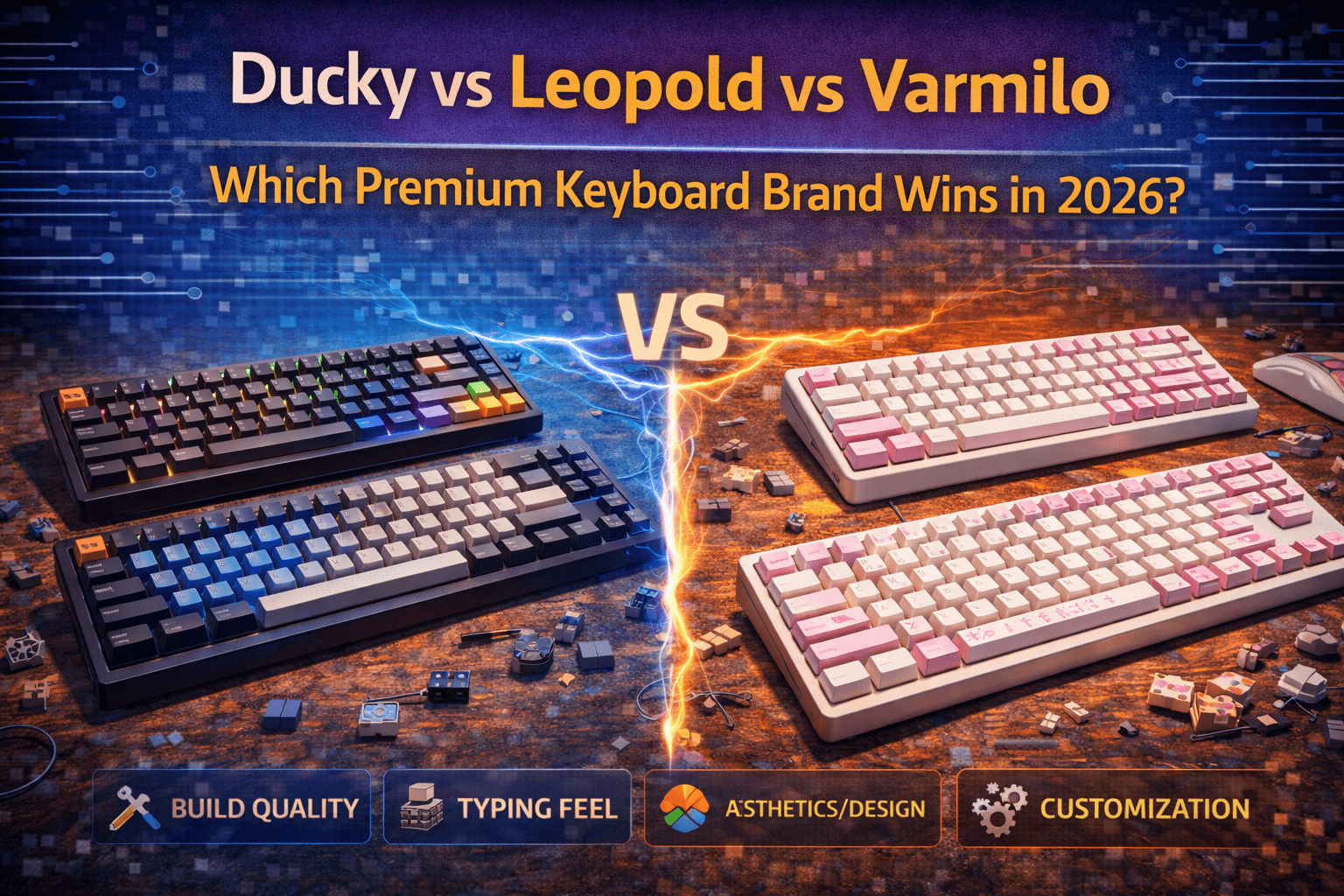
Ducky, Leopold, and Varmilo occupy the premium pre-built keyboard space, representing what mechanical keyboards can achieve through refined manufacturing and meticulous attention to detail rather than flashy features or gaming-focused marketing. These brands built their reputations on exceptional typing experiences, rigorous quality control, and enthusiast-focused design philosophies long before custom keyboards became mainstream. For another enthusiast-respected niche brand with its own distinctive approach, see our Vortex Core vs Race 3 vs Pok3r guide. Understanding these brands requires appreciating subtlety—none of them shout about gaming performance, excessive RGB, or revolutionary features. Instead, they perfect fundamentals: switch quality, stabilizer tuning, case acoustics, keycap thickness, and overall typing refinement. The differences between them are nuanced rather than dramatic, making direct comparison valuable for buyers choosing between excellent options.
Ducky established itself through consistent quality, extensive switch variety, and reasonable pricing for premium keyboards. They offer premium typing experiences at prices that don't require extreme budgets while maintaining quality standards that satisfy enthusiasts. Leopold obsesses over typing feel above all else. Their keyboards feature the best stabilizers in the industry, meticulously tuned acoustics, and typing experiences that feel refined from the first keystroke. They sacrifice features like RGB and programmability to focus entirely on typing quality, appealing to purists who value feel over functions. Varmilo combines premium quality with distinctive aesthetics. Their collaboration keyboards feature artwork and color schemes unavailable elsewhere. Beyond aesthetics, Varmilo maintains excellent build quality and typing feel comparable to Ducky and Leopold while offering more visual personality.
This guide compares these brands across brand philosophy and approach, build quality and typing feel, pricing and value propositions, aesthetic and design approaches, switch options and availability, features and functionality, specific product recommendations, and guidance for matching brands to user priorities—helping you identify which premium brand matches your typing and purchasing needs.
Note: This guide contains affiliate links. If you purchase through our links, we may earn a commission at no extra cost to you. This helps support our in-depth testing and content creation.
Brand Philosophy and Approach
Understanding each brand's values and target audience contextualizes their products and explains their strategic choices.
Ducky: Consistent Premium Quality
Ducky, from Taiwan, emerged in the enthusiast keyboard space in the 2000s, building a reputation on reliable premium quality at reasonable prices. Their brand philosophy centers on providing consistently excellent typing experiences with wide variety, making premium keyboards accessible to enthusiasts without extreme pricing. They target enthusiasts wanting premium quality, people stepping up from gaming keyboards, users who prioritize typing feel, and buyers wanting a reliable premium brand.
Approach: Wide product range covering multiple sizes, extensive switch options, both RGB and non-RGB versions, PBT keycaps as standard, and reasonable pricing between $100-180 for typical models.
Strengths: Consistency across their lineup, excellent value relative to quality, wide availability, good switch variety, and reliable build quality.
Weaknesses: Conservative aesthetics, no wireless options, limited innovation, and nothing particularly unique or special compared to competitors.
Positioning: Reliable premium mainstream—a safe choice for quality typing experience.
Leopold: Typing Feel Purist
Leopold, from Korea, focuses obsessively on typing feel and sound, sacrificing features to perfect these fundamentals. Their brand philosophy is simple: perfect typing experience above all else. Eliminate anything that doesn't directly improve typing feel. They target typing purists, writers and programmers, people who've tried many keyboards and appreciate subtle refinements, and enthusiasts valuing feel over features. For a broader cross-brand selection focused on long-form writing, see our best keyboards for writers and authors.
Approach: Limited product range, no RGB (just simple LED or none), no programmability, no wireless, outstanding stabilizers, sound-dampened cases, and premium typing feel.
Strengths: Best-in-class stabilizers, exceptional typing feel, refined acoustics, meticulous quality control, and focus on fundamentals.
Weaknesses: Expensive pricing ($120-180+), no modern features (wireless, RGB, QMK), limited aesthetic options, and conservative designs.
Positioning: Typing experience specialist—for people who care most about how a keyboard feels.
Varmilo: Premium Aesthetics and Quality
Varmilo, from China, combines premium quality with distinctive visual designs and collaborations. Their brand philosophy is making premium quality keyboards with unique aesthetics—keyboards that type beautifully and look beautiful. They target enthusiasts wanting premium quality with personality, people valuing aesthetics, collectors wanting unique designs, and users wanting something distinctive.
Approach: Collaboration keyboards (Miya Pro series, artist collaborations), unique colorways and designs, premium build quality, dye-sublimated PBT keycaps, and extensive customization options.
Strengths: Unique aesthetics unavailable elsewhere, excellent build quality, beautiful keycaps, wide customization, and premium feel.
Weaknesses: Expensive pricing ($150-220+), limited availability on some designs, no standard wireless, and potential flashiness for professional environments.
Positioning: Premium quality with artistic personality—for people wanting premium keyboards with distinctive aesthetics.
Build Quality and Typing Feel
This is where these brands excel, and subtle differences emerge that distinguish premium keyboards from mass-market alternatives.
Ducky Build Quality
Ducky keyboards consistently demonstrate solid construction and good attention to detail. Their plastic cases have good weight and rigidity with no flex during typing—quality that feels substantial without being excessive. Stabilizers are good quality, factory-lubed, and deliver minimal rattle. While not achieving Leopold-level perfection, they significantly outperform budget keyboards. The spacebar and large keys feel smooth and consistent.
Their neutral to slightly high-pitched sound profile is pleasant without being particularly distinctive. Some newer models include dampening material. Keycaps are thick PBT doubleshot with excellent quality, crisp legends, and outstanding texture and durability—among the best stock keycaps on any pre-built. Cherry MX switches are well-aligned and consistent with reliable quality control ensuring no scratchy or inconsistent switches.
Typing feel: Very good. Smooth, consistent, and reliable, it provides a solid typing platform that gets out of your way. Ducky provides very good build quality and typing feel at prices ($120-160) where others compromise. The refinement level is high but not ultimate.
Leopold Build Quality
Leopold represents the pinnacle of pre-built typing refinement. Their plastic cases feature internal sound dampening with substantial weight and rigid construction—zero flex. Every aspect is engineered for sound and feel. The stabilizers are definitively best-in-class. Perfectly tuned from the factory with no rattle, tick, or mushiness, large keys feel identical to regular keys, which is extraordinary. This alone justifies Leopold's premium pricing. See our keyboard stabilizers guide to understand why stabilizer quality matters so much.
Their deep, muted, refined sound profile results from dampening materials and case design creating the "thocky" acoustics that enthusiasts spend hours modding customs to achieve—Leopold achieves it stock. Thick PBT keycaps with dye-sublimated legends feature excellent texture and quality. Only minor criticism: legends can be subtle and hard to see in low light. Cherry MX switches come from best bins, feeling smoother and more consistent than typical Cherry implementations.
Typing feel: Exceptional. The refinement is immediately noticeable. Every keystroke feels deliberate, satisfying, and refined. Stabilized keys feel perfect. Sound is pleasing. This is what justifies Leopold's premium pricing. Leopold provides best typing feel in pre-built keyboards.
Varmilo Build Quality
Varmilo matches Ducky and Leopold in quality while adding distinctive aesthetics. Solid plastic cases have good weight and no flex. Quality is comparable to Ducky. Very good, factory-lubed stabilizers deliver minimal rattle and approach Leopold's excellence. Large keys feel smooth and refined—better than Ducky but behind Leopold. Pleasant sound that's slightly deeper than Ducky, with good acoustics though not Leopold's distinctive refinement.
Their keycaps are thick PBT dye-sublimation with beautiful artwork—this is Varmilo's standout. Keycaps are gorgeous with intricate designs matching both quality and aesthetics. Cherry MX or Gateron switches are well-aligned and consistent. Quality control is good, though occasional inconsistencies are reported (rare).
Typing feel: Excellent, very close to Leopold in overall refinement. Stabilizers slightly trail Leopold but lead most competition. Varmilo provides premium typing experience matching Ducky and approaching Leopold, with distinctive aesthetics adding value.
Build Quality Ranking
- Leopold wins on: Stabilizer quality (definitively), sound refinement (refined dampening), overall typing feel (typing purist focus)
- Varmilo excels on: Keycap aesthetics and artistic design
- Ducky leads on: Value-to-quality ratio
For most buyers, Ducky or Varmilo provide sufficient typing quality. For people who care deeply about typing feel and have budget for the best available, Leopold delivers.
Pricing and Value Analysis
Understanding value propositions helps match budget to brand strategy.
Ducky Pricing
Standard models: $100-140 (One 3 series)
Premium models: $150-180 (Shine, Year of series)
What you get: Thick PBT keycaps, Cherry switches, good stabilizers, solid build, and extensive size/switch options.
Value proposition: Best value among premium brands. Ducky provides typing experience approaching Leopold at significantly lower prices. You're not paying for extreme refinement or unique aesthetics—just very good keyboards.
Assessment: Outstanding value. $120-140 Ducky keyboards compete with $180-200 Leopold keyboards on most factors.
Leopold Pricing
Standard models: $120-150 (FC660, FC750R)
Premium/Topre models: $200-260+ (FC660C, FC980C)
What you get: Exceptional stabilizers, refined acoustics, premium typing feel, thick PBT keycaps, and Cherry MX or Topre switches.
Value proposition: Paying premium for best-in-class typing refinement. Not features (no RGB, wireless, programmability)—pure typing quality.
Assessment: Premium pricing justified if typing feel is priority. Not good value if you want features. Excellent value if ultimate typing refinement is priority.
Varmilo Pricing
Standard models: $130-180 (VA series)
Collaboration/custom options: $180-250+ (Miya Pro, artist collaborations)
What you get: Unique aesthetics, beautiful keycaps, excellent build quality, good stabilizers, and premium typing feel.
Value proposition: Premium pricing for premium quality plus distinctive aesthetics. You're paying for visual personality unavailable elsewhere plus excellent typing experience.
Assessment: Justified if aesthetics matter. Expensive if you only care about typing (Leopold is better) or value (Ducky is better). Unique value if you want premium quality with personality.
Value Summary
| Brand | Entry Price | Mid-Range | Premium | Best Value | Best Typing | Best Aesthetics |
|---|---|---|---|---|---|---|
| Ducky | $100-130 | $130-160 | $160-180 | ✓ | Very Good | Conservative |
| Leopold | $120-150 | $150-180 | $200-260 | — | ✓ Best | Minimal |
| Varmilo | $130-180 | $150-220 | $200-250+ | — | Excellent | ✓ Unique |
Aesthetics and Design Philosophy
Visual design and aesthetics vary significantly between brands, reflecting different design priorities.
Ducky Aesthetics
Design approach: Conservative, gaming-influenced but not excessive.
Color schemes: Black, white, and limited special editions. RGB models are available. Generally understated.
Keycap designs: Simple and functional with sharp legends (doubleshot allows crisp, bold legends). Some special editions have color accents.
Visual personality: Minimal. Ducky keyboards look professional and clean but not distinctive. You buy Ducky for typing, not aesthetics.
Assessment: Works anywhere (home, office, professional). Won't turn heads but won't offend. Safe aesthetic choice.
Leopold Aesthetics
Design approach: Ultra-minimalist and function-focused.
Color schemes: Black, white, gray, and navy with no RGB (simple white LED backlighting on some models). Extremely understated.
Keycap designs: Subtle dye-sub legends. Some models have blanks or minimal printing.
Visual personality: Almost nonexistent intentionally. Leopold makes no aesthetic statements—pure typing tool.
Assessment: Professional, mature, understated. Perfect for offices or minimalists. Boring if you want personality.
Varmilo Aesthetics
Design approach: Artistic, expressive, and unique.
Color schemes: Extensive—pandas, sakura, koi, sea melody, countless themes. Collaboration keyboards feature intricate artwork.
Keycap designs: Beautiful dye-sublimation with detailed illustrations.
Visual personality: High. Varmilo keyboards make statements. They're distinctive, memorable, artistic.
Assessment: Beautiful and unique, collectible. Can be too flashy for professional environments. Perfect for home setups where aesthetics matter.
Aesthetic Recommendations
- Professional/office environments: Ducky (clean) or Leopold (minimal) are safer
- Home enthusiasts: Varmilo (personality) or Ducky (versatile) work better
- Minimalists: Leopold exclusively
- Collector/aesthetic focus: Varmilo collaboration keyboards
- Wanting to blend in: Ducky or Leopold
Switch Options and Availability
Switch variety and availability vary between brands, affecting your ability to find specific configurations.
Ducky Switch Options
Available switches: Cherry MX (Red, Brown, Blue, Black, Silent Red, Speed Silver), sometimes Gateron.
Variety: Extensive. Most models available in 4-6 switch options. Easy to find preferred switch.
Quality: Standard Cherry MX consistency. Across keyboards, quality is consistent.
Availability: Good—Ducky keyboards widely available with multiple switch options regularly in stock.
Assessment: Best variety for buyers knowing switch preferences. Easy to get exactly what you want.
Leopold Switch Options
Available switches: Cherry MX (Red, Brown, Blue, Black, Silent Red) and Topre (exclusive to Leopold in some models).
Variety: Good but more limited than Ducky. Popular switches covered.
Quality: Excellent—Leopold sources premium Cherry bins with switches feeling smoother than typical Cherry implementations. Topre switches (FC660C, FC980C) are Leopold's exclusive offering in pre-builts.
Availability: More limited than Ducky. Specific switch/layout combinations can be hard to find.
Assessment: Quality over variety. What Leopold offers is exceptional even if selection is smaller.
Varmilo Switch Options
Available switches: Cherry MX (multiple), Gateron, and some proprietary options.
Variety: Good variety with customization options on their website. Can configure switches per keyboard.
Quality: Cherry MX or Gateron, both good quality with consistent performance.
Availability: Some models readily available, others require ordering/customization. Collaboration keyboards may have limited switch options.
Assessment: Good variety with customization flexibility for those willing to order directly.
Switch Recommendations
- Maximum switch choice: Ducky dominates
- Best switch quality: Leopold's premium Cherry bins and exclusive Topre
- Customization: Varmilo offers direct ordering configuration
See our keyboard switches guide for detailed information on switch types.
Features and Functionality
Features vary significantly—these brands prioritize fundamentals over features.
Ducky Features
- RGB: Available on Shine series with quality implementation. Not excessive gaming RGB.
- Programmability: Limited—some models have basic macro recording but no QMK/VIA.
- Connectivity: Wired USB exclusively (no wireless).
- Extras: DIP switches for layout changes, detachable cables (USB-C), solid aluminum frames on premium models.
- Hot-swap: Ducky One 3 series IS hot-swappable (Kailh yellow sockets).
Assessment: Basic features focusing on keyboard essentials. No modern conveniences like wireless or full programmability, but One 3 hot-swap provides customization flexibility.
Leopold Features
- RGB: None—some models have simple white LED backlighting.
- Programmability: None—zero remapping or macro capability. What you see is what you get.
- Connectivity: Wired USB exclusively (no wireless on standard models, though newer FC900RBT has Bluetooth).
- Extras: Sound dampening pads standard, two-tone keycap color schemes.
Assessment: Intentionally minimal features. Leopold eliminated everything not directly improving typing feel. Newer Bluetooth models (FC900RBT) offer wireless option but remain feature-light.
Varmilo Features
- RGB: Available on some models with clean implementation.
- Programmability: Limited—basic functions only. No QMK/VIA.
- Connectivity: Wired USB (no wireless on standard Miya Pro models, though newer Minilo and Sword68 offer wireless options).
- Extras: Customization options (switch colors, keycaps, cases), beautiful packaging, detachable cables.
Assessment: Features secondary to aesthetics and quality. Customization is main "feature."
Feature Comparison
| Feature | Ducky One 3 | Leopold FC750R | Varmilo Miya Pro |
|---|---|---|---|
| Hot-Swap | ✓ Yes | ✗ No | ✗ No |
| RGB | ✓ Yes (some) | ✗ No | ✗ No |
| Programmability | Limited | ✗ No | Limited |
| Wireless | ✗ No | ✗ No (unless BT model) | ✗ No |
| Macro Support | ✓ Yes | ✗ No | ✗ No |
Important note: None of these brands compete on features. If you want wireless, hot-swap, QMK/VIA, or modern features, look to Keychron or other brands. These brands focus on typing quality, not feature checklists. See our hot-swap keyboards guide for more customization-friendly options.
Availability and Purchasing
Where and how to buy varies significantly.
Ducky Availability
Sources: MechanicalKeyboards.com, authorized retailers worldwide, Amazon (some models).
Stock: Generally good availability with popular models regularly in stock. Some special editions are limited.
Assessment: Easiest to buy among the three brands. Widely distributed.
Leopold Availability
Sources: MechanicalKeyboards.com, specialized retailers, limited distribution elsewhere.
Stock: More limited availability with specific combinations often out of stock for extended periods.
Assessment: Harder to find than Ducky. Requires more patience.
Varmilo Availability
Sources: MechanicalKeyboards.com, Varmilo website direct, limited retailers.
Stock: Standard models are available while collaboration keyboards are limited runs.
Assessment: Moderate availability. Unique models require patience or direct ordering.
Purchasing Recommendations
- Immediate purchase: Ducky from US retailer is fastest
- Willing to wait: Leopold (worth it) or Varmilo (for unique designs)
- Specific configuration: Varmilo direct ordering
Specific Product Recommendations
Best keyboards from each brand for different use cases.
Best Ducky Keyboards
Best Overall Value: Ducky One 3 TKL ($115-140)
- Exceptional build quality and typing feel
- PBT doubleshot keycaps
- Multiple switch options
- Perfect balance of quality and price
- Hot-swappable for customization
- Widely available and in stock
Best Full-Size: Ducky One 3 Full-Size ($140)
- Complete layout with numpad
- Same quality as TKL variant
- Great for office or data entry — see our best keyboards for accountants and finance professionals for more numpad-equipped picks
Best Compact: Ducky One 3 Mini ($130)
- 60% layout for minimal desk space
- Premium Ducky quality in compact form
- Good for minimalist setups
Best RGB: Ducky Shine 7 ($170)
- Premium RGB implementation
- Aluminum top case
- Peak Ducky quality
Recommendation: Ducky One 3 TKL provides best balance for most users.
Best Leopold Keyboards
Best Overall: Leopold FC750R ($130)
- TKL layout with everything for most needs
- Exceptional stabilizers and typing feel
- Best value in Leopold lineup
- Perfect typing experience
Best Compact: Leopold FC660M ($140)
- 65% layout with arrow keys preserved
- Same legendary Leopold feel
- Unique layout with arrows and navigation
Best Full-Size: Leopold FC900R ($150)
- Complete layout with numpad
- Leopold typing quality with numpad
- Great for office professionals
Best Premium: Leopold FC660C ($240)
- Topre switches (exclusive)
- Ultimate typing refinement
- For enthusiasts wanting best available
Recommendation: FC750R for most users wanting ultimate typing feel. FC660C for those prioritizing typing above all else.
Best Varmilo Keyboards
Best Value: Varmilo VA87M ($150)
- TKL layout
- Quality Varmilo build
- Clean aesthetic
Best Aesthetics: Varmilo Miya Pro series ($180-200)
- Unique artwork and designs
- 65% compact layout
- Beautiful keycaps with intricate artwork
- Multiple themes available (Sakura, Panda, Koi, Beijing Opera)
Best Collaboration: Varmilo x Ducky Miya Pro series ($150-180)
- Distinctive panda/sakura/koi themes
- Premium quality
- Collectible designs
Recommendation: Miya Pro for unique aesthetics and quality. VA87M for value-conscious buyers.
Direct Comparisons by Use Case
- Best Typing Keyboard: Leopold FC750R > Varmilo VA87M > Ducky One 3 TKL. Leopold wins on refinement.
- Best Value: Ducky One 3 TKL > Varmilo VA87M > Leopold FC750R. Ducky provides most per dollar.
- Best Aesthetics: Varmilo Miya Pro > Ducky special editions > Leopold. Varmilo uniquely distinctive.
- Best for Office: Leopold FC750R (quiet, refined) > Ducky One 3 (professional) > Varmilo (depends on aesthetic).
- Best Compact Premium: Leopold FC660M (typing) > Varmilo Miya Pro (aesthetics) > Ducky One 3 Mini (value).
Who Should Buy Which Brand?
Matching brand to user priorities and preferences.
Buy Ducky If:
- Premium quality matters at accessible prices
- Value is more important than ultimate refinement
- Wide switch variety and availability matter
- You need keyboard quickly (good availability)
- Professional aesthetic is priority
- Budget is $100-150
- You're stepping up from gaming keyboards
Ducky best for: Most buyers wanting premium typing without extreme budgets.
Buy Leopold If:
- Typing feel is absolute priority
- You've tried many keyboards and appreciate refinement
- Features don't matter (no RGB, wireless, programmability)
- You're writer, programmer, or extensive typist
- Best stabilizers available matter
- Budget allows $130-180 ($240+ for Topre)
- Quality matters more than features or aesthetics
Leopold best for: Typing purists and people who value feel above everything.
Buy Varmilo If:
- Aesthetics and personality matter significantly
- Unique designs unavailable elsewhere appeal
- Beautiful keycaps and artistic design matter
- You appreciate keyboards as collectible items
- Budget is $150-220+
- Premium quality with visual personality is priority
- Distinctive look is important
Varmilo best for: Aesthetic enthusiasts wanting premium quality with distinctive designs.
The Honest Recommendation
- Most readers: Ducky One 3 TKL ($115-140)—exceptional value with great typing feel and reliable quality
- Typing enthusiasts: Leopold FC750R ($130) or FC660M ($140)—best typing feel available in pre-builts
- Aesthetic enthusiasts: Varmilo Miya Pro ($180-200)—unique designs with premium quality
You can't go wrong among these brands. Choose based on priorities (value/typing/aesthetics) rather than quality concerns.
Frequently Asked Questions
Which is better for typing, Ducky or Leopold?
Leopold has better typing feel due to superior stabilizers and refined acoustics. The difference is noticeable but not dramatic. Ducky provides very good typing experience at lower price. Choose Leopold if typing feel is top priority and budget allows. Choose Ducky for excellent typing at better value. Leopold wins on refinement; Ducky wins on value.
Is Leopold worth the extra money over Ducky?
Depends on priorities. Leopold's stabilizers and sound refinement are best-in-class. If you type extensively and appreciate subtle refinements, Leopold justifies premium. For most users, Ducky provides sufficient quality at better value. Leopold worth it for purists; Ducky better for most.
Should I buy Varmilo for the aesthetics?
If aesthetics matter significantly, Varmilo's unique designs justify premium pricing. Build quality and typing feel match Ducky. You're paying extra for distinctive artwork and customization. Worth it if visual personality matters. Not worth it if you only care about typing (get Leopold) or value (get Ducky).
Which brand has best stabilizers?
Leopold definitively. Their stabilizers are perfectly tuned from factory with zero rattle or tick. This alone is worth Leopold's premium for many users. Varmilo has very good stabilizers. Ducky has good stabilizers. Leopold is best by noticeable margin. Stabilizer quality directly impacts large key feel and overall typing experience.
Can I get wireless keyboards from these brands?
Standard models from Ducky and Leopold are wired only. Leopold now offers FC900RBT with Bluetooth. Varmilo's standard Miya Pro is wired, but newer Minilo 75 and Sword68 offer wireless (2.4GHz and Bluetooth). If wireless is important, look to Keychron or other brands. These brands prioritize wired typing quality.
Conclusion
Ducky, Leopold, and Varmilo represent premium pre-built keyboards perfecting fundamentals rather than chasing features. All three produce excellent keyboards—choosing between them depends on priorities rather than quality concerns.
Ducky provides the best value proposition, delivering premium typing experiences at prices ($120-140) that don't require extreme budgets. Their keyboards are reliably excellent without being extraordinary, making them smart choices for most buyers seeking premium quality without breaking budgets.
Leopold obsesses over typing feel, creating best-in-class stabilizers and refined acoustics that justify premium pricing for typing purists. Their keyboards sacrifice features entirely to perfect typing fundamentals. For people who type extensively and appreciate subtle refinements, Leopold delivers typing quality unmatched in production keyboards.
Varmilo combines premium quality with distinctive aesthetics, offering unique designs and beautiful keycaps unavailable elsewhere. Their keyboards provide excellent typing experiences while making visual statements. Varmilo justifies premium pricing through artistic personality plus quality.
The straightforward recommendation is Ducky One 3 TKL for most buyers—exceptional value at $130. Typing enthusiasts should consider Leopold FC750R for ultimate refinement. Aesthetic enthusiasts wanting unique designs should explore Varmilo Miya Pro collaborations.
You can't choose wrong among these brands. All three produce quality keyboards that satisfy enthusiasts. Match your choice to priorities: value (Ducky), ultimate typing feel (Leopold), or distinctive aesthetics (Varmilo). Budget $130-180 for premium pre-built quality from any of these excellent brands and you'll have a keyboard that lasts years and improves your daily typing experience.
Ready to explore more keyboard options? Check our mechanical keyboard buying guide for complete purchase guidance.