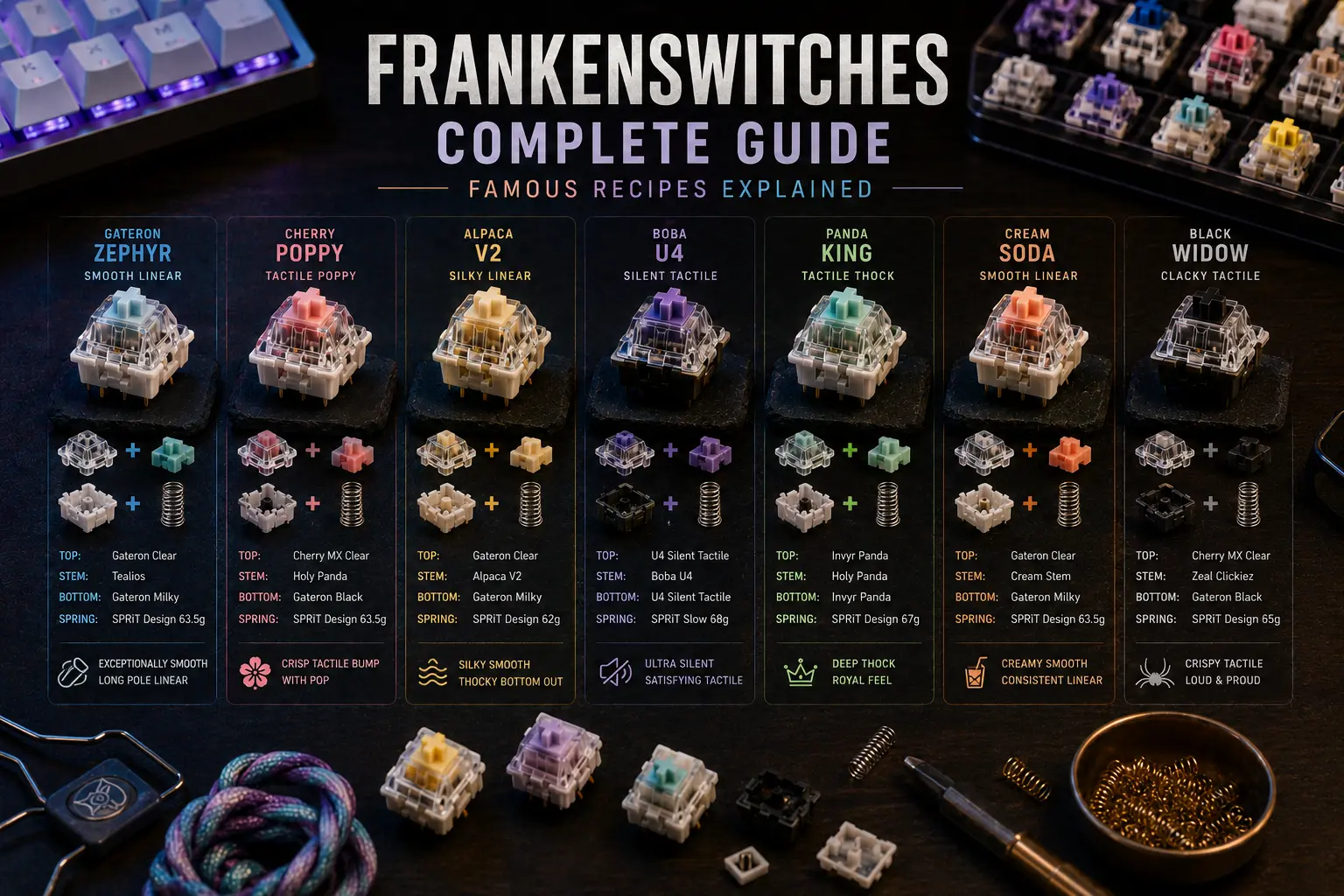
Frankenswitches — hand-built hybrid mechanical switches assembled from the housing of one switch, the stem of another, and often a third-party spring — remain the most culturally important DIY project in the custom keyboard hobby, and this guide documents the definitive recipes that still matter in 2026. The craft sits at the intersection of the how-to-lube-keyboard-switches workflow, the advanced-keyboard-modding-techniques-guide playbook, and raw switch archaeology: pulling apart stock components and rebuilding them into something the factory never intended to ship. A frankenswitch is, at its simplest, a switch whose top housing, bottom housing, stem, and spring do not all come from the same original product.
The term itself was coined on Geekhack and Reddit in the mid-2010s, a knowing nod to Mary Shelley's stitched-together creation. The scene's creation myth is the Holy Panda: around 2017–2018, Quakemz of the Top Clack podcast dropped a Halo True or Halo Clear stem (from the Input Club × Kailh Halo switch, distributed by Massdrop) into an Invyr Panda housing — a linear switch from 2016 widely considered mediocre on its own — and discovered the sharpest, most satisfying tactile bump the hobby had yet experienced. That single substitution reshaped tactile switch design for the next seven years, spawned a factory reproduction (Drop × Invyr Holy Panda, December 2018), triggered a mold-cloning arms race (GSUS, YOK, BSUN, Glorious), and culminated in the bitter Glorious Pandas controversy of 2020. Every modern boutique tactile — Zealios V2, Boba U4T, Holy Panda X — exists in dialogue with that original frankenswitch.
This guide walks through more than ten canonical recipes: the Holy Panda itself in its OG Invyr form, the accessible Halo Panda variant, the evergreen Ergo Clear and its premium variant, the Ultimate T1 build, linear-focused Salmon and MMX recipes, the Silent Holy Panda, modern 2024–2026 Boba U4T hybrids (Holy Boba and Byko), the creamy Gateron POM stem-swap family, JWK Sprit spring mods, and Clear-Top Holy Pandas. Each entry lists exact ingredients, difficulty, time, sound and feel profiles, total cost per 100 switches, and — critically — whether the DIY project still beats the factory alternative in 2026.
Expect four layers of content: a prerequisite section on tools, lube chemistry, and filming technique so the recipes can be followed without guesswork; a component-by-component anatomy explaining why each swap changes what it changes; the recipes themselves with step-by-step assembly; and an honest cost-benefit pass that acknowledges how much the meta has shifted since the Boba U4T, HMX Violet, and Gateron EF Curry made premium factory tactiles and linears dramatically cheaper than a hand-built frankenswitch. Spring modding, common mistakes, sourcing in the United States, and a structured FAQ round out the coverage.
Note: This guide contains affiliate links. If you purchase through our links, we may earn a commission at no extra cost to you. This helps support our in-depth testing and content creation.
What Is a Frankenswitch?
A frankenswitch is a mechanical key switch built by combining parts — top housing, bottom housing, stem, spring, and occasionally the copper leaf assembly — from two or more different donor switches. The goal is to achieve a sound, feel, or weight profile that no single factory product delivers. The philosophy is empirical: every switch component contributes a distinct acoustic and tactile fingerprint, and mixing them unlocks combinations the original manufacturers never chose to produce.
The term "frankenswitch" emerged on Geekhack and the early /r/MechanicalKeyboards subreddit before the Holy Panda, but the Holy Panda is what made the word mainstream. Prior hybrids — the Cherrio (Zealio stem in Cherry housing), the Zanda (Zealio v1 stem in Invyr Panda housing, credited to PerniciousPony), the Unholy Panda (Invyr Panda stem in Halo housing) — circulated in niche groupbuys but never escaped the hobby's inner circle. Quakemz's Holy Panda did, and by late 2018 every major vendor was chasing the recipe. Today the word covers any non-OEM combination, including "same-factory" hybrids built from JWK or Gateron parts that share mold lineage.
Three implicit rules govern the practice. First, mount compatibility is not optional: Cherry-style latches and Kailh-style latches do not interoperate, and some top housings rely on leaf-retention teeth that others lack. SwitchOddities' 34×34 latch compatibility chart, updated through 2024–2025, is the reference. Second, mold generations matter: JWK Alpaca v1 tops retain stems correctly while v2 tops may not, Boba U4T housings tightened tolerances after mid-2021, and post-2021 Kailh Halo stems are slightly larger than their 2018–2020 counterparts. Third, a frankenswitch is only as good as its prep — housings, stems, and springs demand the same lube, film, and break-in discipline described in the how-to-lube-keyboard-switches tutorial.
The Holy Panda Story
Understanding the Holy Panda is prerequisite to understanding every modern tactile. The story begins in October 2016, when the Invyr group (Zisb and Mech27) released the Invyr Panda, a linear switch manufactured by BSUN and universally panned as forgettable. A year or so later, Quakemz — having first experimented with PerniciousPony's Zanda recipe — swapped in a Halo True stem from the Input Club Halo switch. The "P-shaped" tactile event produced (sharp bump at the top, linear travel after) became instantly iconic. Top Clack published the canonical Quakemz write-up in December 2018, the same month Massdrop announced preorders for factory-assembled Holy Pandas.
What followed was a five-year cloning war. GSUS Pandas (Geekhack, late 2018) dropped the housing price significantly. NovelKeys launched YOK Red Pandas in January 2019, then YOK Mint, YOK Trash Pandas (March 2019), and YOK Polar (August 2019). BSUN produced 3-pin variants (old YOK tooling) and 5-pin variants (new molds) through 2020. Drop's first Massdrop × Invyr Holy Pandas shipped in early 2020. In September 2020, Drop briefly advertised Holy Pandas with "100% POM" housings, then retracted the claim as a "miscommunication" on August 19, 2020 — the housings remained polycarbonate top over Nylon PA66 bottom, just painted to match.
The Glorious Pandas controversy erupted that same week. On August 23–24, 2020, Glorious PC Gaming Race teased "Glorious Holy Pandas" on Twitter. An assembly-line video revealed orange-gold stems — visibly not the salmon Halo True or white Halo Clear stems any authentic Holy Panda must contain. Glorious admitted the stems were "our own version" of Halo True, and claimed the housings were cast from "original INVYR Panda housing tooling." Community investigators — ThereminGoat, Switch and Click, iosamfranco — documented that Glorious housings carry cast markings different from Drop × Invyr housings despite both claiming the same tooling. Under pressure, Glorious dropped "Holy" from the name before the September 4, 2020 launch. The resulting Glorious Panda sold at a lower per-switch price than Drop's version and became the best-selling Panda-adjacent switch in history, while purists maintained that only a Halo True or Halo Clear stem earns the "Holy" prefix. A direct comparison lives in the dedicated holy-pandas-vs-glorious-pandas analysis.
Drop closed the Holy Panda chapter on March 1, 2022 with the Holy Panda X (HPX) — a Gateron-manufactured (not Kailh/BSUN) successor designed by Drop with Quakemz, Invyr, and Mech27. HPX uses a translucent black PC top, dark grey nylon bottom, golden-yellow POM stem, and 65g spring with 3.5mm travel. It looks nothing like the original Holy Panda, and community members including ThereminGoat have argued the name is inappropriate — but Quakemz himself publicly prefers HPX over both the original Holy Panda and Glorious Pandas, calling it smoother, more stable, and more consistent.
As of 2026, authentic Invyr Panda housings are essentially unobtainable outside secondary-market listings on r/mechmarket at inflated prices. YOK and BSUN reproductions circulate at NovelKeys, KBDfans, and KeebsForAll. Drop Holy Panda X remains in stock at Drop.com. Glorious Pandas remain in wide distribution including Amazon. A full sourcing breakdown appears in the final section.
Before You Start: Required Tools & Skills
Frankenswitching is not a good first mechanical keyboard project. Every builder should have already assembled at least one custom keyboard per the build-first-custom-keyboard-guide workflow, lubed a set of stock switches per the how-to-lube-keyboard-switches tutorial, and be comfortable handling a switch opener without snapping latches. The prerequisites below are non-negotiable.
Switch opener: Aluminum CNC openers with magnetic closures are standard. The HONKID aluminum switch opener on Amazon supports Cherry MX, Kailh, Outemu, Akko, and Panda latches. The Flashquark 2-piece MX+Kailh opener on Amazon is the closest functional equivalent to a CannonKeys-style dedicated opener. CannonKeys and NovelKeys also sell openers directly.
Lubes: The modder's lube shelf in 2026 holds three essentials. Krytox GPL 205g0 (3mL syringe) on Amazon is the industry-default grease for linear housings and stem rails — thick, PFPE/PTFE-based, neutral to all switch plastics. Tribosys 3203 officially packaged by Miller-Stephenson on Amazon is the correct choice for tactile switches because its thinner viscosity preserves the tactile bump that 205g0 tends to mute; a budget Tribosys 3203 3mL option on Amazon also exists. Krytox 105 oil (5mL dropper) on Amazon is for spring bag-lubing. Tribosys 3204 on Amazon is a valid 205g0-alternative for linears. Never substitute WD-40, silicone spray, or cooking oil — they permanently degrade switch plastics.
Application tools: A size-00 or 000 brush is mandatory. The Glorious Lube Brush on Amazon is the de facto standard. A lube station organizes switches during application; the Glorious 36-switch Lube Station on Amazon holds housings upright, and the RunJRX 32-switch acrylic lube station kit on Amazon bundles pullers, brushes, and an opener for beginners. Fine-tip anti-static tweezers handle stems, springs, and films; the Ranked premium switch film kit with tweezers on Amazon pairs both.
Keycap and switch pullers: The KEMOVE 304 stainless 2-in-1 keycap and switch puller on Amazon covers extraction from hotswap boards.
Switch films: Films reduce housing wobble and alter resonance. The ZugGear Durock 0.15mm HTV+PC switch films (120-pack) on Amazon are equivalent to Deskeys films, which are no longer reliably stocked on Amazon under that brand. For looser housings, ZugGear Durock 0.3mm foam films on Amazon are thicker. TX Films remain vendor-exclusive at Divinikey and CannonKeys.
Workflow ergonomics: Attack Shark's Moore-Garg Strain Index modeling scored an intensive three-hour lubing session at 46.08 — roughly nine times the recommended repetitive-strain safety limit. Practically, no builder should lube more than 20 switches in a single sitting, which makes a 100-switch recipe a 5-session project across several evenings.
Understanding Switch Components
A Cherry MX–compatible switch has four tunable parts: top housing, bottom housing, stem, and spring (with the copper leaf usually fixed to the bottom housing). Each component shifts sound and feel in a predictable direction.
The top housing shapes the upstroke sound and the upper-travel wobble profile. Polycarbonate tops produce brighter, higher-frequency sound; nylon tops produce deeper, muted tones; PME and hybrid plastics sit in between. Top housings with leaf-retention teeth (Cherry, Kailh Halo, most JWK) hold the copper leaf against hotswap insertion forces; tops without them (Boba U4T) require soldered PCBs or careful installation to prevent leaf lift and double-typing.
The bottom housing dictates bottom-out sound — the loudest acoustic event per keystroke — and carries the leaf. Nylon PA66 bottoms produce the thock that dominates Holy Panda and Boba sound; polycarbonate bottoms produce sharper clack; Gateron's Ink-material bottoms (Ink Black, Oil King) add a proprietary creamy profile.
The stem is the single most tactile-relevant component. Stem leg geometry, POM versus nylon versus UHMWPE material, and pole length determine tactile shape, bottom-out hardness, and stem wobble. A Halo True stem's asymmetric leg profile is what creates the Holy Panda's sharp P-bump; a long-pole stem (Gateron Cream Soda, Boba LT) produces an earlier, deeper bottom-out thock than a standard 3.5mm pole.
The spring controls force curve — the resistance felt across the 4mm travel distance. Linear springs (constant pitch) produce Hooke's-law-faithful force increase. Progressive springs (variable pitch) start lighter and ramp exponentially near bottom-out. Slow-curve springs (SPRiT Slow Extreme) are longer with a preloaded initial force. Two-stage springs step between two rates. Ringer Keys' and TX Keyboards' spring inventories are documented in the spring modding section below.
On the copper leaf, the rule is absolute: never lube it, never touch it with a greased stem leg, and never bend it. Leaf contamination causes chatter (double-typing) or failed actuations, and lubed stem legs cause grease migration onto the leaf over the first few hundred keystrokes. ThereminGoat's "Lubing: Where to Lube" short documents the friction zones with ink-marker testing and remains the definitive reference.
Recipe #1: Holy Panda (OG Invyr Version)
Origin: Quakemz, Top Clack, circa 2017–2018. The recipe that named the genre.
Difficulty: Intermediate. Requires sourcing rare Invyr or YOK Panda housings.
Time required: ~6–8 hours for 100 switches across multiple sessions.
Ingredients per 100 switches:
- Housing: Invyr Panda (OG, 2016–2018) or YOK/BSUN Panda reproduction — 100 donor switches. OG Invyr via r/mechmarket at a premium; YOK/BSUN reproductions at NovelKeys or KBDfans at a more affordable price.
- Stem: Halo True (salmon) or Halo Clear (white) stem — 100 donor Halo switches from Drop.com Holy Panda retail inventory, or harvested from Input Club Halo donor stock.
- Spring: Panda stock 67g stainless, or swap to ThicThock DL67.5 or SPRiT Slow Extreme 68g at Ringer Keys.
- Lube: Tribosys 3203 on housing rails only; skip stem legs.
- Film: 0.15mm HTV+PC films, 100-count.
Assembly:
- Open all 100 Panda donors with the aluminum opener; separate top, bottom, stem, and spring.
- Open all 100 Halo donors; extract Halo True or Halo Clear stems and set aside.
- Discard Panda stems (or resell as Unholy Pandas) and Halo housings.
- Bag-lube 100 Panda springs with 3–4 drops of Krytox 105 in a Ziploc; shake 30 seconds.
- Apply Tribosys 3203 sparingly to bottom housing rails with a size-00 brush — the brush should appear shiny, not white-coated.
- Lube the front and back faces of each Halo stem (the flat non-leg surfaces) with a thin 3203 coat; leave the two stem legs completely dry.
- Seat spring on stem pole, drop stem-and-spring into bottom housing, orient legs toward leaf.
- Place a 0.15mm film on the bottom housing rim, seat the top housing, and press closed until latches click.
- Test-type 5 completed switches in a hotswap board before assembling the remaining 95.
Expected sound profile: Bimodal — high-pitched clack on the tactile bump, deep thock on bottom-out. Classic Holy Panda signature.
Expected tactile feel: Sharp P-shaped tactile event at the very top of travel, then linear through to bottom-out. ~67g bottom-out force.
Total cost per 100 switches (2026): Mid-range to premium depending on housing sourcing, plus a small additional amount in springs, films, and lube.
Holy Panda vs Boba U4T: which wins? The Boba U4T produces a rounder D-shaped bump, deeper thock, tighter tolerances, and is more affordable per 100 unmodded. The OG Holy Panda wins only on sharper tactile character and nostalgia; the U4T wins on every objective quality metric including stem wobble, which ThereminGoat called the gold standard.
Community verdict: Historically the most important frankenswitch ever built. In 2026, mostly a collector's recipe — build it once for the craft, then move on.
Recipe #2: Halo Pandas (Accessible Alternative)
Origin: Community simplification, 2019–2020, when Invyr housings became scarce.
Difficulty: Beginner.
Time required: ~4–5 hours for 100 switches.
Ingredients per 100 switches:
- Housing: Drop Halo True or Halo Clear — 100 donor switches from Drop.com. Historical context on Kailh Halo switches lives in the zealpc-switches-deep-dive-guide.
- Stem: Keep the Halo stem from the donor.
- Spring: Cherry 67g or SPRiT 63.5g Progressive from RNDKBD.
- Lube: Tribosys 3203 on rails; dry stem legs.
- Film: Optional 0.15mm film.
Assembly:
- Open 100 Halo donors.
- Discard stock Halo springs.
- Bag-lube 100 replacement 67g Cherry or SPRiT Progressive springs with Krytox 105.
- Apply Tribosys 3203 to bottom housing rails.
- Lube stem bodies only; legs remain dry.
- Reassemble with optional film under the top housing.
Expected sound profile: Lighter and brighter than Holy Panda — polycarbonate Halo top produces less thock than nylon Panda bottom.
Expected tactile feel: Same Halo tactile event (sharp top bump), slightly less aggressive than OG Holy Panda due to housing resonance. ~67g bottom-out.
Total cost per 100 switches: Affordable, all-in.
Halo Pandas vs boutique alternative: At this price point, Durock T1 or Gazzew Boba U4T deliver stronger tactility for comparable cost. Halo Panda survives as a gateway build for newcomers who want to learn the craft on a single donor switch.
Community verdict: Training wheels. Legitimate but superseded.
Recipe #3: Ergo Clear (Classic Tactile Mod)
Origin: Geekhack user "mtl," 2011. Older than the term "frankenswitch" itself.
Difficulty: Beginner.
Time required: ~5–6 hours for 100 switches.
Ingredients per 100 switches:
- Housing: Cherry MX Clear — 100 donor switches. Standalone MX Clear packs are inconsistently stocked on Amazon; the Cherry MX Ergo Clear 23-switch kit on Amazon is Cherry's factory-lubed descendant. Pure MX Clear donors available at NovelKeys and CannonKeys. Broader Cherry context in cherry-mx-switches-complete-guide.
- Stem: Keep Cherry MX Clear stem.
- Spring: 62g or 65g — SPRiT 63.5g Supreme from Ringer Keys, ThicThock DL62 from RNDKBD, or Cherry 62g.
- Lube: Tribosys 3203 on rails; 3203 light coat on stem body, dry legs.
- Film: Optional 0.15mm if housing wobble is present.
Assembly:
- Open 100 Cherry MX Clear donors.
- Discard stock 55g/95g Clear springs (they are famously heavy).
- Bag-lube replacement 62–65g springs with Krytox 105.
- Apply Tribosys 3203 to rails.
- Light 3203 on stem body only; legs remain dry to preserve the Clear tactile bump.
- Reassemble with optional film.
Expected sound profile: Bright, dry, characteristic Cherry clack. No thock.
Expected tactile feel: Cherry MX Clear's medium tactile bump at lighter 62–65g bottom-out — the original lightweight office tactile. Cherry's own factory MX Ergo Clear (released October 2022 after twelve years as a DIY mod) and the newer MX2A Ergo Clear are close but not identical.
Total cost per 100 switches: Affordable to mid-range.
Ergo Clear vs boutique alternative: Ergo Clear has no exact boutique equivalent in 2026. Cherry's factory Ergo Clear is the closest, but many enthusiasts still prefer the DIY version for precise spring-weight control via SPRiT Progressive or Slow Extreme options. This recipe remains competitive.
Community verdict: Evergreen. Fifteen years old and still worth building.
Recipe #4: Premium Ergo Clear (Upgraded Version)
Origin: Community iteration, 2019 onward.
Difficulty: Intermediate.
Time required: ~6–7 hours for 100 switches.
Ingredients per 100 switches:
- Housing: Gateron Clear top + Cherry MX Clear bottom (hybrid top-swap) OR full Cherry MX Clear housing. Context on Gateron's lineup available in the broader Gateron guide.
- Stem: Cherry MX Clear stem.
- Spring: SPRiT 63.5g Complex Rate or SPRiT 63.5g Slow Extreme from Ringer Keys.
- Lube: Tribosys 3203 plus a light single drop of Krytox 105 oil on the front face of each stem leg (optional ping reduction — never on the leaf itself).
- Film: 0.15mm HTV+PC films mandatory.
Assembly:
- Open Cherry MX Clear and Gateron Clear donors (if using the top swap).
- Swap Cherry MX Clear bottom onto Gateron Clear top — verify latch fit before committing.
- Replace spring with SPRiT 63.5g Complex Rate.
- Bag-lube springs with Krytox 105.
- Apply Tribosys 3203 to both top and bottom housing rails.
- Light 3203 on stem body only.
- Install 0.15mm film on every switch.
- Optional: single 105 oil drop on the front of the stem leg (not the leaf) to reduce leaf ping without muting tactility.
Expected sound profile: Deeper, more refined than stock Ergo Clear; the Gateron top adds slight fullness.
Expected tactile feel: Lighter top-of-travel than standard Ergo Clear (Complex Rate spring starts gentle), with clean tactile event preserved and smooth linear descent.
Total cost per 100 switches: Mid-range.
Premium Ergo Clear vs boutique alternative: Outpaces factory Cherry MX2A Ergo Clear in smoothness and tunability. Still the premium Cherry-style tactile build.
Community verdict: The enthusiast's Ergo Clear. Worth the extra effort for builders who specifically want Cherry-style tactility at custom weights.
Ergo Clear vs Premium Ergo Clear: Which to Pick
Select the classic Ergo Clear for a first-time modder with one donor switch and a fixed budget — it teaches spring swapping, lube application, and Cherry disassembly all at once. Select Premium Ergo Clear when a second build or a dedicated tactile daily-driver is the goal: the Complex Rate spring and Gateron top combination produce a clearly superior feel, but the cost and complexity jump make it wasted effort on a first attempt.
Recipe #5: Ultimate T1 (Premium Tactile Modern Build)
Origin: KeebTalk community, 2020, refined through 2024–2026.
Difficulty: Intermediate.
Time required: ~6–8 hours for 100 switches.
Ingredients per 100 switches:
- Housing: Durock T1 70-pack on Amazon — need roughly 100 switches, so two 70-packs. Also available at KBDfans and NovelKeys. Full context on JWK-family sourcing at durock-jwk-tecsee-boutique-switches-guide.
- Stem: Keep Durock T1 stock stem.
- Spring: SPRiT 60g Slow Extreme or TX Long 16mm at Mekibo.
- Lube: Tribosys 3203 on rails; Christo Lube MCG 129 optional alternative.
- Film: 0.15mm HTV+PC films via the ZugGear Durock films on Amazon listing — mandatory for T1 housings, which benefit dramatically from filming.
Assembly:
- Open 100 Durock T1 donors.
- Bag-lube replacement 60g Slow Extreme or TX Long springs with Krytox 105.
- Apply Tribosys 3203 sparingly to T1 bottom housing rails.
- Light 3203 on stem body; legs dry.
- Install 0.15mm film on every switch.
- Reassemble and test-type five before committing.
Expected sound profile: Full, heavy thock with pronounced upper-register tactile click.
Expected tactile feel: Heavy, aggressive tactile bump — the largest tactile event of any modern stock switch — at roughly 67g bottom-out, smoothed significantly by the Slow Extreme spring's gentle top-of-travel.
Total cost per 100 switches: Mid-range.
Ultimate T1 vs boutique alternative: Durock T1 stock is already an excellent tactile. The "Ultimate T1" mod converts it from good to exceptional; stock T1 plus the Ultimate T1 treatment rivals Zealios V2 at half the cost.
Community verdict: Underrated. The T1 housing's aggressive leaf and deep bottom chamber respond better to modding than almost any other tactile housing.
Recipe #6: Salmon Pandas (Linear-Adjacent Franken)
Origin: Colloquial community naming, 2019–2020.
Difficulty: Intermediate.
Time required: ~6–7 hours for 100 switches.
Ingredients per 100 switches:
- Housing: YOK Trash Panda (grey linear) or BSUN Translucent Panda — 100 donors at an affordable price.
- Stem: Halo True (salmon-colored) stem — this specific color is what earns the "Salmon" name.
- Spring: SPRiT 62g Supreme or TX Long 55g for a lighter top-of-travel.
- Lube: Krytox 205g0 (linear-appropriate despite the tactile stem).
- Film: 0.15mm films optional.
Assembly:
- Open 100 Panda donors and 100 Halo donors.
- Discard Panda stems (linear), Halo housings, Halo springs.
- Bag-lube replacement springs with Krytox 105.
- Apply Krytox 205g0 to Panda bottom housing rails (heavier lube is acceptable because the stem legs will be untouched).
- Light 205g0 on stem body; legs remain dry to preserve some residual tactility.
- Reassemble.
Expected sound profile: Deep Panda thock with only a faint tactile event — approaching linear.
Expected tactile feel: Extremely soft tactile bump, nearly linear. A hybrid-feel switch for builders who want Panda sound without full tactility.
Total cost per 100 switches: Mid-range.
Salmon Pandas vs boutique alternative: Modern long-pole linears (Gateron Oil King, HMX Cheese V2, Mode Obscura) produce deeper thock at lower prices. Salmon Panda is preserved mostly for aesthetic (the salmon stem in a black housing is iconic).
Community verdict: A curiosity build. Interesting once.
Recipe #7: MMX Linear (Cherry Hybrid)
Origin: Informal community mod, 2015–2018.
Difficulty: Beginner.
Time required: ~4–5 hours for 100 switches.
Ingredients per 100 switches:
- Housing: Cherry MX Black (vintage or modern) — 100 donors.
- Stem: Cherry MX Red stem.
- Spring: Cherry 62g or SPRiT 55g Supreme for a lighter feel.
- Lube: Krytox 205g0 on rails and stem body.
- Film: 0.15mm film optional.
Assembly:
- Open 100 MX Black donors and 100 MX Red donors (or enough Red donors to harvest 100 stems).
- Swap Red stems into Black housings.
- Bag-lube 62g or 55g replacement springs with Krytox 105.
- Apply 205g0 to rails and stem body generously.
- Reassemble.
Expected sound profile: Deeper than stock MX Red, slightly higher pitch than MX Black.
Expected tactile feel: Cherry MX Red's ~45g linear feel with MX Black's deeper housing resonance.
Total cost per 100 switches: Affordable.
MMX Linear vs boutique alternative: Outclassed by any modern boutique linear. Gateron Milky Yellow Pro delivers a better linear for less money.
Community verdict: Historical interest only. Skip unless donor switches are already on hand.
Recipe #8: Silent Holy Panda
Origin: Community iteration, 2020–2022.
Difficulty: Advanced.
Time required: ~7–9 hours for 100 switches.
Ingredients per 100 switches:
- Housing: YOK or BSUN Panda housing.
- Stem: Halo stem with Deskeys silent stem clips fitted over the legs, OR Zealios Silent stem as drop-in replacement. Stem sourcing context in zealpc-switches-deep-dive-guide.
- Spring: Cherry 67g or SPRiT 63.5g Complex Rate.
- Lube: Tribosys 3203; avoid lubing silencing pads.
- Film: 0.15mm film recommended.
Assembly:
- Open Panda and Halo donors.
- Fit Deskeys silent clips onto each Halo stem's legs (or substitute Zealios Silent stems directly).
- Bag-lube replacement 67g springs.
- Apply 3203 to housing rails.
- Reassemble carefully — silent clips must seat flush or tactility suffers.
Expected sound profile: Muted thock, quiet upstroke, faint tactile click only.
Expected tactile feel: Retains Holy Panda tactility with noticeable dampening on bottom-out and return.
Total cost per 100 switches: Premium.
Silent Holy Panda vs boutique alternative: Gazzew Boba U4 silent (factory) or Boba U4Tx (silent upstroke only) deliver cleaner silent tactility at lower cost. DIY Silent Holy Panda wins only on the OG P-bump character.
Community verdict: Niche. Office workers seeking silent tactility should buy Boba U4 instead.
Recipe #9: Boba U4T Hybrids (Holy Boba & Byko — Modern 2024–2026)
Origin: Community iteration, 2022–2024, post-Gazzew Boba U4T release.
The Boba U4T became the dominant modern tactile after 2022, but its tighter 2022+ housing tolerances and lack of leaf-retention teeth in the top housing complicate frankenswitch builds. These recipes remain viable with caveats. A direct U4T vs Zealios analysis lives in zealios-vs-boba-u4t-tactile-switch-compared.
Holy Boba (Main U4T Hybrid)
Difficulty: Advanced. Requires older-batch or RGB (clear-top) U4T.
Time required: ~7–9 hours for 100 switches.
Ingredients per 100 switches:
- Housing: Gazzew Boba U4T RGB (clear-top) from Ringer Keys or Thock King.
- Stem: Drop Halo Clear stem harvested from Halo donors.
- Spring: SPRiT 63.5g Slow Extreme, TX 55g Long, or Gazzew 63.5g long spring.
- Lube: Tribosys 3203; Gazzew Blend #7 on springs if available.
- Film: Not required — U4T housings are already tight.
Assembly:
- Open Boba U4T RGB donors and Halo donors.
- Discard U4T stems (sell as hybrid donors) and Halo housings.
- Bag-lube 63.5g long springs with Krytox 105.
- Apply Tribosys 3203 to U4T bottom housing rails.
- Light 3203 on stem body; legs dry.
- Assemble carefully — test each switch for stem hangup (post-2021 Halo stems sometimes bind in U4T housings and may require light sanding).
- Install in a soldered PCB preferentially; U4T tops lack leaf-retention teeth, risking leaf lift in hotswap boards.
Expected sound profile: Deeper than stock Boba U4T thanks to Halo stem geometry interacting with U4T's long-pole bottom chamber.
Expected tactile feel: Sharper tactile event than stock U4T with the same deep thock.
Total cost per 100 switches: Premium.
Byko (Zeal Bottom + Boba Top + Halo Stem)
Ingredients per 100 switches:
- Housing top: Boba U4T RGB top.
- Housing bottom: Zealios V2 bottom (Zeal leaf).
- Stem: Halo Clear stem.
- Spring: SPRiT 67g Supreme or Complex Rate.
- Lube: Tribosys 3203 on rails, stem body only.
- Film: Not required.
Total cost per 100 switches: Premium. The Zealios V2 bottom's aggressive leaf delivers stronger tactility than any U4T variant, while the Boba U4T top contributes the signature deep-chamber resonance. Pre-solder pins before final assembly to prevent leaf displacement during hotswap insertion.
Community verdict: Holy Boba is a marginal upgrade over stock U4T. Byko is a genuine enthusiast build — more tactile than anything commercially available — but expensive.
Holy Boba vs Byko: Which to Pick
Holy Boba is the sensible modern franken — deeper thock than stock U4T, tolerable cost, manageable assembly. Byko is the tactile maximalist's build: the Zealios V2 bottom with its aggressive leaf produces the strongest tactility available in any combination, but the price per switch doubles and leaf-management during assembly demands soldering. Choose Holy Boba for a daily driver; build Byko only if pursuing the most tactile switch technically possible.
Recipe #10: Frankenswitch Creamy (Gateron Milky + POM Stem)
Origin: NovelKeys Cream community, 2019–2022; revived 2024–2025 by budget builders.
Difficulty: Beginner.
Time required: ~5–6 hours for 100 switches.
Ingredients per 100 switches:
- Housing: Gateron Milky Yellow Pro 90-pack on Amazon or Gateron Milky Yellow Pro V2 70-pack on Amazon. Broader Gateron context in gateron-switches-complete-guide.
- Stem: NovelKeys Cream POM stem, Alpaca POM stem, or Akko V3 Pro Cream Yellow 45-pack on Amazon POM stem. More on Akko at akko-switches-complete-guide.
- Spring: SPRiT 62g or 65g Supreme.
- Lube: Krytox 205g0 on rails.
- Film: Optional.
Assembly:
- Open Milky Yellow and Cream donors.
- Swap Cream POM stems into Milky Yellow housings.
- Bag-lube replacement springs with Krytox 105.
- Apply 205g0 to rails and stem body.
- Reassemble.
Expected sound profile: Creamy, muted, low-pitched thock — the signature poppy linear sound.
Expected tactile feel: Smooth linear at 62–65g bottom-out. POM-on-Milky creates mild stick-slip without lube, so generous 205g0 application is required.
Total cost per 100 switches: Affordable.
Frankenswitch Creamy vs boutique alternative: Gateron Cream Soda (factory Milky top + Ink V2 bottom + long-pole nylon stem) ships this exact concept off the shelf affordably. DIY remains valid for builders who already own donors.
Community verdict: Still popular as a budget entry point. A gateway to linear frankens.
Recipe #11: JWK Sprit Spring Mod
Origin: Community iteration, 2020 onward.
Difficulty: Beginner.
Time required: ~4–5 hours for 100 switches.
Ingredients per 100 switches:
- Housing: JWK/Durock linear — Alpaca, Lavender, Lilac, Sunflower — 100 donors at an affordable price from NovelKeys, Divinikey, or Primekb.
- Stem: Keep stock JWK stem.
- Spring: SPRiT 63.5g Progressive or SPRiT 68g Complex Rate from Ringer Keys or RNDKBD.
- Lube: Krytox 205g0.
- Film: Optional.
Assembly:
- Open JWK donors.
- Bag-lube SPRiT Progressive or Complex Rate springs.
- Apply 205g0 to rails and stem body generously.
- Reassemble.
Expected sound profile: Unchanged from stock JWK.
Expected tactile feel: The progressive spring curve adds a bouncy return and discourages bottom-out, transforming the feel without any housing changes.
Total cost per 100 switches: Mid-range.
JWK Sprit Mod vs boutique alternative: This is the cheapest way to customize feel on a boutique linear. Genuinely useful.
Community verdict: Underrated. The SPRiT Progressive effect is subtle but real.
Recipe #12: Clear-Tops Holy Panda
Origin: Aesthetic-driven community variant, 2020–2022.
Difficulty: Intermediate.
Time required: ~6–7 hours for 100 switches.
Ingredients per 100 switches:
- Housing: Gateron Milky top OR BSUN Translucent Panda top + Invyr/YOK Panda bottom.
- Stem: Halo Clear stem.
- Spring: SPRiT 63.5g Slow Extreme.
- Lube: Tribosys 3203.
- Film: 0.15mm mandatory due to mold mismatch.
Assembly: Mirrors the Holy Panda recipe with a top-housing swap after verifying latch compatibility via the SwitchOddities chart.
Expected sound profile: Brighter than standard Holy Panda due to lighter-material top.
Expected tactile feel: Identical to Holy Panda.
Total cost per 100 switches: Mid-range.
Clear-Tops Holy Panda vs boutique alternative: Purely aesthetic. Drop Holy Panda X achieves similar visual appeal factory-assembled.
Community verdict: Build it for photographs.
Spring Modding: The Often-Forgotten Variable
Spring selection is the single most underrated frankenswitch lever. A new spring changes force curve, return speed, and top-of-travel feel without touching the housing or stem. Four spring manufacturers dominate the 2026 market.
SPRiT Designs (founded 2013) publishes the deepest catalog. The Supreme line is linear and Cherry-faithful. The Progressive line (launched January 2019) uses variable pitch for an exponential force curve — light at top, heavy at bottom-out — discouraging bottom-out and producing a bouncy return. The Complex Rate line ramps exponentially to actuation then flattens linearly after, popping cleanly over tactile events. The Slow Extreme line uses longer, preloaded springs for a heavier top-of-travel with gentler rise. The Multi-Stage line, launched April 2021, adds stepwise force jumps. Weights run from 50g to 210g in fine increments. Sourcing is safest through resellers — Ringer Keys, RNDKBD, TypeMachina — rather than direct from spritdesigns.com, which has a checkered groupbuy history.
TX Keyboards springs, now sold through Mekibo, dropped the "progressive" and "slow curved" labels entirely in favor of length-based naming: Short (14mm), Medium (15mm, Cherry-equivalent), Long (16mm), Extra Long (18mm), and Ultra Long (22mm, DL only). Longer springs carry heavier preload. Quality control is ±1g.
ThicThock springs are manufactured by the JWK/Durock factory. The MP (Magically Progressive) line at 64g and 68g ships in ThicThock Marshmallow switches and produces a bouncy discourage-bottom-out feel. The DL (Deliciously Linear) line at 55g, 58.5g, 62g, 65g, and 67.5g is a cleaner Cherry-alternative. Available at Ringer Keys, RNDKBD, and ThocStock.
Cherry OEM springs still ship in 62g, 67g, and 78g variants. Cherry rates by actuation force while Korean springs rate by bottom-out force, so a Cherry 62g feels heavier than a SPRiT 62g — always verify rating convention before swapping.
The physics primer: linear springs follow Hooke's law with constant force per unit compression. Progressive springs use variable coil pitch to deliver exponential force rise near bottom-out. Slow-curve springs preload higher initial force with a shallower slope, mimicking vintage Cherry Black springs. Two-stage springs step between two distinct rates, often producing a "snappy" linear feel. Note that Deskthority force-curve measurements have shown the progressive effect is smaller than marketing implies — the feel differs meaningfully in subjective impression more than in measured force.
Matching springs to recipes: Holy Panda variants want 67g (ThicThock DL67.5 or SPRiT Slow Extreme 68g); Ergo Clears want 62–65g; linears want 55–67g with TX Long 16mm adding preload. The Holy Sheißio specifically uses either a TX Long or SPRiT Slow Extreme to produce heavier top-of-travel resistance that makes the switch feel more tactile.
Common Mistakes & How to Avoid Them
Over-lubing stem legs on tactiles remains the #1 failure mode. Grease on the legs migrates onto the copper leaf during the first hundred keystrokes and mutes the tactile bump into a mushy quasi-linear. Attack Shark's analysis attributes roughly 80% of ruined tactiles to leg-lube migration. Fix: wipe legs with isopropyl alcohol or leave them bone-dry from the start.
Wrong lube for switch type mutes tactility even on dry-legged builds. Krytox 205g0's high viscosity smooths too aggressively on tactile housings; use Tribosys 3203 on tactiles and reserve 205g0 for linears. The dual-lube technique documented by Kinetic Labs — 205g0 on rails, 3203 on stem bodies and leaves — is the gold standard for tactiles.
Too much lube overall produces gummy, sluggish switches regardless of type. The correct brush appearance is shiny, not white-coated. Add less than seems necessary on the first five switches and evaluate before committing to the remaining 95.
Housing latch incompatibility causes hours of wasted effort. Cherry-style and Kailh-style latches do not interoperate, and some tops depend on leaf-retention teeth that others lack. Consult the SwitchOddities 34×34 latch chart before ordering components. The kailh-box-switches-complete-guide also covers Kailh's unique stem geometries for reference.
Post-2021 Halo stem tolerance issues affect Holy Boba, Poor-Man's Soju, and any recipe combining Halo stems with Boba U4T bottoms. Newer Kailh Halo stems are slightly larger than 2018–2020 stems; they bind in tight U4T housings with roughly 30% failure rates. Mitigations include light sanding of Boba top housings, using older Halo stem inventory, or switching to Boba U4T RGB (clear-top) housings which accept modern Halo stems more readily.
Boba top housings lack leaf-retention teeth. Hotswap installation of Holy Boba and Byko builds can push leaves upward, causing contact failures or double-typing. Preference: install these switches in soldered PCBs only.
Over-filming with films thicker than 0.20mm prevents housings from fully closing and creates stem bind. Measure wobble first; use 0.125mm for minor wobble (Alpaca), 0.15mm for typical (Boba, T1, Halo), 0.20mm for loose (some Cherry). Never stack films.
Spring weight mismatch ruins tactility when a heavy spring overwhelms a weak leaf, or a light spring fails to return a heavy stem. Holy Pandas want 67g; Ergo Clears want 62–65g; match intentionally.
Mold generation confusion affects JWK Alpaca v1 vs v2 tops, Boba U4T pre- vs post-mid-2021 housings, and Gateron Ink v1 vs v2 housings. Always buy a sample batch first and verify assembly before committing to 100.
Skipping the five-switch sanity test is the cardinal beginner sin. Build five complete switches, test-type for five minutes, and only then commit to the remaining 95. For the underlying modding fundamentals, the advanced-keyboard-modding-techniques-guide is the companion reference.
Neglecting stabilizer lube produces keyboards where the stabs are audibly worse than the switches. Lube stabilizers first, switches second. The keyboard-foam-types-guide covers the other major acoustic variables.
Cost Analysis: Frankenswitch vs Buying Boutique Equivalent
The economics of frankenswitching have inverted since 2020. Every recipe must now justify itself against an increasingly capable factory alternative.
Budget tier (under $0.50/switch factory): Gateron EF Curry, Gateron EF Grayish, HMX Violet, Akko Fairy Silent, and HMX Clouds. None of these existed at current price points in 2020. They render most budget frankens obsolete. TTC's modern lineup, covered in ttc-switches-complete-guide, sits in similar territory.
Mid tier ($0.50–$0.75): Durock T1, Alpaca, ThicThock Marshmallow, Gateron Oil King, Boba U4T, and C³Equalz × TKC Tangerine. This is where factory quality caught up to frankenswitch results. The Ultimate T1 and Premium Ergo Clear still beat stock; Holy Boba barely does.
Premium tier (over $0.85): Drop Holy Panda X and Zealios V2. At these prices, a DIY Holy Panda or Byko build becomes competitive purely on feel quality.
DIY recipe totals per 100 switches (2026):
- Holy Panda (OG): mid-range to premium
- Halo Pandas: affordable
- Ergo Clear: affordable to mid-range
- Premium Ergo Clear: mid-range
- Ultimate T1: mid-range
- Salmon Pandas: mid-range
- MMX Linear: affordable
- Silent Holy Panda: premium
- Holy Boba: premium
- Byko: premium
- Frankenswitch Creamy: affordable
- JWK Sprit Spring Mod: mid-range
- Clear-Tops Holy Panda: mid-range
Add 5–10 hours of labor per build; ergonomic modeling caps healthy lubing at 20 switches per session.
The verdict tree for 2026:
- For factory-comparable tactility at low cost: buy Boba U4T V2 or Durock T1 stock.
- For the absolute strongest tactility available anywhere: build Byko.
- For Cherry-style tactility at custom weight: build Ergo Clear or Premium Ergo Clear.
- For deep thock with a P-bump: build Ultimate T1 or Holy Boba.
- For collecting / craft / history: build OG Holy Panda once.
- For budget linears: buy HMX Violet or Gateron EF Curry and don't mod at all.
The broader switch landscape is cataloged across best-tactile-switches, best-linear-switches, and best-mechanical-keyboard-switches-guide.
Where to Source Components (2026 US Vendors)
Drop.com remains the sole official source for Halo True, Halo Clear, and Holy Panda X. Halo stems are periodically restocked in the Holy Panda retail SKU.
NovelKeys stocks YOK Panda reproductions, Durock T1, Cherry MX Clear, Gateron Ink, and most JWK linears. The single best first-stop vendor for frankenswitch builders.
KBDfans offers Durock T1, Gateron Milky Yellow, Ink variants, and budget modding supplies.
Ringer Keys is the authoritative US source for SPRiT springs, ThicThock springs, Gazzew Boba U4T V2, and Boba U4Tx. Gazzew-authorized.
TX Keyboards / Mekibo sells the current TX spring catalog (Short, Medium, Long, Extra Long, Ultra Long), TX films, and select hybrid donor switches.
CannonKeys stocks TX films, switch openers, and rotating inventory of boutique switches.
Divinikey rounds out TX inventory and stocks hard-to-find JWK colorways.
KeebsForAll runs a pre-built frankenswitch marketplace including hand-assembled Holy Boba at premium prices.
Amazon covers commoditized items — lubes (Krytox 205g0, Krytox 105, Tribosys 3203, Tribosys 3204), tools (openers, pullers, tweezers, lube stations), films, and mainstream switches (Gateron Milky Yellow Pro, Durock T1, Drop Holy Panda X, Cherry MX Ergo Clear kits, Akko V3 Pro Cream Yellow, Gateron Ink V2 Pro Black). Amazon is rarely the best source for boutique housings or stems.
Avoid: Unverified sellers on AliExpress or eBay for Panda housings — counterfeit BSUN-marked Holy Panda clones with different molds circulated widely 2020–2022.
For the broader custom-build workflow around these switches, see custom-mechanical-keyboard-building-guide and custom-mechanical-keyboard-guide. Newcomers should start with mechanical-keyboard-buying-guide.
Frequently Asked Questions
Q: Are Holy Pandas worth making in 2026?
A: For most builders, no. The Boba U4T V2 delivers a rounder tactile bump, deeper thock, tighter tolerances, and better factory lubing than a DIY Holy Panda. Build a Holy Panda once for the craft and the history — it remains the most culturally important frankenswitch ever made — but expect it to feel dated next to modern boutique tactiles. Builders specifically chasing the sharper P-shaped bump, the classic bimodal sound, or the aesthetic still have reason to build; everyone else should buy Boba U4T or Drop Holy Panda X instead.
Q: What's the difference between OG Holy Pandas and Glorious Pandas?
A: OG Holy Pandas combine an authentic Invyr or YOK/BSUN Panda housing with a genuine Kailh-manufactured Halo True (salmon) or Halo Clear (white) stem. Glorious Pandas launched in September 2020 with orange-gold POM stems that Glorious admitted were "our own version" modeled after Halo True, not actual Halo stems, and with housings that despite claiming "original Invyr tooling" carry cast markings different from Drop × Invyr housings. Community investigators including ThereminGoat documented the discrepancy. Glorious dropped "Holy" from the product name before launch under community pressure. The short answer: Glorious Pandas are Halo-inspired hybrids that look like Holy Pandas but contain neither genuine Halo stems nor verified-original Invyr housings. Deeper analysis at holy-pandas-vs-glorious-pandas-tactile-switch-compared.
Q: Do I need to lube frankenswitches?
A: Yes, with one narrow exception. Every recipe in this guide assumes lube — Tribosys 3203 for tactile housings, Krytox 205g0 for linear housings, Krytox 105 for springs — because unlubed boutique and hybrid switches sound scratchy and feel rougher than their potential. The exception is silent switches (Boba U4 silent, Akko Fairy silent, Silent Holy Panda builds): never lube the silicone silencing pads, as lube migrates into the dampening material and turns it gummy. Apply 3203 only to rails and stem bodies on silent builds.
Q: What lube works for tactile frankenswitches without killing the bump?
A: Tribosys 3203 applied exclusively to housing rails and the stem body — never on the stem legs, which rub the copper leaf and create the tactile event. Leg lube migrates onto the leaf over the first few hundred keystrokes and mutes tactility into a mushy quasi-linear feel. Kinetic Labs recommends a dual-lube workflow for tactiles: 205g0 on housing rails for smoothness, 3203 on stem bodies for restraint. A single drop of Krytox 105 oil on the front face of each stem leg (not the leaf itself) can reduce leaf ping without muting tactility, but this requires a steady hand.
Q: Can frankenswitches use any top and bottom housing combination?
A: No. Cherry-style and Kailh-style latch mechanisms are mutually incompatible, and some tops depend on leaf-retention teeth that others lack. Consult the SwitchOddities 34×34 latch compatibility chart before committing. Known gotchas include post-2022 Boba U4T housings binding on newer Halo stems, JWK Alpaca v1 versus v2 top housings not behaving identically, and Boba top housings lacking leaf-retention teeth (requires soldering, not hotswap). Always buy a sample batch of 10 switches before ordering 100.
Q: Which frankenswitch recipes still beat boutique alternatives in 2026?
A: Three clear winners remain. Ergo Clear and Premium Ergo Clear have no factory equivalent at custom spring weights — Cherry's official MX Ergo Clear from 2022 is the closest but many enthusiasts still prefer DIY for precise weight control. Byko (Zealios V2 bottom + Boba U4T top + Halo Clear stem) is the most tactile switch technically buildable; no commercial product matches it. Ultimate T1 (Durock T1 with Slow Extreme springs and films) converts a good stock tactile into one that rivals Zealios V2 at half the cost. Holy Panda, Holy Boba, and Salmon Panda are mostly outclassed by modern boutique alternatives.
Q: How long does it realistically take to build 100 frankenswitches?
A: Between 5 and 10 hours of active lubing and assembly, spread across 3–5 sessions to manage repetitive-strain risk. Attack Shark's Moore-Garg Strain Index modeling scores an intensive three-hour lube session at 46.08 — roughly nine times the recommended safety limit. A healthy workflow caps lubing at 20 switches per session, turning a 100-switch project into a week-long commitment. Add 1–2 hours for component sourcing research, another hour for a five-switch sanity test, and realistic total elapsed time from order to finished board is 2–3 weeks.
Q: Is switch filming always worth it?
A: No. Filming benefits housings with measurable wobble (Durock T1, older Cherry MX, some YOK Pandas) and housings with thin walls prone to resonance. It adds little to already-tight housings like Boba U4T V2 and modern Alpacas, where films can even cause stem bind if too thick. Measure wobble first; apply 0.125mm films for minor wobble, 0.15mm for standard builds, 0.20mm only for loose housings. Never stack films.
Final Verdict (2026)
Frankenswitching in 2026 occupies a paradoxical position. The craft has never been more accessible — SPRiT, ThicThock, and TX springs are abundant, switch openers cost twenty dollars on Amazon, and YouTube tutorials from Taeha Types, ThereminGoat, and Magniboards document every technique — yet the craft has never been less necessary. Affordable factory switches now match or exceed what DIY frankenswitches delivered in 2019–2020. The Boba U4T V2, HMX Violet, Gateron EF Curry, and Mode Obscura were designed by engineers who grew up frankenswitching, and their products reflect that heritage.
That shift reframes every recipe in this guide. The OG Holy Panda is primarily a historical build, worth doing once to understand where the hobby came from. The Ergo Clear and Premium Ergo Clear remain genuinely useful because Cherry-style tactility at custom spring weights has no factory equivalent. The Ultimate T1 converts a good stock switch into an excellent one at reasonable cost. Byko is the genuine maximalist build: more tactile than anything commercially available, at twice the price, demanding soldered installation. Holy Boba is a marginal upgrade over stock U4T complicated by post-2021 tolerance issues. The budget linear frankens are outclassed by factory HMX and Gateron EF releases.
The single highest-impact technique is not recipe choice but spring selection. A SPRiT Progressive or Slow Extreme spring transforms any boutique linear or tactile more dramatically than most housing swaps — and at a very low cost per switch plus fifteen minutes of labor, it is the cheapest meaningful mod available. Every frankenswitch builder should keep a small inventory of 60g, 63.5g, and 67g springs in Supreme, Progressive, and Slow Extreme variants for experimentation.
The final verdict for 2026: frankenswitching has matured from a necessity into a craft. Build for curiosity, for history, for the specific feel no factory ships, or for the satisfaction of a hand-assembled switch. Do not build as a shortcut to quality — the factory caught up. The Holy Panda story remains the scene's most important myth, and stitching together one's own hybrid switch remains the deepest way to understand how mechanical switches actually work. That educational value is the real return on the ten hours of lubing.