Introduction
Hall Effect keyboards dominated competitive gaming in 2025. In 2026, they're becoming mainstream.
For decades, mechanical keyboards were the only standard for serious gamers. Then Hall Effect technology arrived. Instead of using metal contacts that physically touch, Hall Effect keyboards use magnets and sensors—contactless activation that's faster, more durable, and infinitely customizable.
The technology isn't new. Hall Effect sensors have been used in industrial applications for years. But applying them to keyboards? That's revolutionary for competitive gaming.
Major brands noticed. Wooting pioneered Hall Effect keyboards in 2017 and spent years perfecting the technology. By 2024, Razer, Corsair, and SteelSeries released competing products. Now in 2026, Hall Effect keyboards are becoming the standard for anyone serious about gaming performance.
The question isn't whether Hall Effect is better anymore. It's whether the premium price is worth it for your specific use case. This guide explains the technology clearly, shows practical gaming advantages, and helps you decide if upgrading is justified.
Note: This guide contains affiliate links. If you purchase through our links, we may earn a commission at no extra cost to you. This helps support our testing and content creation.
Quick Overview
Hall Effect keyboards work through magnets in switch stems and sensors on the PCB that detect position without any physical contact. The main advantage comes from adjustable actuation points (0.1-4.0mm) plus rapid trigger technology, delivering faster response than traditional mechanical switches. This technology shines brightest for competitive FPS players in games like CS2 and Valorant, rhythm gamers playing osu!, pro players, and enthusiasts who appreciate cutting-edge tech. The downside hits your wallet hard at $150-350+, and the technology proves overkill for casual gaming or typing, offering only linear feel options. Bottom line: if you're Diamond+ rank in competitive FPS, Hall Effect delivers measurable advantage. Otherwise, mechanical keyboards provide better value for your money.
What Is Hall Effect Technology?
The Simple Explanation
Traditional mechanical switches rely on metal contacts that physically touch when you press a key. Hall Effect switches use magnets detected by sensors, eliminating physical contact entirely. This fundamental difference changes everything about how keyboards respond to your inputs.
How It Works
The Hall Effect principle was discovered way back in 1879. When a magnet moves near an electrical conductor, it creates a detectable voltage change. Scientists call this the Hall Effect, and keyboards harness this principle to detect keypresses without any physical contact whatsoever.
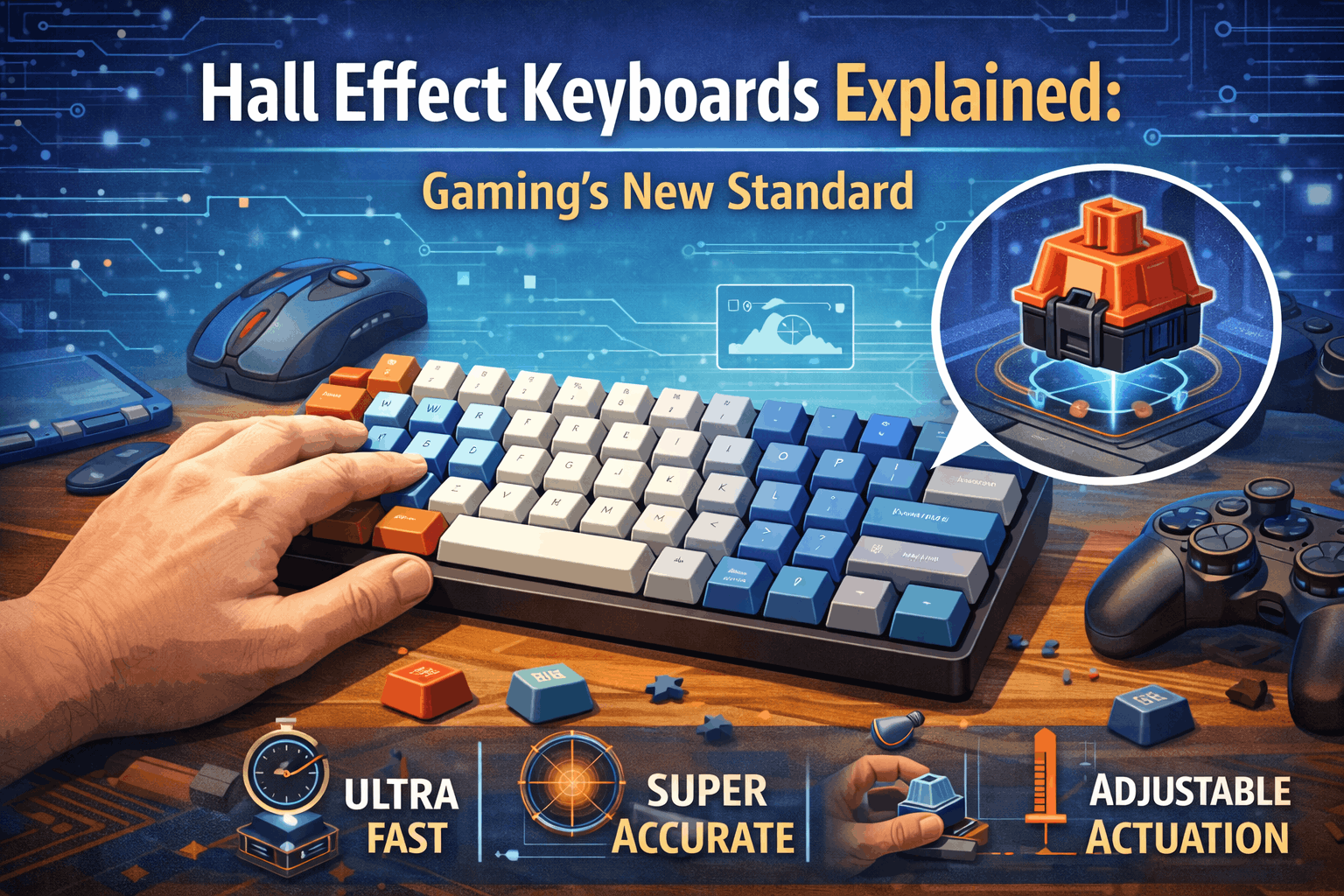
In Hall Effect switches, the system works through a carefully orchestrated dance. A small magnet gets embedded in the switch stem. A Hall Effect sensor mounts on the keyboard PCB (circuit board) directly beneath each switch. When you press a key, the magnet moves downward. The sensor detects this magnetic field change instantly and sends a digital signal to your computer indicating the key activated. Release the key, and the magnet moves upward. The sensor detects this change and signals key deactivation.
Zero physical contact means zero wear, translating to theoretically infinite durability. No metal contacts grinding against each other means no degradation over time.
Why Contactless Matters
Traditional mechanical switches face inherent limitations. Metal contacts wear from friction over millions of keypresses, typically rated for 50-100 million actuations. Contact degradation happens gradually, eventually developing "chattering" where a single press registers multiple times. Eventually, the contacts fail completely and the switch dies.
Hall Effect switches eliminate these problems entirely. No friction means no wear. Manufacturers rate these switches for 100 million+ actuations, though the theoretical lifespan approaches infinity since nothing physical wears out. No contact degradation can possibly occur. Consistency improves over time rather than degrading.
The speed advantage adds another dimension. Mechanical switches require debounce delays of 1-5ms because metal contacts physically bounce when they touch. Hall Effect switches send instant signals in 0.2-0.5ms because magnetic detection happens continuously. The real-world difference ranges from 2-4ms faster response, which sounds tiny until you multiply it by thousands of keypresses per gaming session.
How Hall Effect Keyboards Work
Component Breakdown
The magnetic switch stem contains a small permanent magnet embedded directly in the stem. This magnet moves vertically with every keystroke while maintaining standard MX-compatible stem design, meaning any keycaps fit without compatibility issues.
The Hall Effect sensor mounts on the PCB directly under each switch. This sensor detects magnetic field strength with incredible precision, measuring position accurately to 0.01mm. The sensor sends continuous analog signals rather than simple on/off states, enabling advanced features impossible with traditional switches.
The keyboard controller reads sensor data from all keys simultaneously, determines activation based on your custom settings, and communicates with your computer through USB or wireless connection. This three-component system creates capabilities that fundamentally change what keyboards can do.
The Analog Advantage
Unlike mechanical switches that operate in binary states (pressed or not pressed), Hall Effect switches provide true analog input. The sensor knows the exact key position anywhere from 0.01mm to 4.0mm throughout the entire keystroke travel range. The system tracks full keystroke travel and updates sensor data thousands of times per second, creating unprecedented control possibilities.
This analog awareness enables three revolutionary features that transform competitive gaming.
1. Adjustable Actuation Point
You can set activation anywhere between 0.1mm and 4.0mm, with per-key customization possible for ultimate control. Imagine a gaming setup where your WASD movement keys activate at 0.2mm for instant response, ability keys like Q/E/R require 1.5mm to prevent accidental casts, and interact keys like F demand 2.0mm for intentional actions. Switch to typing mode and set all keys to 2.0-2.5mm for comfortable, typo-resistant input.
This flexibility extends beyond simple customization. You're fundamentally reshaping how your keyboard responds to your specific playing style and hand mechanics.
2. Rapid Trigger (Most Important Feature)
The key resets immediately when released, with no minimum reset distance required. This sounds simple but revolutionizes fast-paced gaming.
Mechanical switches actuate at their fixed point (typically 2.0mm) on the downstroke and reset at that same 2.0mm point on the upstroke. You must release the key completely back to starting position before it can register another press. This creates unavoidable delay between repeated inputs.
Hall Effect with Rapid Trigger changes the game completely. Set your actuation at 0.2mm on the downstroke. The instant you begin releasing the key (any upward movement at all), it deactivates. The slightest downward movement re-activates it immediately. No waiting, no reset distance, no delay.
The gaming impact becomes obvious in competitive scenarios. Counter-strafing in CS2 or Valorant traditionally works like this: press A to move left, release A completely, wait 20-40ms for the switch to reset, then press D to move right. With Hall Effect and Rapid Trigger, you press A, release A with instant deactivation, and press D immediately. Time saved: 20-40ms per strafe change, translating to 15-25% faster directional changes. In competitive gaming, that's enormous.
3. Analog Input (Like Controller Joystick)
The system provides gradual input data from 0-100% throughout the entire key press range. Racing games benefit from analog throttle and brake control, providing gradual acceleration without needing a controller for more precise lap times. Flight simulators gain smooth pitch and roll control with better precision than binary on/off inputs. Even walking speed becomes adjustable—light press at 30% makes you walk, full press at 100% makes you run, creating gradual acceleration that feels natural.
This analog capability remains niche for most gamers, but for racing and flight sim enthusiasts, it's transformative.
Hall Effect vs Mechanical Switches
Direct Comparison Table
| Feature | Hall Effect | Mechanical |
|---|---|---|
| Actuation Method | Magnetic sensor (contactless) | Metal contact (physical) |
| Lifespan | 100M+ (no wear) | 50-100M (contact wear) |
| Actuation Point | Adjustable (0.1-4.0mm) | Fixed (~2.0mm) |
| Rapid Trigger | Yes (instant reset) | No (fixed reset point) |
| Analog Input | Yes (0-100% position aware) | No (binary only) |
| Response Time | 0.2-0.5ms | 1-5ms (debounce) |
| Customization | Per-key software settings | Switch replacement only |
| Price | $150-350 | $80-200 |
| Typing Feel | Smooth linear | Linear/Tactile/Clicky variety |
Speed Advantage: Real or Hype?
Actuation speed shows measurable differences. Hall Effect keyboards respond in 0.2-0.5ms while mechanical switches require 1-5ms due to necessary debounce delays. Time saved ranges from 0.5-4.5ms per individual keypress.
The significance of these numbers requires context. At 60 FPS, each frame takes roughly 16ms to render. Saving 2-3ms represents approximately 15-20% of a frame's duration—a meaningful advantage. But this matters most for pro competitive gaming (top 5% rank) and matters much less for casual gaming or typing where milliseconds don't determine outcomes.
The Rapid Trigger advantage proves more impactful in practical terms. Counter-strafing becomes 20-40% faster in execution. Rhythm game accuracy improves noticeably with faster reset times. Bunny hopping consistency increases dramatically. These advantages are measurable, observable, and real—not marketing hype.
Durability Advantage
Mechanical switches carry ratings of 50-100 million keypresses with real-world lifespan running 5-10 years under heavy use. Failure modes include contact wear, chattering, and oxidation over time. These are proven, reliable technologies that work extremely well.
Hall Effect switches boast ratings of 100+ million actuations with theoretical infinite lifespan since no physical wear occurs. The only aging component becomes the PCB electronics themselves, which typically last 10-20+ years. The practical reality: you'll replace your keyboard long before Hall Effect switches fail from wear.
Customization Advantage
Mechanical switches require physical replacement for different feel characteristics. Want different actuation force or travel distance? You're removing 87+ switches and installing new ones. Hot-swappable keyboards make this easier (read our hot-swappable keyboards guide), but you're still limited to the physical characteristics of available switches.
Hall Effect keyboards change everything through software. Modify actuation points instantly without opening your keyboard. Make adjustments in real-time while testing. Customize per-key settings for different scenarios. Create multiple profiles for gaming versus typing versus different games. The flexibility exceeds anything possible with mechanical switches.
Typing Experience
Mechanical switches win decisively for typing enthusiasts. The variety encompasses tactile, clicky, and linear options with hundreds of variants available. Each switch type delivers distinct character and personality. Community knowledge runs deep with established preferences and detailed comparisons. Long typing sessions benefit from this variety and character.
Hall Effect keyboards for typing deliver smooth linear feel as the only option. The consistency works fine—it's not bad by any measure—but it lacks engagement and personality. Fine for typing, but not optimized for it. Typing enthusiasts find mechanical switches more satisfying overall.
The verdict splits cleanly: Hall Effect excels for gaming performance. Mechanical excels for typing variety and character.
Key Features Deep Dive
Rapid Trigger (Most Impactful)
Rapid Trigger activates the key on any downstroke movement, deactivates instantly on any upstroke movement (even microscopic), and re-activates instantly on the next downstroke. This simple description masks revolutionary gaming implications.
Counter-strafing in CS2 and Valorant becomes dramatically tighter. You achieve tighter strafe angles previously impossible. Direction changes happen 20-40% faster in execution. Corner peeking improves through more responsive positioning. Crosshair positioning stays more consistent through movement because the keyboard responds to your intentions faster than your conscious thought.
Bunny hopping in Source engine games benefits from tighter timing windows that become achievable. You reach higher jumps with more consistent technique. Momentum maintenance improves noticeably. This creates niche competitive advantages in specific games where movement mechanics matter.
Rhythm games like osu! and Beat Saber see faster note recovery time between inputs. Higher accuracy becomes possible because the keyboard keeps pace with your fingers better. Double-tap patterns execute more reliably because the reset happens instantly. Score improvements become measurable when comparing before and after Hall Effect adoption.
Reality check: Rapid Trigger requires deliberate practice to exploit effectively. The advantage isn't automatic. You must train your muscle memory and technique to benefit from the faster response. Many players take weeks to fully utilize the capability.
Adjustable Actuation Point
Sensitivity options span an enormous range. Ultra-light "feather touch" settings at 0.1-0.5mm respond to barely touching the keys. "Competitive" settings at 1.0-1.5mm balance speed with safety against accidental presses. "Standard mechanical feel" at 2.0-2.5mm mimics traditional keyboards. "Heavy" settings at 3.0-4.0mm prevent accidents entirely during tense moments.
Per-key customization opens tactical possibilities. Set WASD to 0.2mm for movement speed priority. Configure ability keys like Q/E/R to 1.5mm to prevent accidental ultimate activations. Assign reload and interact keys (F/G) to 2.0mm for intentional actions only. Adjust utility buttons variably based on your personal preferences and hand mechanics.
Profile switching enables instant adaptation between games and tasks. Your CS2 profile uses ultra-low actuation for maximum speed. Your Valorant profile employs medium actuation for different movement mechanics. Your typing profile returns to standard actuation for comfortable document work. Switch instantly between these profiles without restarting anything.
Real-world usage patterns show most gamers settling on 0.2mm for competitive gaming and 2.0mm for everything else. The customization proves powerful but ultimately optional—many users find a setting they like and stick with it.
Analog Mode (Advanced, Niche)
Analog mode supports gradual input similar to controller joysticks. Racing games gain throttle and brake control without needing a wheel. Flight simulators achieve pitch and roll precision impossible with binary switches. RPGs can implement walking speed adjustments based on pressure. These applications remain genuinely useful for specific genres.
The reality: most gamers never use analog mode. Rapid Trigger and adjustable actuation provide the real competitive advantages that matter for mainstream gaming. Analog mode represents a bonus feature rather than a primary selling point.
Who Should Buy Hall Effect Keyboards?
Strong Candidates
Competitive FPS players represent the primary target audience. Games like CS2, Valorant, Apex Legends, and Fortnite benefit enormously from Rapid Trigger technology. The measurable advantage in counter-strafing becomes significant at high skill levels. The skill threshold where this matters sits around Diamond+ rank (top 5% of players). Below that rank, mechanical skill and game sense matter far more than equipment advantages.
Why this matters for competitive players: at high ranks, milliseconds determine round outcomes. Rapid Trigger enables movement techniques that become impossible on mechanical keyboards. Counter-strafing requires practice to exploit, but the benefits prove real and measurable in competitive scenarios.
Rhythm game players find immediate benefits. Games like osu!, Beat Saber, and Friday Night Funkin' demand extremely fast repeated inputs. Faster note recovery improves accuracy scores directly. Higher score potential becomes achievable through better equipment. Competitive leaderboard positions shift based on equipment quality at the highest levels.
Pro gamers and esports players view Hall Effect as essential equipment. Every competitive advantage matters when prize money and careers depend on performance. Every millisecond counts in tournament settings. Hall Effect has become industry standard equipment across multiple esports. Player credibility and streaming audience expectations increasingly assume Hall Effect keyboards as baseline.
Enthusiasts and early adopters appreciate Hall Effect for different reasons. These users want cutting-edge technology regardless of competitive benefit. The customization options appeal to tinkerers who enjoy optimization. Engineering innovation itself provides satisfaction. These buyers willingly pay premiums for being first to adopt new technology.
The best Hall Effect keyboards available in 2026 include the Wooting 60HE and 80HE at around $200, offering the best software (Wootility) with most granular control. Razer Huntsman V3 Pro at roughly $250 provides mainstream excellence with excellent build quality and mature software. Keychron K2 HE at $200 delivers the best wireless option with good software support. Budget-conscious buyers can find the Gamakay x NaughShark NS68 at just $40-60 as a true entry-level Hall Effect option.
Maybe Not For You
Casual gamers playing for entertainment rather than competition won't justify the extra cost. These players won't notice marginal advantages in actual gameplay. Better mechanical keyboards at $80-150 provide superior value for casual gaming scenarios.
Typing-focused users find mechanical switches offering vastly more variety in feel and character. Hall Effect typing feel reduces to "smooth linear" without the tactile feedback or clicky satisfaction many typists prefer. No typing-specific advantages exist to justify the price premium. Tactile mechanical switches provide objectively better typing experiences.
Budget-conscious buyers face tough math. Hall Effect keyboards start at $150 minimum with most quality options exceeding $200. Great mechanical keyboards exist at $80-120 with proven performance and reliability. The price premium becomes hard to justify unless competitive gaming performance truly matters. GMMK 2 and Keychron Q series deliver excellent mechanical experiences at fraction of Hall Effect pricing.
MOBA and strategy gamers gain no meaningful advantage from Hall Effect technology. Rapid Trigger provides no benefit in League of Legends, Dota 2, or Starcraft 2. Actuation speed proves less critical in turn-based or slower-paced competitive scenarios. No measurable performance benefit exists over quality mechanical keyboards. Standard gaming mechanical keyboards serve these genres perfectly well.
Drawbacks & Honest Limitations
Price Premium
Real costs hurt when comparing options directly. Hall Effect keyboards range from $150-350 across the market. Comparable mechanical keyboards cost $80-150 for equivalent build quality and features. The premium ranges from 2-3x more expensive for Hall Effect technology.
The value question demands honest assessment. This premium proves worth it only if you're a competitive gamer at high rank (top 5%) or a rhythm game enthusiast chasing leaderboard positions. For everyone else, the cost-benefit analysis favors mechanical keyboards decisively.
Limited Switch Variety
Mechanical switches offer incredible diversity. Linear, tactile, and clicky options number in the hundreds of variants. Deep customization becomes possible through switch mixing and hot-swap experimentation. The community knowledge runs deep with detailed comparisons available for every preference. Learn more in our Cherry MX vs Gateron guide if you want a baseline on how traditional mechanical switch families differ.
Hall Effect keyboards provide mostly smooth linear feel across all options. Less character and personality emerge from the uniform smoothness. Typing enthusiasts find this boring compared to mechanical switch variety. The consistency works wonderfully for gaming but lacks the engagement many keyboard enthusiasts seek.
Software Dependency
Hall Effect keyboards require software for core functionality. Actuation point customization happens entirely through software interfaces. Rapid Trigger configuration demands software access. Profile management relies on software stability. Driver updates can cause temporary issues or compatibility problems.
When software fails, consequences follow. Your keyboard may not function properly until updates install. Software bugs can cause issues requiring troubleshooting. The system proves more complex than mechanical keyboards that work without any software at all. This dependency creates potential failure points that don't exist with simpler mechanical alternatives.
Overkill for Most Users
Honest assessment reveals uncomfortable truth: 90% of gamers won't notice meaningful performance differences in actual gameplay. Player skill matters exponentially more than equipment advantages at most rank levels. Rapid Trigger requires dedicated training before benefits materialize. The placebo effect versus real advantage debate continues with valid points on both sides.
The reality: unless you're Diamond+ rank in competitive FPS or a serious rhythm gamer chasing high scores, the advantage remains marginal at best. Equipment upgrades never substitute for skill development and practice. Many players would benefit more from aim training or game sense improvement than keyboard upgrades.
Popular Hall Effect Keyboards 2026
Wooting 60HE / 80HE (~$200)
The original Hall Effect gaming keyboard remains best-in-class through continuous refinement. Wootility software provides the most granular control available with the most refined Rapid Trigger implementation in the market. Available layouts include 60% compact and 80% TKL options for different desk space requirements.
Advantages center on best-in-class customization with active development maintaining cutting-edge features. The enthusiast community around Wooting provides excellent support and shared knowledge. Disadvantages include limited availability through direct sales only and longer shipping times compared to mainstream alternatives.
Razer Huntsman V3 Pro (~$220)
The mainstream champion delivers excellent build quality with premium materials throughout. Razer Synapse software has matured into feature-rich platform with reliable performance. Multiple layout options span full-size, TKL, and mini variants for different preferences.
Advantages include ready availability through major retailers, premium feel worthy of the price point, and good manufacturer support with regular updates. Disadvantages involve Razer ecosystem lock-in if you prefer avoiding brand-specific software and higher cost compared to alternatives with similar performance.
Keychron K2 HE (~$140)
The best wireless Hall Effect option combines magnetic switch technology with Bluetooth freedom. Good software support handles customization needs adequately. Compact 65% layout saves desk space while maintaining arrow keys and essential navigation.
Advantages spotlight wireless capability with solid battery life, affordable pricing for Hall Effect technology, and good overall quality in materials and construction. Disadvantages reflect newer brand status with less polished software compared to Razer or Wooting and smaller community for troubleshooting help.
DrunkDeer A75 (~$180)
The value leader combines 75% layout with gasket mount construction (learn more in our gasket mount vs tray mount guide) for premium typing feel. Decent software handles essential customization needs. Premium build quality rivals more expensive options.
Advantages focus on price-to-performance leadership with excellent construction at lower price point. Disadvantages stem from smaller brand recognition, less polished software experience, and limited community resources for advanced customization.
Corsair K70 Max (~$200)
The full-size option maintains traditional layout with all keys including numpad. Corsair iCUE software provides powerful customization though the interface complexity challenges some users. Solid construction uses premium materials throughout.
Advantages include reliable brand reputation with good customer support, comprehensive software features for power users, and traditional layout many users prefer. Disadvantages involve bulky footprint consuming significant desk space and expensive pricing for full-size layout compared to compact alternatives.
Hall Effect vs Optical Switches
Another contactless technology deserves comparison. Optical switches use light beam interruption instead of magnetic detection. These also operate without physical contact and deliver sub-1ms response times comparable to Hall Effect.
Hall Effect advantages become clear in practical use. Better analog input implementation provides smoother gradual control. More adjustable actuation options enable finer customization. Smoother Rapid Trigger execution feels more natural in gaming. More established community support provides better resources for optimization.
Optical advantages include sometimes lower pricing for entry-level models. More models remain available due to Razer's historical focus on optical technology. Slightly faster response time (roughly 0.1ms difference) proves imperceptible in actual use.
The verdict favors Hall Effect decisively for gaming applications. Optical switches represent "fast mechanical" alternatives but lack the advanced features that make Hall Effect revolutionary. The 2026 market trend shows brands transitioning from optical to Hall Effect specifically because of superior Rapid Trigger implementation.
The Learning Curve
Adaptation Timeline
Week one brings adjustment period challenges. The keyboard feels different from traditional mechanical switches in subtle ways. Rapid Trigger takes conscious acclimation as your muscle memory adapts. You may overshoot movement inputs initially as hands learn new response characteristics. Settings experimentation dominates this phase as you discover optimal configurations.
Weeks two through three involve calibration refinement. Finding your optimal actuation points requires testing across different scenarios. Muscle memory gradually adapts to new response patterns. Performance approaches your baseline mechanical keyboard skill level as adaptation progresses.
Week four and beyond deliver the advantage you purchased the keyboard to achieve. Counter-strafing becomes noticeably faster in execution. Movement precision improves measurably. Full benefit realization happens as adaptation completes and new muscle memory solidifies.
Training Required
Rapid Trigger advantages require deliberate practice to exploit effectively. This isn't plug-and-play performance boost technology. Kovaak's aim trainer or Aim Lab practice becomes recommended for developing new techniques. Expect 2-4 weeks of focused practice before seeing tangible results in competitive play. Some gamers never fully adapt due to personal preference or existing muscle memory proving too deeply ingrained.
Honest assessment: don't expect instant rank improvements upon plugging in your new keyboard. The hardware enables higher skill ceiling, but you must develop the skills to exploit that potential. Equipment upgrades enhance peak performance but don't replace fundamental skill development and practice.
FAQ: Common Questions
Are Hall Effect keyboards worth it for casual gaming?
No, not for most casual players. Unless you're competing at high ranks (Diamond+ in competitive FPS) or playing rhythm games seriously with leaderboard ambitions, a good mechanical keyboard provides better value for your money. Hall Effect advantages remain marginal for casual play where milliseconds don't determine match outcomes. Spend the difference on better mouse, monitor, or more games.
Do Hall Effect keyboards feel like mechanical keyboards?
Similar but noticeably smoother overall. Most Hall Effect switches feel like premium linear mechanical switches in character. You won't get tactile bumps or satisfying clicky feedback—just smooth, consistent keypresses throughout travel. The smoothness appeals to some users while feeling bland to others who prefer mechanical switch character.
Can I use any keycaps on Hall Effect keyboards?
Yes, without restrictions. Hall Effect switches use standard MX-style stems, meaning any MX-compatible keycaps work perfectly. This opens the entire aftermarket keycap ecosystem for customization. Learn about materials in our PBT vs ABS guide and explore different shapes in our keycap profiles explained guide.
Will Hall Effect keyboards make me a better gamer?
Not automatically through simple ownership. They provide small advantages—faster response times and Rapid Trigger capability—that skilled players can exploit for measurable benefit. If you're struggling with fundamental aim or game sense issues, upgrading equipment won't fix those problems. Practice and skill development matter infinitely more than equipment at most skill levels.
How long do Hall Effect keyboards last?
Effectively forever from a switch perspective. With no physical contact wear occurring, switches won't degrade from use. PCB electronics might age after 10-20+ years of continuous use, but the switches themselves remain essentially immortal. You'll replace the keyboard for other reasons (new features, aesthetic preference, spilled coffee) long before Hall Effect switches fail from wear.
Is Rapid Trigger even necessary?
Context determines necessity. For competitive FPS at high rank (Diamond+), yes—Rapid Trigger enables movement techniques impossible on mechanical keyboards. For casual play, no—the advantage exists but doesn't significantly impact match outcomes at most skill levels. For rhythm games, yes—improved accuracy translates directly to higher scores. For typing or strategy games, no—provides zero benefit in those scenarios.
Conclusion: Is Hall Effect Worth It?
Hall Effect keyboards represent the cutting edge of gaming keyboard technology. Magnetic contactless sensing provides analog precision that revolutionizes competitive gaming for players who can exploit the advantages. The technology proves real, measurable, and meaningful.
The honest verdict breaks down cleanly by use case. For Diamond+ FPS players, Hall Effect delivers clear competitive advantage worth the investment cost. For pro and esports players, this technology has become industry standard and necessary equipment investment. For rhythm gamers, measurable accuracy improvements justify the premium pricing. For enthusiasts, interesting technology and future-proof design appeal regardless of competitive benefit. For casual gamers, the technology proves overkill with mechanical keyboards providing better value. For typists, mechanical switches remain decisively superior due to variety and character.
Key insight bears repeating: Hall Effect keyboards don't automatically make you better at gaming. They raise your skill ceiling by enabling faster inputs and better control. You must develop the skills through practice to benefit from that raised ceiling. Equipment upgrades enhance peak performance potential but never replace fundamental skill development.
The 2026 reality shows Hall Effect becoming the gaming standard at competitive levels. Mechanical keyboards remain objectively better for typing variety and character. Both represent legitimate tools with different strengths serving different needs.
Don't buy based on marketing hype alone. Buy based on actual usage patterns and honest self-assessment. If you're a competitive gamer with proven high rank, Hall Effect delivers measurable advantages worth paying for — our best keyboards for Valorant and CS2 roundup highlights the top picks for those titles specifically. If you value unprecedented customization control, Hall Effect offers capabilities impossible with mechanical switches. If you're cost-conscious or play casually, mechanical keyboards remain excellent value providing 95% of the performance at 50% of the cost.
The technology has matured beyond experimental status. This isn't risky early adoption anymore. Thousands of professional players rely on Hall Effect keyboards daily. The question isn't whether Hall Effect technology works—it definitively does. The question becomes whether the premium pricing proves worth it for your specific needs and skill level.
Try before buying when possible. Gaming events often feature demo stations. Return policies exist specifically for testing equipment fit. Don't commit hundreds of dollars without knowing whether the feel and responsiveness match your preferences.
The best keyboard remains the one that makes you play better and enjoy gaming more. For most players, that's still a quality mechanical keyboard. For competitive gamers at high ranks, that's increasingly Hall Effect technology. Choose based on your actual rank and needs, not on theoretical advantages or marketing hype.
Your skill matters more than your equipment. Always remember that fundamental truth.