Introduction
Hall Effect keyboards cost 2–3 times more than mechanical. Are they worth it?
In 2026, the mechanical keyboard market faces its most significant technology shift in decades. Hall Effect keyboards—using contactless magnetic sensors instead of physical contacts—represent the future. Yet mechanical switches remain the overwhelmingly dominant choice, with good reason.
The decision between these technologies isn't simple "one is better" territory. Both excel in different contexts. Hall Effect keyboards offer speed advantages and durability that matter for competitive gaming. Mechanical keyboards provide typing variety, customization, and value that suit most users.
This guide presents an objective comparison across eight critical dimensions: speed, features, typing experience, gaming performance, durability, sound, price, and future trajectory. By understanding where each technology excels—and where it falls short—you can make an informed decision aligned with your actual needs rather than marketing hype.
The goal isn't to convince you to buy either technology. It's to help you choose the right one for YOUR specific use case.
Note: This guide contains affiliate links. If you purchase through our links, we may earn a commission at no extra cost to you. This helps support our in-depth testing and content creation.
Quick Overview
Speed comparison shows Hall Effect faster at 0.2–0.5ms versus mechanical's 1–5ms actuation time, though this only matters at Diamond+ competitive rank level. Features divide clearly: Hall Effect delivers adjustable actuation plus rapid trigger while mechanical provides hundreds of switch varieties. Typing experience favors mechanical decisively with tactile and clicky options, while Hall Effect remains limited to linear feel. Price reveals mechanical ranging $50–150 compared to Hall Effect's $150–350 premium representing 2–3x cost increase. Durability belongs to Hall Effect with 100M+ versus mechanical's 50M actuations and no contact wear mechanism. Gaming advantages split: Hall Effect wins for competitive FPS, mechanical proves overkill for casual gamers. Best applications: Hall Effect if Diamond+ rank, mechanical for typing focus. Honest verdict: mechanical serves most users well, Hall Effect targets competitive gaming specialists.
Technology Comparison: How Each Works
Mechanical Switches (Traditional Contact-Based)
The core mechanism relies on physical metal contacts inside each switch. Press a key and the stem moves downward until contacts touch, creating electrical signal. This creates binary input operating as either on or off state. Debouncing gets required, adding 1–4ms delay to prevent signal noise from contact bounce.
Physical design includes housing, stem, spring, and metal contact leaf as primary components. These switches come in three types: linear, tactile, and clicky variants. Thousands of variants exist across the market. The wear mechanism centers on contact degradation occurring over time through repeated use.
Signal characteristics show fixed actuation point typically at roughly 2.0mm travel distance. Reset point requires approximately 2.0mm return travel before reactivation. Contact bounce necessitates debounce filtering in firmware. Lifespan typically reaches 50–100 million actuations depending on switch quality.
Real-world lifespan varies by usage intensity. Heavy daily use delivers 5–7 years typical lifespan. Moderate use extends to 8–10 years. Light use can reach 10–15 years before issues emerge. Failure mode manifests as contact wear causing "chattering" where single press registers multiple times.
Hall Effect Switches (Contactless Magnetic)
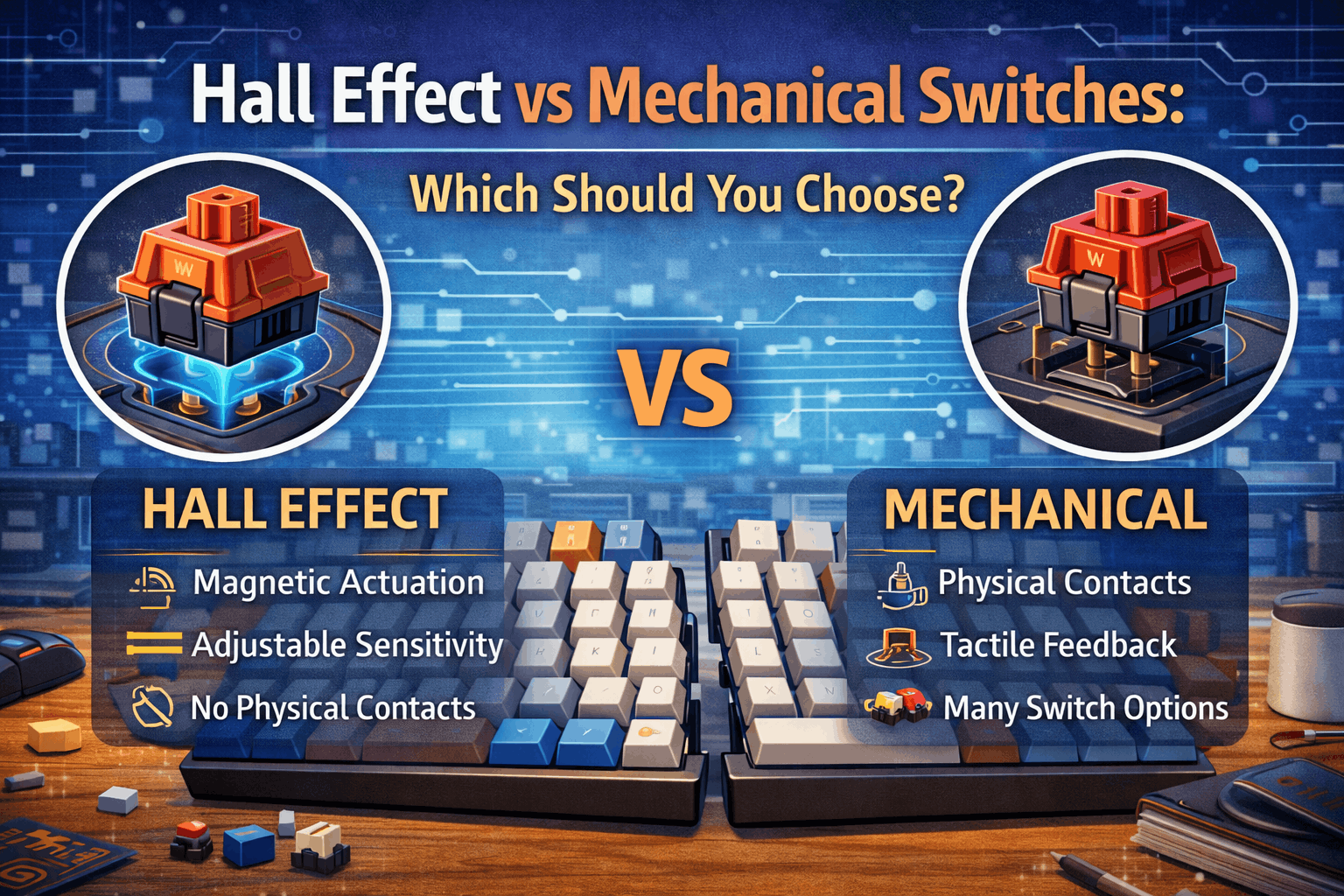
The core mechanism uses magnetic sensor (Hall Effect IC) mounted in PCB. A magnet attaches to the switch stem itself. Moving the stem changes magnetic field, which sensor detects instantly to measure position. This creates analog input knowing exact position from 0–100% throughout travel. No debouncing gets needed since contactless detection eliminates bounce. Combined with native N-key rollover and anti-ghosting, this makes Hall Effect particularly attractive for fast simultaneous inputs.
Physical design embeds magnet in stem while Hall Effect sensor mounts on keyboard PCB below. Standard MX-compatible design uses regular keycaps without modification. Implementation requires special PCB with Hall Effect compatibility built in.
Signal characteristics enable adjustable actuation point through software configuration from 0.1–4.0mm. Instant reset occurs with no minimum return distance needed. Position-aware sensing knows depth at all times throughout travel. No contact degradation occurs since magnetic field doesn't wear physically. Lifespan reaches 100+ million actuations with theoretical infinite durability.
Real-world lifespan shows no contact wear mechanism exists in design. Primary failure comes from PCB and electronics aging over time. Projected lifespan reaches 10–20+ years before degradation begins. Switch component itself theoretically lasts indefinitely since no wear occurs.
The critical difference: mechanical switches wear contacts requiring eventual replacement, while Hall Effect has no wear mechanism eliminating replacement need.
For deep technical explanation, see our Hall Effect keyboards explained guide for comprehensive details.
For a deeper technical breakdown of how this technology works in practice, see our Hall Effect keyboards explained.
Head-to-Head Comparison: Eight Critical Categories
1. Speed & Response Time
Mechanical switches deliver actuation latency from 1–5ms depending on switch quality. Debounce processing adds 1–4ms for signal filtering. Total response time typically ranges 2–9ms in practice. Fixed actuation point always triggers at roughly 2.0mm travel.
Hall Effect achieves actuation latency of just 0.2–0.5ms. Debounce processing isn't needed since contactless design eliminates bounce. Total response time stays at 0.2–0.5ms consistently. Adjustable actuation point enables software configuration from 0.1–4.0mm per individual key.
Raw difference shows Hall Effect responding 4–17ms faster than mechanical alternatives. For another non-traditional actuation technology often grouped in the same comparison, see our optical vs mechanical switches guide. Practical gaming impact requires context though. At 60 FPS, each frame takes 16.67ms to render. Hall Effect saves roughly 10–50% of frame time in theory. This difference proves meaningful for competitive FPS professionals in top 1–2% of players. For the remaining 95%+ of gamers, the advantage registers as negligible in actual gameplay.
Bottom line: Hall Effect runs faster objectively, but mechanical proves adequate for 99% of users in real-world scenarios.
2. Features & Customization
Mechanical switches offer extensive physical customization options. Hundreds of switch types exist for choosing. Tactile, linear, and clicky options all remain available. Spring weights span from 35g to 100g+ for different preferences. Housing materials vary including nylon, polycarbonate, and POM options. Sound tuning becomes possible via lubing, filming, and modding techniques.
Hardware flexibility extends further. Hot-swap boards enable easy switch testing without soldering. Easy switch replacement requires minimal tools. Keycap diversity spans Cherry, SA, DSA profiles and beyond. Software features remain limited though, with fixed actuation points and binary input only providing on or off states.
Hall Effect delivers different strengths through software customization. Adjustable actuation per key ranges 0.1–4.0mm. Rapid trigger enables instant reset without minimum travel. Analog input provides gradual keystroke information. Per-key customization becomes possible through firmware. Dynamic keystroke detection enables multiple actions per single press. Multi-tap detection adds advanced feature possibilities.
Physical variety suffers dramatically though. Mostly smooth linear feel represents only option. Very limited switch options exist compared to mechanical. Difficult switch changes occur since most implementations use soldered switches rather than hot-swap.
Winner depends entirely on priority. Mechanical excels at variety and physical options with hundreds of switches available. Hall Effect dominates software features and adjustable settings through advanced firmware.
3. Typing Experience
Mechanical switches provide extensive variety for typing preferences. For users who prefer smooth and consistent keystrokes, this variety becomes especially important—see our best linear switches guide for typing- and gaming-focused options. If you rely on physical feedback while typing, tactile switches offer a much richer experience than Hall Effect linears (see our best tactile switches guide). Tactile switches deliver satisfying bumps through models like Boba U4 and Holy Panda. Clicky switches serve feedback lovers seeking audible confirmation. Linear switches offer smooth feel for those preferring uninterrupted travel. Heavy and light weight options accommodate different hand sizes and typing styles. Sound customization extends deeply through material choices and modifications.
Maturity spans 40+ years of continuous refinement. Millions of user preferences get catered to through this variety. Community knowledge runs exceptionally deep with extensive documentation and shared experience.
Hall Effect limitation shows clearly: mostly smooth linear options exist with no true tactile or clicky alternatives available yet.
Hall Effect switches deliver consistency as primary advantage. Smooth and predictable feel remains constant across all keys. No surprise tactile bumps interrupt typing rhythm. Adjustability enables actuation point customization to optimize for personal preference and hand mechanics.
Character remains limited though. Mostly linear design equals less personality compared to mechanical variety. Softer landing feeling emerges from magnetic versus mechanical contact physics. Limited feedback options restrict typing satisfaction for those seeking tactile confirmation.
Sound variety suffers similarly. Quieter operation than most mechanical switches reduces acoustic feedback. Less "clack" satisfaction disappoints enthusiasts. Limited to smooth linear sound profile without variety.
Winner: Mechanical delivers superior typing experience and variety decisively. Best mechanical switches for typing include tactile options like Boba U4T and Holy Panda at $0.65–$0.80 per switch, clicky variants like Gateron Blue and Outemu Sky at $0.50–$0.70 per switch, and heavy linear choices like Cherry MX Black at $0.70 per switch.
4. Gaming Performance
Mechanical switches prove adequate for gaming across nearly all scenarios. Fast enough response for 99% of competitive players exists naturally. Light linear switches at 45–50g prove ideal for rapid tapping patterns. Proven performance extends across all competitive games over decades of use.
Limitations emerge in specific areas though. Fixed actuation point prevents optimization per different game. Reset delay requires returning to reset point before reactivation. Debounce lag accumulates across rapid keypresses.
Hall Effect provides competitive advantages that matter at highest levels. Rapid trigger enables 20–40% faster counter-strafing in FPS games. Instant reset eliminates return travel requirement completely. Adjustable actuation per game optimizes for CS2 versus Valorant versus Apex differences. Analog input supports racing games with continuous steering control. Pro player standard equipment in 2026 increasingly uses Hall Effect.
Esports adoption shows clear trends. Majority of professional players use Hall Effect for FPS competition. Standard equipment in tournament setups has shifted. Technology becomes requirement at top competitive level increasingly.
Winner: Hall Effect dominates competitive FPS advantage category clearly. Critical rank threshold determines when advantage matters practically. Below Diamond rank, mechanical remains adequate with Hall Effect proving overkill. Diamond rank sees Hall Effect providing measurable advantage. Master and Grandmaster ranks find Hall Effect near-mandatory. Professional level treats Hall Effect as industry standard equipment.
Gaming assessment breaks down by use case. Casual gaming finds mechanical perfect for needs. Mid-rank competitive play considers mechanical adequate. High-rank competitive benefits from Hall Effect recommendation. Professional esports treats Hall Effect as standard expectation.
See our Rapid Trigger keyboards explained for gaming-specific implementation details.
5. Durability & Longevity
Mechanical switches carry rated lifespan specifications of 50–100 million actuations depending on quality. Reality delivers 5–10 years under heavy use patterns. Degradation occurs through contact wear over extended time. Failure mechanism centers on contacts degrading progressively. Chattering develops where key registers multiple times per press. Eventually dead keys result from complete contact failure.
Advantage emerges in easy replacement options. Hot-swap boards enable simple switch swapping. Cost to fix problems ranges $20–60 for new switch set. Modular design enables testing different switches easily.
Hall Effect delivers rated lifespan specifications of 100+ million actuations. Theory suggests infinite lifespan since no wear mechanism exists. Reality projects 10–20+ years before electronics age significantly. Failure mechanism differs completely: no contact wear occurs by design. Failure comes from PCB and electronics aging over time. Magnet and sensor degradation proves unlikely in practice.
Disadvantage shows in replacement difficulty. Harder replacement process typically requires soldering to PCB. Entire keyboard replacement becomes necessary if PCB fails. Limited repair options exist compared to mechanical modularity.
Winner: Hall Effect achieves longer lifespan through elimination of contact wear mechanism. Real-world impact shows mechanical offering better repair and replacement ease. Hall Effect provides longer total lifespan if properly maintained throughout ownership.
6. Sound Profile
Mechanical switches provide huge variety in acoustic signatures. Linear switches span "clack" and "thock" spectrum widely. Tactile switches combine clack with tactile snap sound. Clicky switches add audible click plus clack for maximum feedback. Silent options become available through rubber dampeners for office use.
Customization extends deeply through material choices. Housing material dramatically changes sound character. Lubing modifies acoustics significantly. Keycap material proves critical with PBT versus ABS creating different tones. Modding community offers extensive sound tuning knowledge.
Character diversity enables personal preference satisfaction. Diverse sound signatures accommodate different tastes. Personal enjoyment from acoustic feedback drives many purchases.
Hall Effect delivers consistent and predictable sound. Smooth sound signature remains professional and office-appropriate. Limited variety restricts acoustic options though. Mostly linear smooth sound lacks personality and character. Quieter operation than average mechanical reduces acoustic feedback. Customization options for sound profiles remain severely limited. Can't choose tactile or clicky alternatives for different sound.
For office or shared environments where noise is a real concern, mechanical keyboards paired with silent switches are often a better solution.
Winner: Mechanical provides more sound options and customization possibilities decisively.
7. Price & Value
Mechanical keyboards in 2026 span wide price ranges. Budget tier runs $50–80 for options like Keychron C, RK87, and Epomaker models. Mid-range pricing reaches $100–150 for Keychron Q and GMMK 2 quality. Premium custom builds extend $200–400 for Mode, Think6.5, and Sat75 level quality.
Hall Effect keyboards command premium pricing universally. Entry level starts $150–180 for DrunkDeer A75 and budget brands. Mid-range pricing hits $200–250 for Wooting 60HE+ and Razer Huntsman V3. Premium options reach $300–400 for Corsair, SteelSeries, and high-end brands.
Cost comparison shows dramatic differences. Minimum entry: mechanical starts $50 while Hall Effect begins $150, representing 3x more cost. Mid-range: mechanical averages $120 compared to Hall Effect's $220, showing 1.8x more expense. Premium: mechanical costs $300 versus Hall Effect's $350, narrowing to 1.2x difference.
Five-year total cost of ownership reveals interesting patterns. Mechanical keyboard investment includes initial keyboard at $100, potential switch replacement at $30 if needed, optional keycap upgrades at $50, totaling $130–180 over five years. Hall Effect investment starts with initial keyboard at $220, zero switch replacement cost since not needed, optional keycap upgrades at $50, totaling $220–270 over five years.
Value assessment shows clear patterns. Mechanical advantages include 50–70% lower entry cost, modular replacements costing less, easier resale if preferences change, and better value at all price points objectively. Hall Effect advantages include no replacement switch costs long-term, better durability justifying premium over time, and cost amortized effectively over 5–10 years ownership.
Winner: Mechanical provides better value for budget-conscious buyers clearly. Break-even analysis shows Hall Effect worth premium only if planning 8–10+ year lifespan. Mechanical proves better if budget limited or uncertain about long-term preferences. Hall Effect justifies premium only if competitive gaming benefits truly matter to usage.
8. Comprehensive Comparison Table
| Feature | Mechanical | Hall Effect | Winner |
|---|---|---|---|
| Actuation Speed | 1–5ms | 0.2–0.5ms | Hall Effect |
| Adjustable Actuation | ❌ Fixed | ✅ 0.1–4.0mm | Hall Effect |
| Rapid Trigger | ❌ No | ✅ Yes | Hall Effect |
| Switch Variety | ✅ 500+ options | ⚠️ 5–10 options | Mechanical |
| Tactile Options | ✅ Yes | ❌ No | Mechanical |
| Clicky Options | ✅ Yes | ❌ No | Mechanical |
| Sound Customization | ✅ Extensive | ⚠️ Limited | Mechanical |
| Rated Durability | 50–100M | 100M+ | Hall Effect |
| Real-world Lifespan | 5–10 years | 10–20+ years | Hall Effect |
| Contact Wear | ✅ Exists | ❌ None | Hall Effect |
| Replacement Cost | $20–60 | Entire keyboard | Mechanical |
| Gaming (Competitive) | Adequate | ✅ Advantage | Hall Effect |
| Gaming (Casual) | ✅ Excellent | Overkill | Mechanical |
| Typing Experience | ✅ Superior | Good | Mechanical |
| Price (Budget) | $50–80 | $150–180 | Mechanical |
| Price (Premium) | $200–300 | $300–350 | Mechanical |
| Hot-swap Available | ✅ Common | ⚠️ Rare | Mechanical |
| Physical Customization | ✅ Extensive | ⚠️ Limited | Mechanical |
| Software Features | ⚠️ None | ✅ Advanced | Hall Effect |
| Market Maturity | ✅ 40+ years | 5–8 years | Mechanical |
| Availability | ✅ Everywhere | Growing | Mechanical |
Tally by category reveals Hall Effect wins 4 categories covering speed, adjustment capability, rapid trigger, and durability. Mechanical wins 13 categories spanning variety, typing quality, sound options, price competitiveness, and customization depth. Three categories result in ties.
Analytical conclusion shows Hall Effect delivering specialized advantage for competitive gaming and durability scenarios. Mechanical provides general-purpose superiority across variety, value, and typing applications.
Who Should Choose Hall Effect?
Competitive FPS players form the primary target audience with minimum rank thresholds determining benefit. CS2 players need Global Elite or Faceit Level 8+ rank. Valorant requires Immortal+ representing top 1% of players. Apex Legends demands Master+ rank at top 0.5% skill level. Overwatch needs Top 500 professional level performance.
Why Hall Effect matters at these levels: rapid trigger enables 20–40% faster counter-strafing execution. Every millisecond affects positioning outcomes in high-level play. Industry standard among professional players has shifted to Hall Effect. Competitive tournament equipment increasingly expects this technology.
Below these rank thresholds, mechanical switches remain perfectly adequate. Skill gaps far exceed equipment gaps at lower ranks. Hall Effect won't improve rank significantly without underlying skill development.
Best Hall Effect keyboards for FPS include Wooting 60HE+ at $200 for best software and most refined experience, Razer Huntsman V3 Pro at $250 for mainstream reliability, and DrunkDeer A75 at $180 representing best value proposition.
Rhythm game players benefit measurably in games like osu! at 4–5 star+ beatmaps, Beat Saber expert+ custom songs, Friday Night Funkin' expert modes, and Stepmania/ITG competitive play. Hall Effect helps through instant key reset improving rapid tapping patterns, reduced reset delay on stream patterns, higher BPM achievable with confidence, and competitive leaderboard advantage.
Pro gamers and esports players find Hall Effect essential as professional requirement. Tournament standard equipment expectations exist. Sponsor partnerships align with major brands. Content credibility matters for streamers. Team expectations increasingly demand Hall Effect.
Enthusiasts and early adopters wanting cutting-edge technology appreciate Hall Effect when budget isn't primary concern. These users enjoy advanced software customization, value innovation and future-proofing, and prioritize technology leadership.
Future-proofing investment makes sense for those planning 5–10 year keyboard use. Superior durability justifies premium pricing over time. No switch replacement costs accumulate. Technology continues improving. Hall Effect becomes market standard increasingly.
Who Should Choose Mechanical?
Typing-focused users prioritizing writing, programming, and content creation find mechanical superior. Tactile and clicky switches deliver better typing-specific designs. Hundreds of switch options accommodate personal preference. Sound customization enables satisfaction through acoustic feedback.
Best mechanical switches for typing include tactile options like Boba U4T and Holy Panda at $0.65–$0.80 per switch, clicky variants like Gateron Blue and Outemu Sky at $0.50–$0.70 per switch, and heavy choices like Cherry MX Black at $0.70 per switch.
Budget-conscious buyers in the $50–120 budget range benefit from mechanical's lower entry cost. Hall Effect minimum starts at $150 making it inaccessible. Excellent mechanical options exist at $80–120 price points. Better value proposition exists across the board. Money saved can upgrade monitor or mouse instead.
Best budget mechanical keyboards include Keychron C series at $60–80, RK84/87 at $50–70, and GMMK 2 at $120 for quality hot-swap experience.
Casual and mid-rank gamers at Gold or Platinum competitive rank playing for enjoyment rather than profession benefit from mechanical adequacy. Performance difference proves unnoticeable at these skill levels. Skill development matters infinitely more than equipment. Better investment opportunities exist in GPU or monitor upgrades. Mechanical keyboards prove perfectly adequate for these scenarios.
Recommendation: keep mechanical keyboard and spend price difference on monitor upgrade for actual performance improvement.
Office and general use requiring all-around versatility benefits from mechanical advantages. Silent switches become available for quiet operation. Better typing experience emerges naturally. Tactile feedback options improve comfort. No wasted gaming features reduce complexity.
Best mechanical keyboards for office include Keychron silent switches, RK Royal Kludge silent options, and dedicated mechanical silent switches for professional environments.
Modding and customization enthusiasts enjoying switch swapping, lubing, and physical modifications find mechanical perfect. Hot-swap boards exist abundantly. Over 500 switch options enable endless experimentation. Lubing and modding community provides extensive knowledge. Keycap variety reaches extreme levels. Customization hobby enables continuous testing and refinement.
Best keyboards for modders include GMMK 2 Pro for hot-swap and extensive customization, Keychron C2 for affordable hot-swap modificability, and custom build kits providing ultimate flexibility.
First mechanical keyboard purchases should start with mechanical technology. Lower financial commitment at $80 versus $200 reduces risk. Learning preferences becomes risk-free at lower cost. Easy upgrade path to Hall Effect exists later if desired. Hot-swap boards enable switch experimentation. Understanding whether Hall Effect benefit justifies premium requires baseline experience.
Common Misconceptions Debunked
Myth: "Hall Effect makes you better at gaming instantly." Reality shows Hall Effect raises skill ceiling but doesn't boost current skill level. Technology requires 2–4 weeks adaptation and training before benefits emerge. Only helps if you're already skilled at Diamond+ rank minimum. Skill always exceeds equipment importance. Many Immortal rank players successfully use mechanical keyboards.
Truth: Hall Effect acts as multiplier for existing skill, not booster for developing skill fundamentally.
Myth: "Mechanical switches are obsolete." Reality demonstrates mechanical switches still dominate the market in 2026. Superior performance for typing applications exists clearly. Better value for most users persists. Massive ecosystem support continues growing. Different purpose than Hall Effect makes it complement not replacement.
Truth: both technologies have permanent places in market for different use cases long-term.
Myth: "Hall Effect keyboards are silent." Reality reveals Hall Effect switches still produce audible sound. Slightly quieter than mechanical due to no contact noise, but not truly "silent" without dampeners. Sound comes from keycaps and housing, not actuation method itself.
Truth: Hall Effect can be quieter but not silent without additional dampening modifications.
Myth: "All Hall Effect keyboards feel the same." Reality shows different switch implementations vary significantly. Wooting versus DrunkDeer versus Razer sound distinctly different. Build quality significantly affects feel across models. Software customization creates variety through settings. Premium Hall Effect feels substantially better than budget alternatives.
Truth: Hall Effect variety increases as market grows and matures.
Myth: "You need Hall Effect for gaming." Reality indicates mechanical proves adequate for 95% of gamers. Hall Effect advantage only matters at Diamond+ competitive level. Professional players successfully use both technologies. Personal preference matters more than technology choice. Skill development and aim training delivers more value than equipment upgrades.
Truth: Hall Effect helps professional players; proves overkill for casual and mid-rank players.
Myth: "Hall Effect will replace mechanical." Reality shows mechanical too entrenched to disappear. Different use cases for typing, variety, and value persist. Price gap won't fully close over time. Enthusiast community proves too large to abandon. Both technologies will coexist permanently in market.
Truth: market will support both technologies indefinitely into future.
Future of Both Technologies
Hall Effect trajectory from 2026–2030 shows current state in 2026 with major brands adopted including Razer, Corsair, SteelSeries, and Wooting. Prices slowly decrease annually. Technology becomes standard for $200+ gaming keyboards. Esports equipment standard shifts to Hall Effect.
Future prediction from 2027–2030 suggests prices approaching mechanical parity at $100–150 entry points. More switch variety emerges with tactile Hall Effect becoming possible. Mainstream adoption for gaming completes. Office keyboard adoption becomes likely. Wireless Hall Effect becomes common standard.
Long-term outlook shows Hall Effect becoming default for competitive gaming. Prices stabilize 20–30% above mechanical long-term. Feature parity with mechanical gets achieved eventually. Market share reaches 30–40% of total keyboard market.
Mechanical switch evolution from 2026–2030 shows current state as mature and stable technology. Innovation continues in materials and sound quality. Pre-lubed switches improve stock feel quality. Silent switches continue improving.
Future prediction from 2027–2030 indicates continued switch variety expansion. Better stock smoothness becomes standard expectation. Modding community flourishes with knowledge sharing. Accessibility improves for newcomers entering hobby. Price stability maintains across market.
Long-term outlook shows mechanical remaining dominant at 60–70% market share. Typing, budget, and enthusiast markets remain stronghold. Continued innovation in feel and sound persists. Thriving community support continues long-term.
Will mechanical disappear? Short answer: absolutely not. Long-term coexistence seems certain with Hall Effect capturing 25–35% market share by 2030 while mechanical maintains 65–75%. Gaming focus splits with Hall Effect dominating pro level while mechanical serves casual and variety needs. Typing focus remains mechanical's optimized domain. Value advantage stays with mechanical for budget conscious. Customization divides between software for Hall Effect and physical for mechanical. Lifespan shows Hall Effect's theoretical infinite versus mechanical's practical 10 years.
Verdict: both technologies have permanent places in market for different user segments and distinct use cases.
FAQ: Common Questions
Is Hall Effect worth 2–3 times the price of mechanical?
Only if you're competitive FPS player at Diamond+ rank or plan 8–10 year lifespan where durability justifies premium pricing. For typing focus, casual gaming, or budget builds, mechanical keyboards offer significantly better value proposition. Rapid trigger advantage proves meaningful only at professional competitive levels where milliseconds determine outcomes.
Can I get tactile or clicky Hall Effect switches?
Not in 2026. Hall Effect switches remain almost exclusively smooth linear in feel. If you want tactile bumps or clicky audible feedback, mechanical switches remain the only viable option currently. See our tactile switch guide for comprehensive options.
Do Hall Effect keyboards last longer than mechanical?
Absolutely yes. Hall Effect has zero contact wear mechanism with 100M+ actuations rated, theoretically infinite lifespan. Mechanical switches rated 50–100M actuations translating to 5–10 years realistic use. However, mechanical switches prove easier and cheaper to replace individually when eventual failure occurs.
Should I upgrade from mechanical to Hall Effect?
Only if three conditions met: you're Diamond+ competitive FPS player, your mechanical keyboard needs replacement anyway, or you're enthusiast wanting latest technology. Otherwise, keep your current mechanical keyboard and invest money in skill training instead for better results. See our Rapid Trigger guide for detailed analysis.
Are Hall Effect keyboards better for typing?
No, definitely not. Mechanical keyboards offer superior typing experience due to extensive tactile and clicky switch options available. Hall Effect switches remain mostly smooth linear with limited "character" or personality. Choose mechanical for typing as primary use case without question.
Conclusion: Choose Based on Your Priority
Neither technology achieves universal "better" status. Both excel in different contexts and scenarios. Your choice depends on honest assessment of your actual needs and priorities.
Choose Hall Effect if competitive FPS gaming at Diamond+ rank forms primary use, playing 20+ hours per week consistently, latest technology represents priority, durability and longevity investment matters, and $200+ budget exists available — see our best analog & Hall Effect gaming keyboards for the top picks.
Choose mechanical if typing forms primary use case, budget-conscious approach at $50–150 range, customization and variety prove important, casual gaming at any rank level, or purchasing first mechanical keyboard without experience.
Hall Effect advantages include 20–40% faster counter-strafing for competitive play, adjustable per-key features through software, theoretically infinite lifespan eliminating replacement, and emerging technology advantage for early adopters.
Mechanical advantages include 500+ switch varieties accommodating preferences, tactile and clicky options unavailable elsewhere, superior typing experience through feedback, better value at all price points objectively, and massive community support providing knowledge.
The honest truth: speed difference of 1–8ms only matters at professional competitive level. Hall Effect isn't "better" universally, just different for specific use. Mechanical isn't "outdated" technology, just different purpose and audience. Both technologies excel for their respective niches and markets.
Choose based on YOUR priority—not hype or trends driving purchases. If you type more than game, mechanical proves perfect choice. If you're competitive FPS player, Hall Effect becomes justified investment. If you're casual gamer? Mechanical offers better value without question. No shame exists in either choice when properly matched to needs.
Learn more about your choice through Hall Effect keyboards explained for deep technical dive, best mechanical switches for finding your perfect switch, and Rapid Trigger guide for competitive gaming features.
Ready to choose? Consider your use case, budget, and priorities carefully before purchasing. Both technologies will serve you well within their optimal contexts and applications.