Introduction
Gaming keyboards dominate mechanical keyboard marketing with promises of competitive advantages, faster response times, and enhanced performance. RGB lighting blazes across product pages. Marketing emphasizes millisecond latencies and specialized features. The implicit promise is clear: better keyboard equals better gaming performance.
The reality is more nuanced. Mechanical keyboards provide genuine benefits for gaming—faster actuation than membrane keyboards, more consistent key feel, better durability under intense use, and features like n-key rollover that matter for complex inputs. These benefits are real and measurable. But mechanical keyboards don't magically improve aim, reaction time, or game sense. Professional players perform excellently on various keyboard types. The keyboard matters, but skill, practice, and game knowledge matter far more. A mediocre player on a premium keyboard still loses to skilled players on budget boards.
What gaming keyboards do provide is consistent, reliable performance that doesn't hinder you, comfortable feel during extended gaming sessions, durability to withstand millions of rapid keystrokes, and features that eliminate technical limitations as performance factors. They remove keyboard as potential bottleneck without creating competitive advantages from equipment alone.
Understanding what actually matters for gaming helps you choose keyboards that enhance your experience without overpaying for marketing hype or features that don't affect performance. This guide separates genuine performance factors from marketing noise, helping you make informed decisions about gaming keyboard choices.
We'll cover performance factors that actually matter, optimal switch selection for different game types, keyboard size considerations for gaming ergonomics, essential versus nice-to-have features, wireless versus wired for competitive gaming, top gaming keyboard recommendations across budgets and game types, and gaming myths that need debunking. By the end, you'll understand what genuinely affects gaming performance and what's marketing superlative.
Note: This guide contains affiliate links. If you purchase through our links, we may earn a commission at no extra cost to you. This helps support our in-depth testing and content creation.
Performance Factors That Actually Matter
Understanding which performance aspects affect gaming helps you prioritize features appropriately and avoid overpaying for irrelevant specifications.
Latency and Response Time
Latency and response time represent delay between pressing a key and the computer registering that input. Lower latency theoretically provides faster response.
The critical reality check: modern keyboards (gaming or otherwise) have latency of 1-10 milliseconds. Human reaction time averages 200-250 milliseconds. Even significant keyboard latency differences (5ms vs 1ms) are imperceptible within the context of total system latency and human limitations. Your brain's processing time dwarfs any keyboard latency differences.
When latency matters: competitive gaming at the highest levels where every millisecond counts might provide theoretical advantage. For 99% of gamers, latency differences between quality keyboards are completely irrelevant.
What to look for: any modern mechanical keyboard with USB connection provides adequate latency. Don't obsess over 1ms marketing claims—any modern gaming keyboard achieves this.
Polling Rate
Polling rate determines how frequently the keyboard reports its state to the computer. Higher rates (1000Hz) check more frequently than lower rates (125Hz).
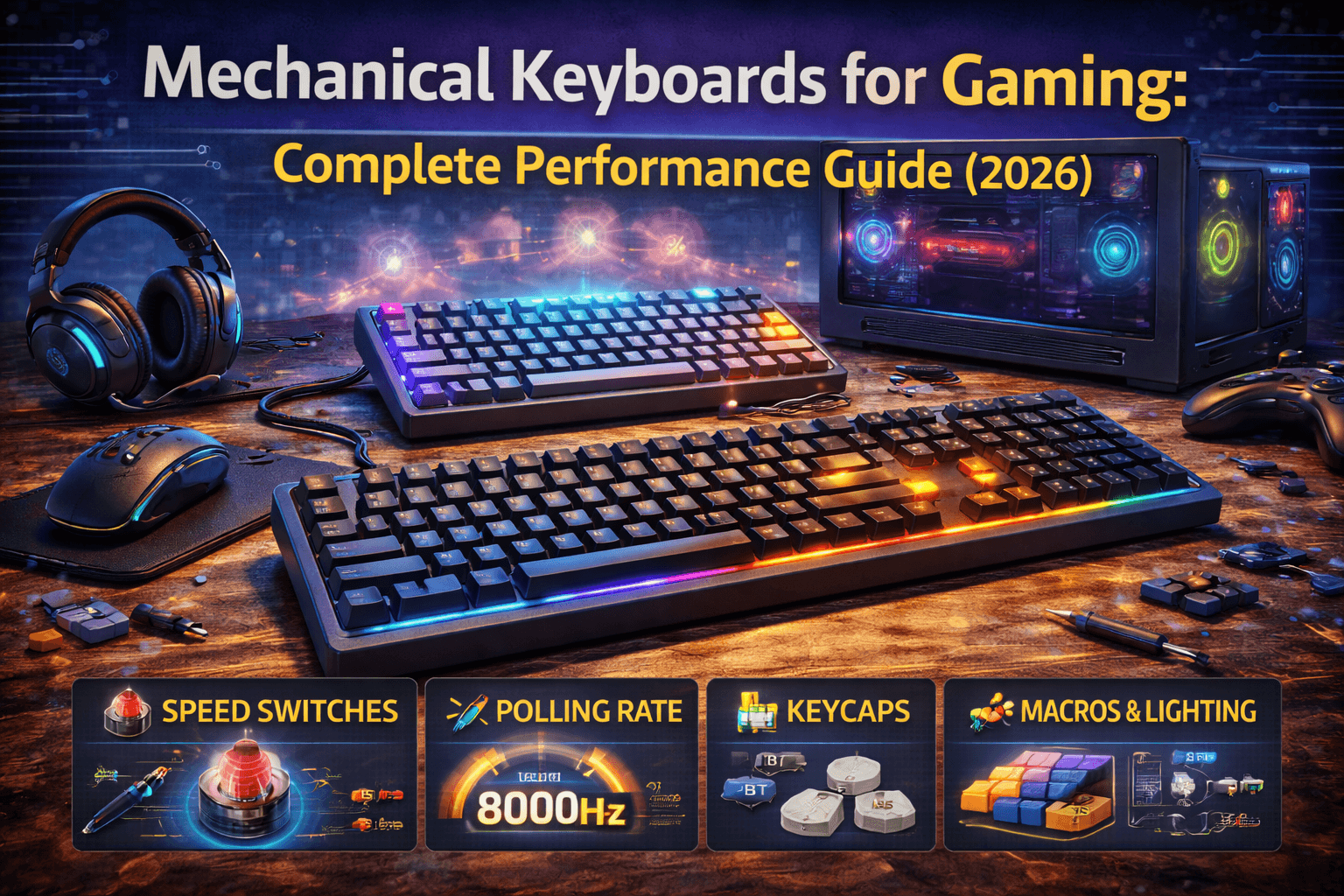
The reality check: 1000Hz (1ms intervals) is standard for gaming keyboards and is adequate for all gaming scenarios. Higher rates (2000Hz, 4000Hz, 8000Hz) exist but provide no perceptible benefit whatsoever. The bottleneck is human reaction time, not polling rate. Professional esports players use 1000Hz keyboards successfully in tournaments.
When polling rate matters: 1000Hz is fine for everyone including professional players competing in esports. Higher rates are marketing rather than meaningful performance improvements.
What to look for: verify your keyboard supports 1000Hz polling (standard on gaming keyboards). Don't pay premium prices for higher rates—the difference is imperceptible.
N-Key Rollover (NKRO)
N-key rollover (NKRO) allows keyboards to register unlimited simultaneous key presses without ghosting or missed inputs. This is essential for gaming where multiple keys are often pressed together during complex inputs.
The reality check: gaming requires maybe 5-10 simultaneous key presses maximum (WASD plus modifiers plus ability keys). Full NKRO is overkill, but minimum 6-key rollover is essential for preventing missed inputs.
When NKRO matters: it's always important for gaming—it prevents ghosting or missed inputs during complex key combinations that are common in virtually every game type.
What to look for: NKRO or minimum 6-key rollover specification. This is standard on mechanical keyboards but verify before purchase.
Anti-Ghosting
Anti-ghosting prevents phantom key presses when certain key combinations are pressed simultaneously. This relates directly to NKRO implementation and proper circuit design.
The reality check: properly implemented NKRO includes anti-ghosting as inherent function. Separate "anti-ghosting" marketing claims are often redundant with NKRO.
What to look for: NKRO specification covers this—don't evaluate anti-ghosting separately from rollover.
Switch Actuation Force and Travel Distance
Switch actuation force and travel distance determine how much pressure and distance is required for switches to register key presses. Lighter switches (45g) actuate with less pressure than heavier switches (60-67g). Shorter actuation distances theoretically provide marginally faster response.
The reality check: actuation force affects typing feel and fatigue more than raw speed. Personal preference matters more than theoretically optimal specifications. Some people perform better with heavier switches providing better control and reduced accidental presses. Incredibly fast professional gamers use switches across a range of weights.
When switch weight matters: personal preference and comfort during extended sessions matter far more than theoretical speed advantages.
What to look for: choose switch weight based on your preference and testing. Most gamers prefer light-to-medium weight (45-55g), but individual variation is huge. See our keyboard switches guide for complete switch information.
Build Quality and Mechanical Consistency
Build quality and mechanical consistency ensure the keyboard maintains consistent switch feel, reliable key registration, and stable construction during intense gaming sessions. This matters more practically than latency or polling rate specifications.
Quality keyboards maintain:
- Consistent actuation across all switches
- Reliable registration of every key press
- Stable typing platform without flex or wobble
Poor quality results in:
- Inconsistent switches feeling different from each other
- Some keys registering unreliably
- Wobbly construction affecting aiming and typing
What to look for: metal construction in case, quality switches from established manufacturers, good stabilizers under large keys, stable typing platform without flex.
What Doesn't Actually Matter for Gaming
- Latency differences under 10ms are imperceptible
- Polling rates above 1000Hz provide zero perceptible benefit
- Specialized "gaming switches" marketing is often misleading—quality switches from any manufacturer work fine
- Excessive RGB lighting has zero performance impact (purely aesthetic)
- Brand-specific claims about competitive advantages are marketing superlatives
Focus on fundamentals—quality construction, good switches, proper features. Ignore marketing hyperbole about revolutionary performance improvements.
Switch Selection for Gaming
Switch choice significantly affects gaming experience and comfort. Understanding options helps you choose appropriately for your playstyle and preferences.
Linear Switches
Linear switches move smoothly from top to bottom without tactile bumps or clicks. They're overwhelmingly the most popular choice among gaming professionals and serious gamers.
Why gamers prefer linear switches:
- Fast, uninterrupted key presses for rapid inputs
- Consistent force throughout the travel enabling predictable timing
- No bump to interrupt rapid double-taps or repeated presses
- Smooth feeling reduces finger fatigue during extended sessions
Popular linear gaming switches:
- Cherry MX Red (45g): industry standard light linear
- Cherry MX Black (60g): heavier control
- Gateron Yellow (50g): budget-friendly excellent value
- Gateron Ink Black (60g): premium smooth alternative
Switch weight choices:
- Light (45-50g): faster actuation, less fatigue, easier to accidentally press
- Medium (55-62g): balance of control and speed, widely preferred
- Heavy (65g+): maximum control, prevents accidents, can cause fatigue
Recommendation: start with medium weight (50-60g) linear switches like Cherry MX Red or Gateron Yellow. These provide excellent balance most gamers prefer.
Tactile Switches
Tactile switches have noticeable bump at the actuation point, providing feedback without audible click. Less popular for gaming than linear but viable for many gamers.
Why some gamers choose tactile:
- Bump provides confirmation of actuation without looking at keyboard
- Tactile feedback prevents accidental presses better than light linear
- Personal preference—some people simply game better with tactile feel they prefer
Gaming-suitable tactile switches:
- Cherry MX Brown (45g): light tactile, good compromise
- Gateron Brown (45g): similar to Cherry but smoother
- Boba U4T (62g): premium tactile with strong bump
When tactile works: games requiring precise, deliberate inputs rather than rapid tapping—strategy games, MMOs, some MOBAs.
When tactile doesn't work: fast-paced FPS games, fighting games, rhythm games requiring rapid repeated presses.
See our best tactile switches guide for detailed recommendations.
Clicky Switches
Clicky switches combine tactile bump with loud audible click. They're almost universally disliked for gaming.
Why gamers avoid clicky:
- Loud noise annoying to you and others nearby
- Tactile bump interrupts rapid presses
- Heavier actuation than most gaming switches
- No performance benefits over linear
The exception: single-player gaming where noise doesn't matter and you love clicky feel—even then, linear or tactile usually works better.
Silent Switches
Silent switches use rubber dampening to reduce noise substantially while maintaining mechanical switch benefits. Available in both linear and tactile variants.
Silent switches provide gaming performance identical to standard switches with slightly mushier bottom-out feel.
Choose silent switches for:
- Gaming in shared living spaces
- Late-night gaming where noise matters
- Noise-sensitive environments
- Streaming setups where you don't want keyboard noise
Options: Cherry MX Silent Red (linear), Boba U4 Silent (tactile).
Optical Switches
Optical switches use light rather than metal contacts for actuation detection. They're marketed as faster and more durable than mechanical switches.
The reality check: latency advantage is imperceptible in gaming contexts. Durability advantage is theoretical—quality mechanical switches last decades anyway without issues.
Consider optical switches if: you want to try different technology or find a keyboard you love that happens to use optical switches. Don't buy specifically for supposed performance advantages.
Switch Recommendation by Game Type
- FPS games (Counter-Strike, Valorant, Apex): light linear (Cherry MX Red, Gateron Yellow)
- MOBA games (League, Dota): light-to-medium linear or light tactile
- MMO games (WoW, FFXIV): tactile or linear based on personal preference
- Fighting games: medium-heavy linear for control (MX Black, 60-65g linears)
- Strategy and RTS games: tactile or linear based on preference
The honest truth: switch preference is highly personal. Test different switches before committing if possible. Gaming performance differences between quality switches are minimal—comfort and personal preference matter more than theoretical optimization.
Keyboard Size for Gaming
Keyboard size dramatically affects gaming ergonomics and desk space allocation. Understanding trade-offs helps you choose appropriately for your setup.
Full-Size Keyboards (100%)
Full-size keyboards include number pads and measure 17-18 inches wide. They generally create problems for gaming:
- Width pushes mouse far to the right requiring extended arm reach
- Poor ergonomics for low mouse sensitivity common in FPS
- Excessive desk space consumption
- Awkward shoulder/arm positioning
Full-size works for gaming only if: you need number pad for non-gaming work, have enormous desk, or play games not requiring mouse control.
Recommendation: avoid full-size as your primary gaming keyboard.
TKL/Tenkeyless Keyboards (80%)
TKL removes the number pad while keeping everything else, measuring about 14 inches wide. This is the most popular gaming size with huge advantages:
- Saves significant space for mouse movement
- Improves arm positioning and ergonomics substantially
- Retains all keys needed for gaming
- Professional gamers' most popular size
TKL disadvantages for gaming: none significant.
Best for: FPS gamers, anyone with normal desk space, balanced functionality needs.
Recommendation: TKL is excellent gaming size and safe choice for most gamers. See our TKL keyboard guide for recommendations.
75% Keyboards
75% keyboards remove number pad and compress the navigation cluster, making them slightly shorter than TKL.
Gaming advantages:
- Even more mouse space than TKL
- Retains arrow keys and function row
- Compact desk footprint
Gaming disadvantages: compressed layout requiring slight adaptation.
Best for: gamers wanting maximum mouse space while keeping frequently-used keys.
Recommendation: great for FPS and competitive gaming requiring mouse space. See our 75% keyboard guide for options.
65% Keyboards
65% keyboards remove the function row while keeping arrows and few navigation keys.
Gaming advantages:
- Very compact layout
- Maximum mouse space
- Critical arrow key retention
Gaming disadvantages: missing function row requires layer access for F-keys (used in many games).
Best for: gamers comfortable with layers, extreme minimalists.
Recommendation: works for gaming but requires adaptation—ensure your game functions don't rely heavily on F-keys. See our 65% keyboard guide for details.
60% Keyboards
60% keyboards remove function row, arrows, and navigation cluster entirely, keeping only the alphanumeric section.
Gaming problems:
- Missing arrows in many games
- F-keys require layers (annoying for game functions)
- Very small layout requiring significant adaptation
60% works for: very specific use cases where gamers exclusively play games not requiring arrows or F-keys.
Recommendation: generally too compromised for gaming—avoid unless you have specific reasons. See our 60% keyboard guide if interested.
Size Recommendations by Game Type
- FPS and competitive gaming: TKL or 75% (mouse space is crucial)
- MOBA games: TKL or 75% (balanced functionality)
- MMO games: TKL or full-size (many keybinds, might need number pad)
- Strategy games: TKL or 75% (balanced)
- General gaming default: TKL provides best balance
The clear winner for most gamers: TKL (80%) provides optimal balance of space savings and functionality retention.
Essential vs Nice-to-Have Features
Understanding which features genuinely matter helps you prioritize budget and avoid paying for unnecessary extras.
Essential Features
These truly affect gaming performance or usability:
N-key rollover/NKRO: absolutely essential—prevents missed inputs during complex key combinations. Standard on mechanical keyboards but always verify.
Detachable cable: highly recommended. Makes keyboards easier to transport and cables easier to replace when damaged. Increasingly standard.
Standard layout keys: ensures common gaming keys (WASD, shift, control, space) are standard sizes allowing keycap replacement options.
Solid construction: keyboards shouldn't flex or wobble during use. Metal construction preferred.
Quality switches: Cherry MX, Gateron, or equivalent. Avoid no-name switch clones that perform inconsistently.
Nice-to-Have Features
These enhance experience without affecting core gaming performance:
RGB lighting: customizable backlighting with zero performance impact. Pure aesthetic preference. Don't pay premium for RGB you won't use, but worth having if you enjoy it.
Programmable keys and macros: custom key functions and macros. Useful for MMOs and some games, unnecessary for most FPS and competitive gaming.
Dedicated media keys: convenient volume and play/pause control. Not essential.
Wrist rest: padding for wrist support. Ergonomic benefit for some people—try without first.
Onboard memory: saves settings to keyboard rather than software. Useful for tournament players or multi-PC setups, unnecessary for single PC gaming.
Hot-swappable switches: lets you change switches without soldering. Very useful for trying different switches and increasingly common. See our hot-swap keyboards guide for options.
USB passthrough: extra USB port on keyboard for mouse or devices. Minor convenience.
Features to Skip
"Gaming-specific" switches: marketing term—quality linear switches work for gaming regardless of branding.
Advanced polling rates (2000Hz, 4000Hz, 8000Hz): no perceptible benefit. Pure marketing gimmick.
Dedicated gaming modes: (like disabling Windows key) convenient but easily replaced by simple software toggles.
Screen/display on keyboards: showing stats is gimmick providing no value.
Extreme RGB zones (50+ vs 20 zones): no practical difference. Don't pay premium.
Feature Priority Framework
- Essential: NKRO, quality switches, solid construction
- Highly recommended: detachable cable, hot-swap switches
- Personal preference: RGB, programmability, media keys
- Skip: polling rate above 1000Hz, gaming mode, excessive RGB zones
Wireless vs Wired for Gaming
Wireless keyboards have improved dramatically in recent years. Understanding current state helps you make informed decisions.
Wired Keyboards
Advantages:
- Zero latency concerns (wired is inherently fast)
- No battery management
- Slightly less cost than wireless equivalents
- Tournament standard (many tournaments require wired)
- No connection dropouts
Disadvantages:
- Cable clutter on desk
- Less flexible positioning
- Potential cable catching on mouse during gaming
Recommendation: wired is safe choice for competitive gaming if tournaments matter or you want zero latency concerns.
Wireless Keyboards (2.4GHz)
Wireless keyboards using 2.4GHz employ wireless dongles providing 1ms latency—functionally identical to wired connections.
Advantages:
- Clean desk aesthetics
- Flexible positioning without cable constraints
- No cable catching mouse during gaming
- Matches wired latency when implemented properly
Disadvantages:
- Battery management (charging every few days to weeks)
- Slightly higher cost
- Potential interference (rare with quality keyboards)
- Not tournament standard
The critical reality check: quality wireless gaming keyboards (Logitech G915, Keychron K Pro series, Razer wireless offerings) perform identically to wired keyboards for all practical gaming purposes. If you're deciding between Corsair, Razer, and Logitech specifically, our full brand comparison covers which wins for different budgets and use cases. Latency differences are imperceptible. Professional gamers successfully use wireless keyboards in home gaming environments.
Bluetooth Keyboards
Bluetooth uses Bluetooth protocol with higher latency than 2.4GHz wireless. Generally avoid for competitive gaming.
Bluetooth acceptable for: single-player, casual gaming, non-competitive scenarios.
Avoid Bluetooth for: competitive multiplayer, FPS games, fighting games, any latency-sensitive gaming.
Recommendations by Use Case
- Competitive and tournament gaming: wired (tournaments often require it, zero latency concerns)
- Home competitive gaming: quality 2.4GHz wireless works perfectly (Logitech, Razer, Keychron wireless)
- Casual gaming: either choice based on desk aesthetic preferences
- Mixed use (gaming plus work): wireless benefits desk flexibility and aesthetics
The verdict: wired remains safest choice for maximum competitive performance and tournament compatibility. But quality 2.4GHz wireless keyboards perform functionally identically for home gaming, making wireless viable for gamers who prioritize desk aesthetics.
Top Gaming Keyboards by Category
Concrete recommendations balance quality, features, performance, and value across different gaming scenarios and budgets.
Best Overall Gaming Keyboard: Wooting 60HE ($175)
Features analog switches with adjustable actuation points and rapid trigger mode. This represents genuine competitive advantage from analog inputs unlike most "gaming features" marketing.
Why it wins: analog technology provides actual measurable performance benefits, rapid trigger mode reacts faster than standard keyboards, complete customization of actuation and release points.
Best for: competitive FPS gamers, enthusiasts wanting cutting-edge technology, people who value every possible advantage.
Drawback: 60% layout lacks arrows and function row, requiring adaptation.
Best Mainstream Gaming: Logitech G Pro X ($150)
TKL layout, swappable switches, proven tournament keyboard, excellent build quality.
Why it's great: hot-swappable switches let you choose linear/tactile/clicky, professional build quality, compact tournament-proven form factor, excellent software support.
Best for: competitive gamers wanting trusted brand, FPS and esports players, tournament participants.
Drawback: expensive for features provided, brand premium pricing.
Best Budget Gaming: Royal Kludge RK61 ($50)
60% wireless hot-swap keyboard with surprising quality for price.
Why it's great: hot-swap lets you experiment with switches, wireless or wired flexibility, actual mechanical switches, costs less than many membrane gaming keyboards.
Best for: budget gamers, beginners wanting mechanical, students, secondary keyboard.
Drawback: 60% layout requires adaptation, build quality matches price.
Best Premium Gaming: Corsair K70 RGB Pro ($180)
Full-featured gaming keyboard with premium build, excellent switches, extensive RGB, media controls.
Why it's premium: aluminum construction, Cherry MX switches, per-key RGB, dedicated media controls, volume wheel, tournament mode, complete gaming package.
Best for: gamers wanting premium mainstream keyboard with all features, RGB enthusiasts, mixed gaming/productivity use.
Drawback: full-size layout wastes space for serious gaming.
Best Compact Gaming: Keychron Q1 ($170)
75% layout, gasket mount, hot-swap, premium build quality, gaming capability.
Why it's great: enthusiast-grade build quality in compact form, hot-swap for switch experimentation, retains function row and arrows, QMK programmability.
Best for: gamers wanting enthusiast quality, FPS players needing mouse space, people valuing both gaming and typing.
Drawback: heavier than typical gaming keyboards, not specifically gaming-marketed.
Best Wireless Gaming: Logitech G915 TKL ($230)
Low-profile wireless mechanical with 1ms latency, premium build, excellent battery life.
Why it's great: genuinely excellent wireless implementation, low-profile switches for unique feel, premium materials and construction, long battery life.
Best for: wireless enthusiasts, clean desk setups, people preferring low-profile switches.
Drawback: very expensive, low-profile switches require testing—they're love/hate proposition.
Best MMO Keyboard: Razer BlackWidow V3 Pro ($230)
Full-size wireless with programmable keys, excellent switch options, MMO-friendly features.
Why it's great: full-size for extensive MMO keybinds, programmable macro keys, quality wireless, choice of switches including tactile.
Best for: MMO players, people needing many keybinds, mixed gaming types.
Drawback: full-size layout, expensive.
Best Value Gaming: Keychron C1 ($65)
Budget mechanical with quality switches, full-size layout, surprising build quality.
Why it's great: actual mechanical switches (Gateron) at barely-more-than-membrane pricing, solid construction, Mac/Windows compatible.
Best for: budget-conscious gamers, first mechanical keyboard, office gaming setups.
Drawback: no wireless, no hot-swap, basic features only.
Best Ultra-Competitive: Razer Huntsman Mini ($120)
60% optical switches with fastest available actuation.
Why it's competitive: optical switches for minimal latency, 60% for maximum mouse space, compact tournament-friendly form factor.
Best for: hardcore competitive FPS, speed-focused gamers, tournament players comfortable with 60%.
Drawback: 60% requires adaptation, missing arrows and function row.
Best Customization: GMMK Pro ($170)
TKL with hot-swap, gasket mount, aluminum construction, gaming-capable enthusiast design.
Why it's great: hot-swap for unlimited switch experimentation, gasket mount for premium typing feel, modular design for customization.
Best for: gamers who also love keyboards as hobby, people wanting to try many switches, customization enthusiasts.
Drawback: requires some modding for optimal results.
Gaming Keyboard Myths Debunked
Separating fact from marketing fiction clarifies what genuinely affects performance.
Myth: Gaming keyboards make you better at games.
Reality: Keyboards don't improve aim, reaction time, or game sense. They provide consistent platform that doesn't hinder performance. Skill development matters infinitely more than equipment.
Truth: quality keyboard eliminates equipment as performance bottleneck—it doesn't create skill.
Myth: You need ultra-high polling rates.
Reality: 1000Hz (1ms) is more than adequate. Human reaction time averages 200-250ms. Polling at 2000Hz, 4000Hz, or 8000Hz provides no perceptible benefit.
Truth: 1000Hz standard is perfect, higher rates are pure marketing.
Myth: Optical switches are faster.
Reality: latency difference between quality optical and mechanical switches is under 1ms—imperceptible within total system and human reaction time.
Truth: choose switches based on feel preference, not supposed speed advantages.
Myth: Only linear switches work for gaming.
Reality: many successful gamers use tactile switches, some prefer tactile feedback for confirmation. Linear dominates but isn't mandatory.
Truth: linear most popular for gaming, but personal preference matters more than supposed optimization.
Myth: RGB improves gaming performance.
Reality: RGB is pure aesthetics with zero performance impact. Enjoy it if you like it.
Truth: RGB is fun and looks cool—that's its entire value proposition.
Myth: You need expensive gaming keyboard.
Reality: budget mechanical keyboards ($60-80) work fine for gaming. Expensive keyboards provide refinement, features, and aesthetics—not competitive advantages.
Truth: good switches and solid construction matter; excessive price buys luxury, not performance.
Myth: Wireless keyboards are too slow for gaming.
Reality: quality 2.4GHz wireless keyboards match wired latency (1ms). Professional players successfully use wireless.
Truth: modern wireless gaming keyboards perform identically to wired for practical purposes.
Myth: You need mechanical keyboard to compete.
Reality: professional players have competed successfully on various keyboard types including quality membrane keyboards. Mechanical keyboards are preferred but not mandatory.
Truth: mechanical keyboards provide better experience and durability—they're not magical competitive advantages.
The core truth: gaming keyboards matter for comfort, reliability, and removing equipment as a potential issue. They don't substitute for skill development, practice, or game knowledge. Buy quality keyboards that feel good and work reliably—don't expect equipment alone to improve rank or performance.
When to Upgrade Your Gaming Keyboard
Understanding when upgrading makes sense prevents unnecessary spending and helps you prioritize.
Upgrade If:
- Your current keyboard has technical problems like keys not registering, inconsistent switches, or broken components (functional issues justify upgrading)
- You experience discomfort like hand pain, wrist strain, or fatigue during extended gaming (ergonomic issues warrant trying different keyboards)
- Using membrane keyboards and curious about mechanical (the jump is substantial)
- You've identified specific preferences like different switches, different size, specific features your current keyboard lacks
- Your current keyboard is very low quality (upgrading from $20 office keyboard to quality mechanical is worthwhile)
Don't Upgrade If:
- Your current keyboard works fine (no urgency if comfortable and experiencing no issues)
- Thinking better keyboard improves rank (equipment doesn't substitute for skill development—practice matters more)
- Chasing marginal specs like upgrading from 1000Hz to 8000Hz polling or 2ms to 1ms latency (these don't matter)
- Budget is tight (save money for other priorities—keyboard upgrades are luxury purchases)
Upgrade timeline: quality keyboards last 5-10+ years with proper care. Upgrade when you have specific reasons, not on arbitrary schedules. Many gamers use the same keyboard for years very successfully.
Frequently Asked Questions
What's the best keyboard for gaming?
Depends on game type and budget. Overall best for competitive FPS: Wooting 60HE ($175) with analog switches. Best mainstream: Logitech G Pro X ($150) TKL. Best budget: Royal Kludge RK61 ($50). Best all-around: Keychron Q1 ($170). See category recommendations above. No universal best—choose based on your specific needs and game types.
Do I need a mechanical keyboard for gaming?
Not mandatory, but beneficial. Mechanical keyboards provide better feel, durability, and consistency than membrane keyboards. Professional players use mechanical keyboards overwhelmingly, though some compete successfully on membranes. Worthwhile upgrade if budget allows.
What switch type is best for gaming?
Linear switches (Cherry MX Red, Gateron Yellow) are most popular for gaming. Light-to-medium weight (45-60g) is preferred by most. But tactile switches work fine for many gamers—personal preference matters more than theoretical optimization. Test switches if possible before committing.
Should I get TKL or full-size keyboard for gaming?
TKL (tenkeyless) for most gaming. Saves space for mouse, improves ergonomics. Full-size only if you need number pad for work or non-gaming uses. TKL provides best balance for gamers.
Is wireless good enough for competitive gaming?
Yes. Quality 2.4GHz wireless (Logitech, Razer, Keychron wireless) matches wired latency. Tournaments often require wired, but for home competitive gaming, wireless works perfectly. Avoid Bluetooth for competitive use.
Do gaming keyboards actually help performance?
They provide consistent platform that doesn't hinder you—they don't magically improve skill. Good keyboard eliminates equipment as bottleneck. Real performance comes from practice and skill development. Quality keyboard is worthwhile comfort/reliability investment, not competitive cheat code.
How much should I spend on gaming keyboard?
$80-150 provides excellent gaming keyboards with all necessary features. Budget options ($50-80) work fine. Premium keyboards ($150-250) offer refinement but not performance advantages. Don't overspend expecting equipment to improve rank.
What gaming features actually matter?
NKRO (n-key rollover) is essential. Quality switches matter. Solid construction is important. Everything else is preference or convenience—RGB, programmability, media keys. Polling rate above 1000Hz doesn't matter. See features section for details.
Can I use enthusiast keyboard for gaming?
Absolutely. Keyboards like Keychron Q series, GMMK Pro, Mode keyboards work excellently for gaming despite not being gaming-marketed. Often provide better build quality than gaming keyboards. Just ensure they have NKRO and quality switches. See our mechanical keyboard buying guide for more options.
What size keyboard is best for FPS games?
TKL (tenkeyless) or 75% provides best balance—saves mouse space while retaining all needed keys. Many professional FPS players use TKL. Avoid full-size (wastes space) and 60% (missing commonly-used keys).
Conclusion
Gaming keyboards provide genuine benefits through consistent performance, reliable switches, and features like n-key rollover that matter for complex inputs. They create comfortable, durable platforms for extended gaming sessions and eliminate equipment as potential performance limitation.
But mechanical keyboards don't create competitive advantages through equipment alone. Professional players succeed on various keyboard types. The keyboard matters less than skill, practice, and game knowledge. A quality $80 mechanical keyboard serves competitive gaming perfectly well—expensive upgrades buy refinement and features rather than performance improvements.
Focus on fundamentals when choosing gaming keyboards: quality linear switches in medium weight (45-60g), compact layout (TKL or 75%) for mouse space, solid construction with metal elements, NKRO support, and 1000Hz polling rate. These basics cover all genuine performance needs. Additional features are preferences and conveniences rather than competitive necessities.
Switch choice is personal—linear switches dominate gaming but tactile switches work fine if you prefer them. Test switches if possible before committing. Size matters for ergonomics—TKL provides best balance for most gamers. Wireless works perfectly well for home competitive gaming despite tournament requirements for wired.
Avoid paying premium for marketing claims about ultra-low latency, specialized gaming switches, or excessive polling rates. These provide no perceptible benefits. Invest instead in quality construction, switches you enjoy, and features you'll actually use.
Your keyboard should enhance gaming experience through comfort and reliability while getting out of your way performance-wise. Choose keyboards that feel good, work consistently, and match your budget. Spend time practicing and developing skill rather than obsessing over equipment specifications. The best gaming keyboard is the one that works reliably and feels comfortable—everything else is optimization at the margins.
The professional esports scene provides the best evidence: top players succeed on various keyboard types. Their skill, practice, and game knowledge far outweigh equipment advantages. Match this priority in your own gaming—invest in practice and skill development first, then choose quality keyboard providing comfort and reliability. Equipment enables performance but doesn't create it.
Ready to explore more keyboard options? Check our keyboard switches guide for switch details, or see our mechanical keyboard buying guide for complete purchase guidance.
Want to understand how input lag actually works? Our keyboard latency and input lag guide breaks down the numbers. And for Logitech fans, check our complete Logitech G Series comparison to find the right model.