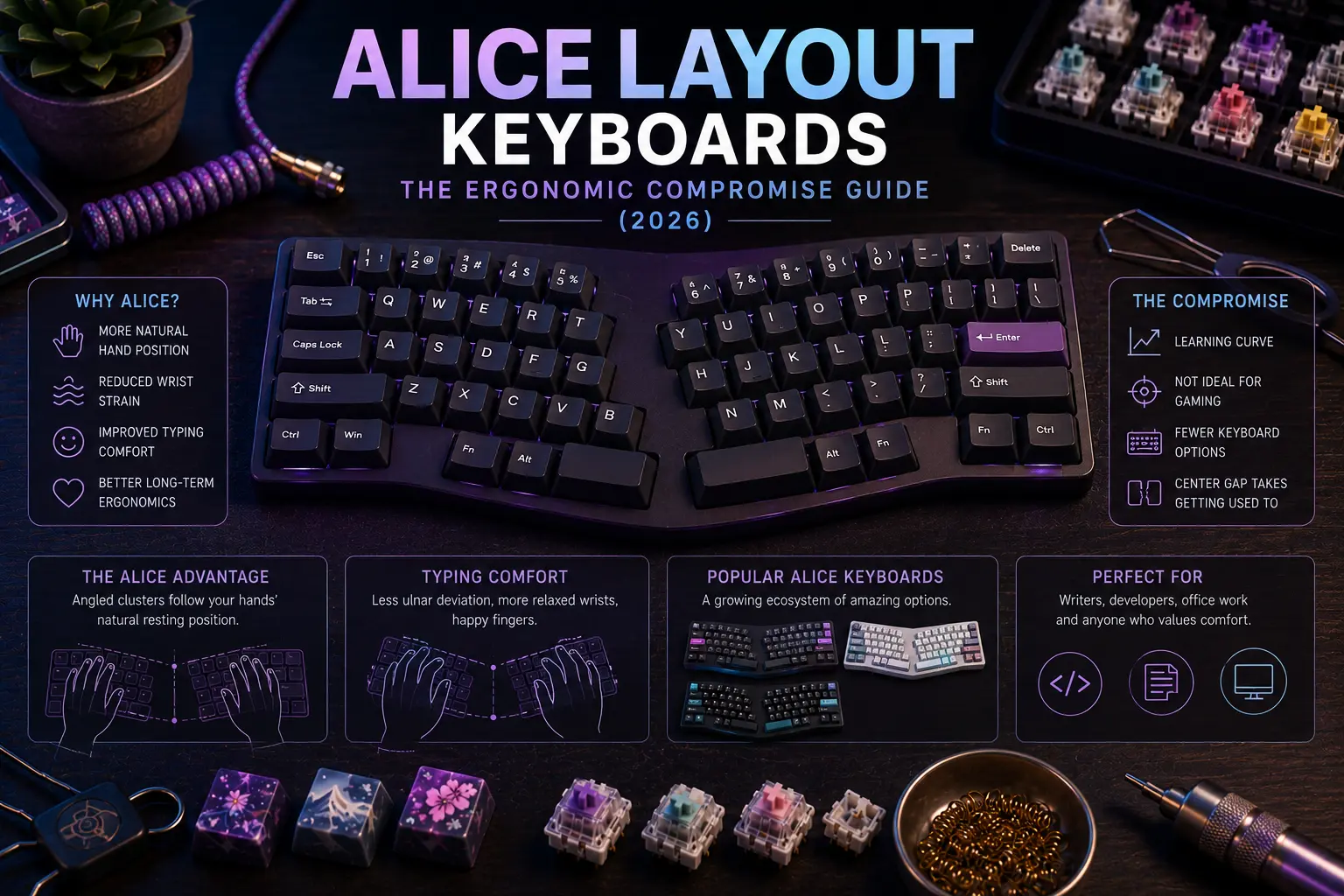
Alice layout keyboards sit in a category most buyers misunderstand, which is exactly what makes them interesting in 2026's mechanical keyboard landscape. The layout angles the two halves of a standard row-staggered board inward on a single PCB, adds a split spacebar, and promises measurable wrist relief without forcing the learning curve of a true split. For desk-bound typists who feel tension creeping into the shoulders and forearms after long sessions, Alice has become the most popular ergonomic stepping stone of the last five years.
Conventional row-staggered boards force the wrists into ulnar deviation, the outward bend toward the little finger that peer-reviewed ergonomics studies place at roughly 10 to 15 degrees on a flat keyboard. Full split keyboards like the ZSA Moonlander or Kinesis Advantage360 solve this completely, but they also demand retraining muscle memory on column-staggered keywells. Alice threads the needle. It keeps the row-staggered layout typists already know, adds a fixed 6 to 10 degree angle per half, and separates the hands just enough to open the wrist path without separating the halves entirely. The result is a compromise, not a cure.
This guide walks through the layout's origin with the 2018 TGR Alice by Malaysian designer Yuk Tsi, clarifies the confusing Alice-versus-Arisu nomenclature, unpacks the real anatomy (split spacebars, dual B keys, angled modifiers), and evaluates the Alice keyboards actually available in 2026. The selection spans budget hot-swap boards under $100, mid-range staples like the Keychron Q10 and Akko ACR Pro, premium wireless flagships like the Keychron Q10 Max, and the boutique groupbuy history that keeps TGR Alice originals trading hands for four figures.
The aim is decision-ready. Buyers comparing an Alice build against a standard 75% layout or a proper split ergonomic keyboard get the trade-offs in plain terms, with the keycap compatibility traps, gaming considerations, and adaptation timelines laid out clearly for 2026.
Note: This guide contains affiliate links. If you purchase through our links, we may earn a commission at no extra cost to you. This helps support our in-depth testing and content creation.
What Is an Alice Layout Keyboard?
An Alice layout keyboard is a single-piece, row-staggered mechanical keyboard whose alpha cluster is split into two halves, each angled inward by roughly 6 to 10 degrees, with a central visual gap and a split spacebar. It is not a split keyboard. The PCB is one continuous board, the halves cannot be physically separated, and the hands remain close together rather than spread to shoulder width.
The defining features are consistent across manufacturers. The left and right alpha blocks tilt toward the center line, creating a visible wedge between them. The bottom row uses a split spacebar, most commonly 2.25u plus 2.75u, though 3u plus 3u and tri-space 2.75u-2.25u-2.75u variants exist. The left shift shrinks from the standard 2.25u to 1.75u so it can angle into the alpha cluster. Classic Alice boards add a duplicate B key on the right half, so the right index finger reaches an inner B instead of crossing into the left hand's territory.
The layout originated as a custom enthusiast design in 2018. By 2022, Keychron's Q8 and Q10 brought Alice to the mainstream, and budget manufacturers followed within a year. In 2026, Alice is no longer exotic. It is a mature sub-category with options at every price tier.
The Ergonomic Problem Alice Solves
The physiological case for Alice rests on three mechanisms: reduced ulnar deviation, a slightly more open shoulder posture, and lower cross-hand reach for the index fingers. None of these are as dramatic as the marketing sometimes implies, but each is measurable.
Ulnar deviation describes the wrist bending outward toward the pinky, a posture typists adopt on flat row-staggered keyboards because the alpha cluster is narrower than shoulder width. Clinical ergonomics literature, including work by Marklin and Simoneau, places the typical ulnar deviation on a conventional keyboard at around 10 to 15 degrees, with broader-shouldered users reaching the higher end of that range. Sustained ulnar deviation above about 10 degrees correlates with increased carpal tunnel pressure and forearm tendon load. Angling each half of the keyboard inward by 6 to 10 degrees brings the wrists closer to a neutral straight line, reducing the deviation meaningfully if not eliminating it.
Shoulder and upper-arm tension is where Alice shows its limits honestly. A true split keyboard placed at shoulder width opens the chest, externally rotates the shoulders, and lets the upper arms hang naturally. Alice keeps the hands close together on a single chassis, so the shoulder benefit is modest. Users experiencing primarily shoulder and upper-back pain from a cramped hand position will get more relief from a full split setup or a Kinesis Advantage360 than from any Alice board.
Cross-hand reach on standard keyboards forces the right index finger to cross the vertical center line for the B key, G on occasion, and for users with non-standard touch-typing habits, N and H. The dual B keys on classic Alice eliminate this for B specifically, and the central gap discourages the subtle hand-drift that accumulates fatigue over a workday. For users already experiencing wrist tension but reluctant to commit to a full split, Alice addresses the most common pain vectors without a retraining cost.
The TGR Alice Story
The Alice layout was created by Sam Yuk Tsi, a Malaysian keyboard designer operating under the TGR brand, and released as the TGR Alice in April 2018. Yuk Tsi posted the Interest Check on Geekhack on April 3, 2018, and opened the group buy on April 6, 2018. The design drew directly from the Leeku EM.7 layout that Yuk Tsi had been typing on and iterating through nine prototypes starting in September 2017.
The original TGR Alice run was 40 units, first-come first-served, and shipped as a kit with case, plate, weight, and pre-populated PCB. A brass plate plus extra PCB and an RGB kit were offered as paid add-ons. The PCB ran on the ps2avrGB platform credited to Leeku. Typing angle was approximately 8 degrees, the mount was gasket-style, and the case carried a brass weight bringing the built weight near 4 kilograms. Originals trade well above their initial price on the aftermarket in 2026, commanding premium sums for complete kits in popular anodization colors.
The community impact was outsized relative to the tiny run. Taeha Types publicly championed the board in 2019, calling it Hall-of-Fame material. Typing sound recordings of the TGR Alice circulated as reference audio for what a premium gasket-mount custom should sound like. More importantly, the concept was open-sourced in spirit if not always in license, and a wave of community reinterpretations followed. The Arisu PCB on GitHub by FateNozomi, released under MIT license, gave anyone the files to build an Alice-alike without paying TGR prices. Boutique vendors picked up the design language, and by 2022, when Keychron launched the Q8, the layout had been validated long enough to merit mass production.
The through line: a 40-unit Malaysian boutique board from 2018 shaped the ergonomic-curious segment of the mechanical keyboard hobby for the next eight years.
Alice vs Arisu: Same Layout, Different Names
The confusion around Alice and Arisu is simple once unpacked. Arisu (アリス) is the Japanese transliteration of Alice. The two terms describe the same general layout family, but in enthusiast usage they reference slightly different reference implementations.
TGR Alice, the 2018 original, has mirrored B keys on both halves and omits a dedicated arrow cluster in its classic 60 percent form. The Arisu PCB by FateNozomi, open-sourced on GitHub, adds an arrow cluster on the right, removes the duplicate right-side B, shifts the bottom alpha row 0.25u, and aligns the two halves on the number row rather than the home row. In practical terms, Arisu reads as the community's iterative fork, Alice as the TGR original, though virtually every commercial board sold as "Alice" in 2026 is closer to the Arisu pattern with arrow keys than to the strict 2018 TGR geometry.
Most buyers can treat the names as interchangeable. Product pages and retailers use Alice almost exclusively because it markets better. The only moment the distinction matters is when ordering keycaps or building a custom: check whether the board includes a duplicate B key (classic Alice does, most commercial Arisu-style boards including the entire Keychron Q8/Q10 line do not) because that single decision determines which keycap kits will fit cleanly.
Alice Layout Anatomy
Understanding what makes an Alice board physically distinct matters for both keycap shopping and adaptation expectations. Six features define the layout in 2026.
The angled key blocks are the signature element. Each half rotates 6 to 10 degrees inward around a pivot near the top-center. TGR Alice uses roughly 8 degrees, Sneakbox AVA uses 6 degrees, QwertyKeys Neo Ergo uses 7 degrees with an added 5 degree tent. Higher angles reduce ulnar deviation more aggressively but also make the board physically wider and require more adaptation.
The central gap separates the halves visually and, more importantly, encourages the hands to rest on their respective sides. Gap widths vary from about 15mm on compact designs to 35mm or more on boards with a function column between the halves.
The split spacebar replaces the single 6.25u or 7u bar with two or three shorter stabilized keys. The 2.25u plus 2.75u combination is the modern default. Programmers and power users often remap one spacebar half to backspace, layer toggle, or enter, which is one of Alice's quietly useful productivity gains.
The angled modifiers primarily mean a 1.75u left shift that slots into the angled alpha block rather than a standard 2.25u shift. Right shift is often 1.75u as well, though many modern designs retain a standard 2.25u or longer right shift.
The dual B key is present on classic Alice designs from TGR and on many boutique builds, where each half has its own B under the right index finger. Mainstream production boards, including the entire Keychron Q8 and Q10 families and most Akko, Feker, and Epomaker Alice models, use a single B key on the left half. This is a critical keycap-compatibility detail.
The compatibility tax is the cumulative consequence of these quirks. A standard ANSI keycap kit will not fill an Alice board. Buyers need a kit with a 1.75u left shift, split spacebar sizes, and ideally a duplicate B if the board is a classic Alice.
Alice vs Split Keyboards: The Real Difference
Calling an Alice a split keyboard is a category error that causes buyer's remorse on both ends. Alice is a single-piece ergonomic keyboard. A split keyboard is two physically separate halves. The distinction drives nearly every meaningful difference.
A split keyboard like the ZSA Moonlander, Kinesis Advantage360, Ergodox EZ, or Dygma Defy gives the user independent placement of each half. The hands can sit at shoulder width, open the chest, fully relax the shoulders, and even tent vertically to bring the thumbs upward. Most splits also use column-stagger, where each column aligns to a finger's natural travel path rather than row-stagger's diagonal shift. Column-stagger is ergonomically superior but requires retraining.
Alice gives up all of that in exchange for continuity. The halves are fixed in one chassis at a predetermined angle. Hands remain close together. Row-stagger is preserved, so muscle memory transfers almost completely. Thumb clusters are limited to a split spacebar rather than the 3 to 6 thumb keys common on splits. Tenting is usually nonexistent, though a handful of 2024 to 2026 customs (QwertyKeys Neo Ergo, QK Alice Duo) introduce adjustable tenting.
The practical implication: Alice reduces ulnar deviation meaningfully but delivers only partial shoulder relief. Users whose main complaint is wrist and forearm tension from long typing sessions are well served by Alice. Users with significant shoulder, upper-back, or thoracic-outlet-style tension should look past Alice toward a true split with tenting, which addresses shoulder and upper-back load that Alice cannot.
A secondary consideration is desk footprint. An Alice 75 is wider than a standard 75 percent because of the angled blocks and central gap. A true split takes less linear desk width per half but requires two mounting positions, which some desk setups cannot accommodate.
Better for wrist-only tension: Alice.
Better for shoulder and upper-back tension: true split.
Better for programmers relearning muscle memory for a year: true split.
Better for keeping existing typing speed intact: Alice.
Adaptation Curve: What to Expect
Community consensus, echoed across Reddit threads, YouTube reviews by Alexotos and others, and manufacturer documentation, puts Alice adaptation at two to five days of dedicated use, with full speed returning within a week for most touch typists. This is not peer-reviewed, but it matches the qualitative reports consistently.
The reason Alice adapts quickly is structural. Row-stagger is preserved, so each finger still moves in the diagonal pattern it already knows. The angled blocks shift the target coordinates by a few millimeters but do not change which finger presses which key. The only genuinely new motor patterns are the split spacebar (thumb selects left or right space) and, on classic Alice boards, the dual B key (right index reaches its own B instead of crossing over).
Compare this to full column-staggered splits, where community reports cluster around two to four weeks for regaining typing speed and one to three months to feel fully native. Kinesis and ZSA report similar timelines in their onboarding documentation. The gap reflects how much more column-stagger changes about the typing motion: every finger learns new vertical paths simultaneously.
Two practical tips smooth the Alice transition. First, remap one split spacebar half to backspace or enter for the first week. This forces the thumbs to differentiate and locks in the split muscle memory quickly. Second, practice typing words with B in them for the first day if the board has dual B keys. The right-hand B feels unnatural for about an hour and native by afternoon.
Users migrating from a 65 percent or 60 percent keyboard adapt to Alice 75 just as quickly as users coming from TKL. The limiting factor is motor memory for the alpha cluster, not the surrounding keys.
Budget Alice Keyboards 2026
The sub-$130 Alice market grew substantially between 2023 and 2026, driven by Chinese manufacturers scaling hot-swap gasket designs. These boards accept the ergonomic trade-offs of plastic cases and proprietary firmware in some cases, but they deliver the core Alice experience at roughly half the price of aluminum customs.
Ajazz AKS068 (Attack Shark AKS068)
- Layout variant: Alice 65
- Key count: 68
- Form factor: prebuilt
- Switch type: hot-swap (5-pin)
- Mount type: gasket
- Firmware: VIA
- Connectivity: wired USB-C
- Case material: ABS plastic
- B key: single
- Budget: $
- Best for: first Alice, budget experiments
- Keycap kit compatibility: requires 1.75u left shift and 2.25u plus 2.75u split spacebar kit, single B
Verdict: The Ajazz AKS068 on Amazon is the cheapest credible Alice in 2026. Not refined, but it proves whether the Alice angle works for the user's wrists before committing more money.
Redragon Pollux K628
- Layout variant: Alice 65
- Key count: 68
- Form factor: prebuilt gaming
- Switch type: hot-swap
- Mount type: tray
- Firmware: proprietary software
- Connectivity: wired
- Case material: ABS plastic
- B key: single
- Budget: $
- Best for: gaming-oriented buyers curious about Alice
- Keycap kit compatibility: standard budget Alice kit requirements; stock caps cover the layout
Verdict: The Redragon Pollux K628 is aggressively priced gaming tuning (linear switches, RGB software) rather than typing-focused, but the entry price is one of the lowest in the category.
Royal Kludge A70 / A72
- Layout variant: Alice 65 (A70) or Alice 72 (A72)
- Key count: 68 or 72
- Form factor: prebuilt
- Switch type: hot-swap
- Mount type: gasket
- Firmware: proprietary with limited remapping
- Connectivity: tri-mode (Bluetooth 5.0, 2.4GHz, USB-C)
- Case material: ABS plastic with knob
- B key: single
- Budget: $$
- Best for: wireless Alice on a budget
- Keycap kit compatibility: standard Alice 65 kit
Verdict: The RK line brings tri-mode wireless into sub-$100 Alice territory on Amazon. Firmware limitations are the main compromise versus QMK boards.
LEOBOG A75
- Layout variant: Alice 75
- Key count: ~82
- Form factor: prebuilt
- Switch type: hot-swap
- Mount type: gasket
- Firmware: proprietary
- Connectivity: tri-mode wireless
- Case material: ABS with joystick and knob
- B key: single
- Budget: $$
- Best for: Alice 75 with F-row on a budget
- Keycap kit compatibility: Alice 75 kit with 1.75u left shift
Verdict: The LEOBOG A75 delivers a full F-row Alice 75 experience wirelessly for roughly half the price of the Keychron Q10. Firmware is the trade-off.
Choose a budget Alice if: the goal is validating whether Alice ergonomics actually help before committing more money. The Ajazz AKS068 or Royal Kludge A70 deliver enough of the core experience to answer that question within two weeks of daily use.
Mid-Range Alice Keyboards
The $130 to $220 tier is where Alice becomes a serious daily driver. These boards combine hot-swap PCBs, better acoustic tuning, VIA or QMK firmware, and aluminum or dense plastic construction.
Keychron V10
- Layout variant: Alice 65
- Key count: 87 with knob
- Form factor: prebuilt
- Switch type: hot-swap Keychron K Pro
- Mount type: double-gasket
- Firmware: QMK/VIA
- Connectivity: wired USB-C
- Case material: ABS plastic
- B key: single
- Budget: $$
- Best for: Alice ergonomics with full QMK flexibility at the lowest price
- Keycap kit compatibility: ships with OSA PBT Alice-cut set, stock caps cover the layout
Verdict: Available on Amazon. The single best price-to-quality Alice for users who want QMK and VIA without paying aluminum prices.
Akko ACR Pro Alice Plus
- Layout variant: Alice 65 with arrow column
- Key count: 68
- Form factor: prebuilt or barebones
- Switch type: hot-swap
- Mount type: gasket
- Firmware: VIA
- Connectivity: wired
- Case material: polycarbonate or aluminum depending on variant
- B key: single
- Budget: $$$
- Best for: typing-focused mid-range, excellent stock acoustics
- Keycap kit compatibility: ships with Akko MDA or ASA profile Alice-cut caps
Verdict: The Akko ACR Pro Alice Plus is widely considered the best sub-$200 Alice for typing feel, with a sound profile that rivals boards twice its price.
Feker Alice 80
- Layout variant: Alice 65
- Key count: 68
- Form factor: prebuilt
- Switch type: hot-swap
- Mount type: gasket
- Firmware: QMK/VIA
- Connectivity: wired USB-C
- Case material: polycarbonate with gasket
- B key: single
- Budget: $$$
- Best for: polycarbonate sound signature, VIA users
- Keycap kit compatibility: ships with Cherry-profile PBT Alice-cut set
Verdict: Strong alternative to the Akko ACR Pro, available as the Feker Alice 80 on Amazon. Slightly brighter sound than the Akko, slightly less rigid.
Feker Alice 98
- Layout variant: Alice 98 (Alice plus numpad)
- Key count: 98
- Form factor: prebuilt
- Switch type: hot-swap
- Mount type: gasket
- Firmware: VIA (wired) or QMK tri-mode on wireless SKU
- Connectivity: wired base, tri-mode wireless variant on MechLands site
- Case material: plastic with gasket
- B key: single
- Budget: $$$
- Best for: spreadsheet-heavy workflows that need a numpad in an Alice chassis
- Keycap kit compatibility: requires Alice 98 kit covering numpad plus angled modifiers
Verdict: The Feker Alice 98 is one of the few production Alice keyboards in 2026 that integrates a full numpad, a genuinely useful combination for accounting and data-entry professionals.
Epomaker Alice 66
- Layout variant: Alice 65
- Key count: 66
- Form factor: prebuilt
- Switch type: hot-swap
- Mount type: gasket
- Firmware: VIA
- Connectivity: tri-mode wireless
- Case material: plastic
- B key: single
- Budget: $$
- Best for: wireless Alice with VIA at a mid price
- Keycap kit compatibility: Alice 65 kit
Verdict: A solid Epomaker workhorse available on Amazon; often discounted below MSRP.
Choose a mid-range Alice if: Alice has already proven worthwhile on a cheaper board, or if the buyer has high confidence they want an Alice as a daily driver. The Keychron V10 for QMK users, the Akko ACR Pro Alice Plus for typing feel, or the Feker Alice 98 if a numpad is mandatory.
Premium & Custom Alice
At $190 and above, Alice keyboards move into full aluminum CNC construction, true QMK firmware, and the refinement expected of a custom build. This tier dominates long-term Alice ownership.
Keychron Q10
- Layout variant: Alice 75 with macro column
- Key count: 84 with knob
- Form factor: prebuilt or barebones
- Switch type: hot-swap Gateron G Pro
- Mount type: double-gasket
- Firmware: QMK/VIA
- Connectivity: wired USB-C
- Case material: full CNC aluminum
- B key: single
- Budget: $$$
- Best for: the definitive mainstream Alice 75
- Keycap kit compatibility: ships with OSA PBT Alice-cut set; aftermarket needs 1.75u left shift plus split spacebar kit
Verdict: The Keychron Q10 remains the reference point for what a mass-production Alice custom should deliver in 2026. Aluminum case, QMK, full F-row plus macro column, quality stabs. Also on Amazon.
Keychron Q10 Max
- Layout variant: Alice 75 with macro column
- Key count: 84 with knob
- Form factor: prebuilt
- Switch type: hot-swap Gateron Jupiter
- Mount type: double-gasket
- Firmware: QMK/VIA
- Connectivity: tri-mode (2.4GHz, Bluetooth 5.1, USB-C)
- Case material: full CNC aluminum
- B key: single
- Budget: $$$
- Best for: wireless Alice endgame for mainstream users
- Keycap kit compatibility: same as Q10; ships with KSA PBT double-shot Alice-cut set
Verdict: The Keychron Q10 Max resolves the Q10's single meaningful weakness, the wired-only constraint. It remains substantially cheaper than boutique alternatives while shipping fully assembled. Also on Amazon.
Keychron Q8 Max
- Layout variant: Alice 65
- Key count: 68
- Form factor: prebuilt
- Switch type: hot-swap
- Mount type: double-gasket
- Firmware: QMK/VIA
- Connectivity: tri-mode wireless
- Case material: aluminum
- B key: single
- Budget: $$$
- Best for: compact Alice 65 in aluminum with wireless
- Keycap kit compatibility: Alice 65 kit
Verdict: The Keychron Q8 Max is the pick for buyers who want Alice ergonomics without the Q10's additional width and F-row.
Keychron Q13 Max
- Layout variant: Alice 96 with numpad
- Key count: 98
- Form factor: prebuilt
- Switch type: hot-swap
- Mount type: double-gasket
- Firmware: QMK/VIA
- Connectivity: tri-mode wireless
- Case material: aluminum
- B key: single
- Budget: $$$
- Best for: the only mainstream aluminum Alice with numpad
- Keycap kit compatibility: Alice 96 kit; challenging to source aftermarket
Verdict: The Keychron Q13 Max targets a narrow but real audience: accountants and engineers who need a numpad, cannot use a separate numpad peripheral, and want Alice ergonomics. Heavy and wide.
Mode Sonnet and Drop Shift
Mode Designs produces premium custom keyboards, but the Sonnet is a TKL-style design rather than an Alice variant. Mode has not released a production Alice board as of 2026. The Drop Shift is frequently lumped in with Alice discussions but is actually an 1800-compact layout, a dense traditional stagger with numpad. Neither product is an Alice keyboard despite common confusion online.
Choose a premium Alice if: this is an endgame purchase. The Keychron Q10 Max is the pragmatic default. The Q8 Max for compact users. The Q13 Max only if a numpad is non-negotiable.
Boutique/Groupbuy Alice History
The boutique Alice market runs parallel to the mainstream and rarely intersects with Amazon. These are the designs that shape custom-community aesthetics and trade at 3 to 10 times their original group buy prices on the aftermarket in 2026.
TGR Alice (Yuk Tsi, 2018): 40-unit original run; rereleases and continuations through TGR's ongoing production. Still referenced as the aesthetic benchmark for the entire category, with complete aftermarket kits in popular anodization colors routinely fetching four-figure sums.
TGR Jane v2, v2 CE, v3 Rubrehose Edition (2024 to 2025): Yuk Tsi's TKL-format ergo continuations of the Alice family, with the v3 Rubrehose Edition group buy closing September 15, 2024 for Q1 2025 shipping. Not classic Alice 60 but share the designer lineage.
Sneakbox AVA: 60 percent Alice-style with 6 degree typing angle, gasket mount, QMK/VIA, polycarbonate or aluminum options, priced in the premium tier.
Prophet by CableCarDesigns (sold through CannonKeys): pin-mount seamless Alice 60 percent design, group buy completed.
KBDfans AVA and Maja V2: KBDfans Alice-style kits in several iterations.
Adelheid: community 75 percent fork of the Arisu files, open-source.
Keylice: 65 percent premium dual-mode wireless Alice groupbuy.
Weikav Record Alice V2: affordable leaf-spring aluminum Alice kit, one of the better sub-$200 custom entries.
QwertyKeys Neo Ergo (2024): Mid-range tented Alice, 7 degree typing angle plus 5 degree tent. Named best overall keyboard of 2024 by reviewer Alexotos.
QwertyKeys QK Alice Duo (2025): split Alice variant with adjustable tenting, pogo-pin connectivity between halves, wireless pod, 8000Hz polling.
Claims of "Yuni," "Rally," "Harbour" HMKB, "TAG Alice," and "AEGIS Alice" boards circulate in community discussion but could not be verified as released products in 2026 research. Treat those names with skepticism until sellers produce group buy receipts. The Drop Shift is occasionally listed in the same conversations but, as noted, is an 1800-compact rather than a true Alice.
Keycap Compatibility Considerations
Alice keycap compatibility is the single biggest source of post-purchase frustration. Standard ANSI kits routinely miss Alice requirements, and replacement keycap shopping carries real cost in both time and money.
The baseline requirements for any Alice board are a 1.75u left shift, a split spacebar in the board's specific sizing (most commonly 2.25u plus 2.75u), and frequently a 1.75u right shift or 2.25u depending on the design. Classic Alice layouts with dual B keys also need a duplicate B, which is where keycap matching gets genuinely difficult.
GMK doubleshot ABS Cherry-profile kits handle Alice through dedicated "Alice," "Ergo," or "Exotic" extension kits sold alongside base kits. Coverage is inconsistent across group buys. Many older or smaller GMK drops omit Alice extensions entirely. Buyers need to check each specific set's kit breakdown for Alice compatibility before ordering. Third-party GMK-clone sets marketed as "GMK+ Alice KCA" solve this with dedicated 68-key ready-to-fit Alice sets.
PBTfans sets on KBDfans typically offer Alice support through "International" or dedicated add-on kits, but coverage varies per drop. Check the product page kit breakdown every time.
Uniform-profile kits (KAT, KAM, DSA, XDA, MT3 when uniform R3) are frequently better bets for Alice because they do not require row-specific sculpted caps. The dual B key, split spacebar, and angled modifiers all fit more easily when every row uses the same cap shape.
Stock keycaps from Keychron (OSA double-shot PBT on Q-series, KSA on Max series), Akko (MDA and ASA PBT), and Feker (Cherry-profile PBT) all include the necessary Alice sizes. Buyers who want a set-and-forget experience should lean on stock caps rather than immediately shopping aftermarket.
Cerakey produces ceramic Alice-specific split spacebars and add-on caps in 2.25u plus 2.75u configurations, useful for filling gaps in otherwise-incomplete kits.
The pragmatic workflow: either commit to a specific in-stock aftermarket set known to cover Alice (check /r/MechanicalKeyboards kit breakdowns and drop listings) or stay on stock keycaps. For a broader treatment of keycap profiles and set selection, the dedicated guide covers compatibility in more depth.
Specifications Comparison
A distilled view across the main 2026 Alice options, oriented by tier and use case.
Keychron V10 (mid-range QMK)
- Alice 65 with knob, 87 keys, QMK/VIA, wired, ABS plastic, single B, $$
Keychron Q8 Max (premium wireless compact)
- Alice 65, 68 keys, QMK/VIA, tri-mode wireless, aluminum, single B, $$$
Keychron Q10 (premium wired default)
- Alice 75 with macro column, 84 keys, QMK/VIA, wired, aluminum, single B, $$$
Keychron Q10 Max (premium wireless default)
- Alice 75 with macro column, 84 keys, QMK/VIA, tri-mode wireless, aluminum, single B, $$$
Keychron Q13 Max (premium with numpad)
- Alice 96, 98 keys, QMK/VIA, tri-mode wireless, aluminum, single B, $$$
Akko ACR Pro Alice Plus (mid-range typing-focused)
- Alice 65, 68 keys, VIA, wired, polycarbonate or aluminum, single B, $$$
Feker Alice 80 (mid-range VIA)
- Alice 65, 68 keys, QMK/VIA, wired, polycarbonate, single B, $$$
Feker Alice 98 (mid-range with numpad)
- Alice 98, 98 keys, VIA or QMK tri-mode, plastic, single B, $$$
Epomaker Alice 66 (budget wireless VIA)
- Alice 65, 66 keys, VIA, tri-mode wireless, plastic, single B, $$
Royal Kludge A70/A72 (budget wireless)
- Alice 65 or 72, proprietary firmware, tri-mode wireless, plastic, single B, $$
LEOBOG A75 (budget wireless Alice 75)
- Alice 75, ~82 keys, proprietary firmware, tri-mode wireless, plastic, single B, $$
Ajazz AKS068 (budget wired)
- Alice 65, 68 keys, VIA, wired, plastic, single B, $
Redragon Pollux K628 (budget gaming)
- Alice 65, 68 keys, proprietary software, wired, plastic, single B, $
TGR Alice (boutique reference)
- Alice 60, ~66 keys, QMK, wired, aluminum with brass weight, dual B, $$$
QwertyKeys Neo Ergo (boutique tented)
- Alice 65, QMK, wired, aluminum, tenting, $$
How to Choose Your First Alice
The decision tree starts with budget and narrows through use case.
Choose a budget Alice (under $120) if: the goal is validating whether Alice ergonomics actually help before committing more money. The Ajazz AKS068 or Royal Kludge A70 deliver enough of the core experience to answer that question within two weeks of daily use.
Choose a mid-range Alice ($120 to $200) if: Alice has already proven worthwhile on a cheaper board, or if the buyer has high confidence they want an Alice as a daily driver. The Keychron V10 for QMK users, the Akko ACR Pro Alice Plus for typing feel, or the Feker Alice 98 if a numpad is mandatory.
Choose a premium Alice ($200 to $300) if: this is an endgame purchase. The Keychron Q10 Max is the pragmatic default. The Q8 Max for compact users. The Q13 Max only if a numpad is non-negotiable.
Choose a boutique or group-buy Alice ($320 to $1,500+) if: aesthetics, sound profile, and custom-community participation matter as much as function. The QwertyKeys Neo Ergo is the accessible entry. Sneakbox AVA, Keylice, or chasing a TGR Alice aftermarket unit are enthusiast-tier commitments.
Two secondary filters apply. Wireless versus wired: for desk-fixed setups, wired is simpler and cheaper; for users who move between spaces, the Max-series or tri-mode plastic boards earn their premium. Size: Alice 65 is the compact reference, Alice 75 adds an F-row, Alice 98 adds a numpad. Buyers comparing Alice 75 to a standard 75 percent should default to whichever their existing workflow already uses. The broader keyboard size guide gives the full layout comparison framework.
Alice vs 75% Standard: When to Pick Each
The Alice versus standard 75 percent decision applies almost exclusively to Keychron shoppers choosing between a Q1 (75 percent standard) and a Q10 (Alice 75), but the logic generalizes.
Pick a standard 75 percent if: the user frequently travels with the keyboard, swaps between multiple keyboards regularly, wants near-universal keycap compatibility, has no specific wrist complaint, or needs to share the keyboard with others who prefer a conventional layout. Standard 75 is the safer default for most users. The mechanical keyboard buying guide covers the baseline 75 percent options in detail.
Pick an Alice 75 if: the user experiences wrist or forearm tension after long sessions, works primarily at one desk, has researched ergonomics enough to understand the trade-offs, and is willing to tolerate more complex keycap shopping in exchange for a more neutral wrist posture. Alice is a specialist's tool.
Alice is wider than standard 75 by roughly 15 to 30mm depending on the model, which matters for tight desk setups. Alice is meaningfully heavier in aluminum construction because the wider footprint requires more material. And Alice always costs more than its standard 75 counterpart from the same manufacturer, typically $20 to $40 more for matched tiers.
For users whose primary driver is specifically wrist pain, the full ergonomic mechanical keyboards and wrist pain guide walks through the options beyond Alice, including split and vertical designs.
Price & Where to Buy
Amazon carries the full mainstream selection: Keychron V10, Q10 Max, Q13 Max, Akko ACR Pro Alice Plus, Feker Alice 80 and 98, Epomaker Alice 66, Royal Kludge A70 and A72, LEOBOG A75, Ajazz AKS068, and Redragon Pollux K628. Prime shipping and easy returns make Amazon the practical default for mainstream purchases. Search broadly using the Alice keyboard listings filter for current pricing.
Keychron direct at keychron.com offers the full Q-series Alice lineup, often with bundle pricing on keycaps and switches, plus region-specific warranty handling. The Keychron Q10, Q10 Max, and Q8 Max are typically available in-stock.
Akko sells the ACR Pro line at akkogear.com in addition to Amazon.
CannonKeys (cannonkeys.com) handles US distribution of boutique Alice designs, group buys, and some in-stock runs. Good starting point for Sneakbox AVA, Prophet, Keylice, and other enthusiast-tier boards.
KBDfans (kbdfans.com) stocks KBDfans-branded Alice kits and a rotating selection of Alice-compatible keycaps.
Drop (drop.com) occasionally runs Alice-adjacent drops and some keycap sets with Alice compatibility; confirm kit breakdowns before ordering.
QwertyKeys direct for Neo Ergo and QK Alice Duo group buys.
Pricing in 2026 has stabilized relative to the 2022-2024 volatility. Budget Alice sits firmly under $110. Mid-range clusters around $150. The Keychron Q10 Max is the de facto premium price anchor. Boutique Alice remains $300 and up, with the TGR Alice aftermarket behaving more like a collectible than a keyboard.
Frequently Asked Questions
Q: What's the difference between Alice and Arisu?
A: Arisu is the Japanese transliteration of Alice, and the two terms describe the same general ergonomic layout family. TGR Alice, the 2018 original, uses mirrored dual B keys and omits arrow keys. The open-source Arisu PCB by FateNozomi adds arrow keys and a navigation column, removes the duplicate B, and shifts the alpha alignment to the number row. Most commercial "Alice" boards sold in 2026 actually follow the Arisu pattern with arrow keys. Treat the names as effectively interchangeable unless ordering keycaps, in which case verify whether the specific board has one or two B keys.
Q: Is an Alice keyboard ergonomic?
A: Alice keyboards provide partial ergonomic benefit. They reduce ulnar deviation by angling each half inward 6 to 10 degrees, which brings the wrists closer to neutral and reduces a measurable contributor to carpal tunnel pressure. They do not deliver the full shoulder-opening benefit of a true split keyboard because the halves remain fixed close together. Users with primarily wrist and forearm tension benefit most. Users with shoulder, upper-back, or chest-closure complaints get better results from a split keyboard like the ZSA Moonlander or Kinesis Advantage360.
Q: How long to adapt to an Alice layout?
A: Community consensus, echoed across Reddit threads and reviewer feedback, puts Alice adaptation at two to five days of dedicated use for most touch typists, with full speed returning within a week. This is substantially faster than column-staggered splits, which typically require two to four weeks. The reason Alice adapts quickly is that row-stagger is preserved, so finger motion paths remain familiar. The only genuinely new elements are the split spacebar and, on classic Alice boards, the dual B key.
Q: Can you game on an Alice keyboard?
A: Yes, with caveats. WASD sits on the angled left half, which can actually reduce wrist strain during long sessions. ESC and the number row remain fully accessible on Alice 65 and Alice 75 variants. Wired Alice boards have no meaningful input lag. Wireless Alice keyboards with 2.4GHz at 1000Hz polling (Keychron Max series, tri-mode plastics) are suitable for most gaming. The main trade-off is that the angled matrix can disrupt vertical muscle memory for high-APM scenarios like StarCraft-style RTS or MOBA hotbar transitions. For competitive FPS play where every millisecond matters, a traditional TKL remains the default, but Alice works well for casual to enthusiast gaming after brief acclimation.
Q: Why do Alice keyboards have two B keys?
A: Classic Alice layouts include a duplicate B on the right half so the right index finger reaches its own B rather than crossing the vertical center line into the left hand's territory. This eliminates the one cross-hand reach common to ANSI touch typing. Most mass-production Alice boards in 2026, including the entire Keychron Q8 and Q10 families plus most Akko, Feker, Epomaker, and Royal Kludge models, use a single B key on the left half to simplify keycap compatibility. The dual B is primarily preserved on boutique and classic TGR-style designs.
Q: Do I need special keycaps for an Alice keyboard?
A: Usually yes for aftermarket, but the stock keycaps that ship with mainstream Alice boards (Keychron OSA PBT, Akko MDA/ASA, Feker Cherry PBT) cover the layout correctly. Aftermarket keycap kits need to include a 1.75u left shift, split spacebar sizes matching the specific board (commonly 2.25u plus 2.75u), and for classic dual-B designs a duplicate B key. Uniform-profile sets like KAT, KAM, DSA, and XDA fit Alice most easily. GMK and PBTfans drops require checking for "Alice" or "Ergo" extension kits on a per-set basis.
Q: Is Alice worth it over a standard 75 percent keyboard?
A: Alice is worth the premium for users who have identified wrist tension as a real problem and who primarily work at one desk. For users without wrist complaints or who value maximum keycap compatibility and portability, a standard 75 percent is the more practical choice. Alice costs $20 to $40 more than the equivalent standard 75, is physically wider, and complicates keycap shopping. The ergonomic benefit is real but modest.
Q: Should I buy an Alice or a true split keyboard?
A: Buy Alice if the main symptom is wrist and forearm tension, if column-stagger retraining is a non-starter, or if a single-piece keyboard is required for desk or aesthetic reasons. Buy a true split keyboard if shoulder and upper-back tension are significant, if programming productivity justifies retraining, or if tenting is needed. Alice is a compromise. Split is a commitment.
Conclusion
Alice layout keyboards earned their position in the 2026 mechanical keyboard market by solving a specific problem honestly. They reduce ulnar deviation and cross-hand reach without asking the user to abandon row-stagger muscle memory, and they do so on a single chassis that fits existing desk setups. That is a real ergonomic gain packaged in a familiar form factor, and for the substantial population of typists who feel wrist tension but balk at the learning curve of a full split, Alice is the most sensible compromise available.
The compromise is genuine in both directions. Alice is not a replacement for a ZSA Moonlander or Kinesis Advantage360 for users with serious shoulder issues or column-stagger ambitions. It is also not a free upgrade over a standard 75 percent, because the wider footprint, keycap compatibility complications, and modest price premium are real costs. Buyers who understand that Alice is a targeted tool for a specific problem, rather than a universal ergonomic upgrade, come away satisfied. Buyers who expect it to eliminate all typing discomfort do not.
For practical 2026 recommendations: the Keychron V10 remains the best entry point for QMK users on a budget, the Akko ACR Pro Alice Plus wins mid-range typing feel, the Keychron Q10 Max is the pragmatic premium endgame, and the TGR Alice continues to set the boutique aesthetic standard at four-figure aftermarket pricing. Budget validators should start with the Ajazz AKS068 or Royal Kludge A70 before committing custom-tier money.
The larger lesson from eight years of Alice evolution is that ergonomic progress in mechanical keyboards does not require revolutionary redesigns. A modest inward angle, a split spacebar, and a thoughtfully placed dual B key were enough to reshape how the hobby thinks about wrist posture. For anyone typing eight hours a day in 2026 and feeling the accumulation of small strains, Alice is worth a two-week trial on a cheap board, and often worth the commitment that follows.