The mechanical keyboard scene of the mid-2020s is defined by two brands that have absorbed most of the mainstream premium market, and anyone looking at a mechanical keyboard buying guide in 2026 will end up weighing them against each other within minutes. Keychron and NuPhy dominate the $100–$250 segment, they dominate the Mac-friendly subcategory, they dominate the wireless tri-mode conversation, and they dominate the recommendation threads on r/MechanicalKeyboards. For buyers who have already narrowed the shortlist to these two, this comparison exists to settle the question cleanly.
Keychron was founded in Hong Kong in 2017 and scaled aggressively through Kickstarter, Amazon, and direct retail, becoming the default Mac-compatible mechanical keyboard brand by 2020–2022. NuPhy launched four years later, in 2021, out of China's industrial design community, and positioned itself from the start as the design-forward alternative — fewer models, tighter curation, and a premium-leaning price ladder. By 2023–2026, both have become the go-to recommendations in almost every mechanical keyboard subreddit, Verge round-up, and YouTube review from Hipyo Tech, BadSeedTech, and MKBHD, yet they represent almost opposite philosophies.
This guide covers the full 2026 lineup of each brand, how their pricing compares tier by tier, the firmware story (which shifted dramatically in 2025), real build-quality differences, stock switches and sound profiles, wireless performance, Mac compatibility, and direct head-to-head matchups between the most cross-shopped models — Keychron Q Max vs NuPhy Halo, K Pro vs Air, low-profile vs low-profile, and Hall Effect gaming boards from both brands. Reviewer consensus from Tom's Hardware, Trusted Reviews, Notebookcheck, Gadgetoid, and RTINGS is integrated throughout.
The final verdict avoids the lazy tie-breaking most comparisons fall into. These brands are not interchangeable: one wins clearly for Mac-focused productivity and firmware freedom, the other wins clearly for aesthetic coherence and acoustic polish. The goal here is to tell you which one wins for your specific use case, with concrete model recommendations, verified Amazon ASINs, and direct links to both manufacturers' stores.
Note: This guide contains affiliate links. If you purchase through our links, we may earn a commission at no extra cost to you. This helps support our in-depth testing and content creation.
Keychron Brand Overview
Keychron operates on a breadth-first strategy. The brand maintains seven parallel keyboard series in 2026, covering almost every form factor, price point, and connectivity configuration that a mainstream buyer might want. The flagship is the Q series, full CNC aluminum boards with QMK/VIA firmware — the Keychron Q series guide covers these in depth. Above it sits the new Q Ultra line (2026 refresh, ZMK firmware, 8K polling). Below it sits the Q Max wireless variant, the K Pro and K Max plastic/aluminum mainstream wireless boards, the V and V Max budget gasket-mount series, and the B Pro and C Pro entry-level tiers starting around $40.
The strategic consequence of this breadth: Keychron has a keyboard for nearly every buyer profile. Alice-layout users get the Q8 and Q10. Ergonomic-split fans get the Q11. 96% compact-with-numpad users get the Q5 or K4. Hall Effect gamers get the K2 HE and Q1 HE. Low-profile travelers get the K3, K1 Max, K7, and K11. ISO-layout buyers in Europe get near-universal coverage. And Mac users get a physical OS toggle on every single model, with macOS keycaps included in every box.
The trade-off of breadth is occasional cannibalization — the V Max and K Max have overlapping use cases, and the firmware story (QMK/VIA on Q/V/K Pro, Keychron Launcher web app on HE boards, ZMK on new Ultra flagships) fragments the ecosystem. But for buyers who want the single brand with the highest probability of having the exact keyboard they need, Keychron is that brand. Official pricing and full SKU availability can be checked at keychron.com.
NuPhy Brand Overview
NuPhy operates on the opposite principle: depth and curation over breadth. The 2026 lineup is concentrated around five core product families — Air (low-profile wireless), Halo (high-profile standard wireless), Field (Hall Effect gaming), Gem (premium TKL), and Kick (dual-profile switching) — plus the new WH80 esports flagship and NuPhyX BH65 all-aluminum magnetic board unveiled at CES 2026. The NuPhy keyboards complete guide catalogs each family in detail.
Every NuPhy product is designed as a design object first and a mechanical tool second. This shows in the colorways (Ionic White, Sakura Fizz, Cosmic Mocha, Mystic Indigo, Inca Rose, Airy Lilac), in the signature wavy RGB halo on the Halo series, in the light-emitting homing bars introduced on Halo V2, and in the deliberate restraint of the product catalog. There is no Alice layout in the NuPhy range. There is no 60% standard-profile. There is no ergonomic split. There is no budget tier under $90. The brand simply declines to enter segments it cannot dominate aesthetically.
That curation comes with a pricing premium. NuPhy boards typically cost 10–20% more than Keychron equivalents at similar feature sets, and the value proposition rests entirely on whether the buyer values the design language and acoustic tuning enough to justify the surcharge. Reviewer consensus in 2025–2026, including Tom's Hardware's glowing Halo75 V2 review and Gadgetoid's analysis of the IO Edition, suggests many do. Full product pages are available at nuphy.com.
Core Difference: Scale vs Design-Focus
The single most useful frame for this comparison is scale versus design-focus. Keychron is a keyboard-maker the way Toyota is a carmaker: massive catalog, consistent quality floor, feature checkbox completeness, and a SKU for essentially every buyer. NuPhy is a keyboard-maker the way Muji is a homewares-maker: fewer products, tighter design integrity, higher per-unit attention to material and form, and a willingness to leave market segments unaddressed if they don't fit the brand aesthetic.
This difference has practical buying consequences. If a buyer needs a very specific layout (Alice, ergonomic split, 1800 compact, left-handed numpad), Keychron probably has it and NuPhy probably does not. If a buyer wants ISO-DE, ISO-UK, ISO-Nordic, or ISO-FR support, Keychron covers nearly the entire range while NuPhy ISO support remains limited to a handful of SKUs. If a buyer wants a complete mechanical keyboard under $60, Keychron has the B Pro and C Pro series; NuPhy does not compete here at all.
Conversely, if a buyer wants a keyboard that will look deliberately beautiful on a clean desk, that ships with a considered colorway rather than a stock black/white binary, and that sounds visibly tuned out of the box, NuPhy has a clear edge in 2026. The brand has invested heavily in mSA and nSA keycap profiles, in multi-layer foam stacks tuned per model, and in functional RGB (the halo on the Halo series, the homing bars on V2) that doesn't read as gamer-bling.
The scale-vs-design split also maps to update cadence. Keychron launches new models monthly; NuPhy refreshes fewer SKUs but with larger version jumps (Air V2 to V3, Halo V1 to V2, Field HE to HE V2). Buyers who value long product support over rapid iteration tend to prefer NuPhy; buyers who value having the newest feature (8K polling, ZMK, 1200-hour battery) usually find it on Keychron first.
Pricing Comparison: Tier by Tier
The pricing pattern is consistent across every tier: NuPhy sits 10–20% above Keychron at equivalent feature sets, with the exception flipping at the ultra-premium end where Keychron's full-aluminum Q Max and Q Ultra boards run more expensive than NuPhy's mixed-material Halo V2.
Entry tier (sub-$100): Keychron B2 Pro (Amazon) and V3 Max starting around $45–$99. NuPhy has no direct answer under $100; the cheapest entry is the Node75 at $99.95 and the Kick75 at $109.95.
Mainstream mid-tier ($100–$140): Keychron K2 Pro (Amazon) at $99–$110, K2 Max (Amazon) at $109–$135, V1 Max (Amazon) at $99–$115. NuPhy Air75 V2 (Amazon) at $110–$130, Halo75 V2 (Amazon) at $117–$130.
Premium enthusiast ($150–$200): Keychron Q3 Max (Amazon) at $199, Q5 Max (Amazon) at $209, Keychron Q1 Max at $199. NuPhy Gem80 at $149–$169 barebones, Field75 HE V2 at $179, Halo96 V2 (Amazon) at $135–$155.
Ultra-premium ($200+): Keychron Q1 Ultra at ~$219 (ZMK, 8K polling), Keychron Q6 Max at $229, Keychron K4 HE (Amazon) at $199–$239. NuPhy WH80 at $249.95 (CES 2026 flagship).
The core lesson: NuPhy costs more for equivalent feature sets below $200, and stops having an answer above $220 unless you buy the WH80. Budget buyers should default to Keychron. Design-first buyers paying the surcharge should default to NuPhy.
Build Quality: CNC Aluminum, Gasket Mount, Plate Options
Both brands deliver quality that exceeds their price brackets, but the execution diverges. Keychron's Q and Q Max series use full 6063 CNC aluminum cases top and bottom, with double-gasket mounting (silicone gaskets on both plate edges and case edges), multi-layer IXPE-PET-latex-foam damping stacks, and steel or brass weight plates on the underside. Trusted Reviews described the Q1 Max as a keyboard that "could very well last a lifetime." For a deeper explanation of the mounting system advantages, see the gasket mount vs tray mount keyboard guide.
NuPhy's Halo V2 and Air V3 use a hybrid construction: CNC aluminum top plate with ABS or semi-aluminum bottom shell. The gasket mount is single-layer rather than double-gasket, but reviewer consensus holds that the tuning is still excellent — Tom's Hardware's Halo75 V2 review praised the softer POM plate option as one of the best-tuned out-of-box typing experiences at the price. The Gem80, NuPhy's premium entry, steps up to full CNC construction and Tom's Hardware explicitly stated it "excels even beyond Keychron with its quality."
Plate options diverge. Keychron ships most Q models with PC (polycarbonate) and offers FR4, POM, and aluminum plates as aftermarket accessories. NuPhy ships Halo V2 with POM as the default, emphasizing softer typing feel over the sharper Keychron PC sound. Both brands use hot-swap PCBs with 5-pin socket compatibility, allowing users to drop in any MX-style switch without soldering.
Weight tells the story at a glance. A Keychron Q1 Max ships at roughly 1.7 kg, a Halo75 V2 at roughly 1.15 kg, and a NuPhy Air75 V2 at roughly 680 g. The Keychron Q Max feels more like a desk anchor; the NuPhy Air is built for portability and commute-friendly weight. Buyers who equate heft with quality will prefer the Keychron Q line; buyers who equate weight with friction will prefer NuPhy Air.
Switches Compared
Keychron's stock switches are manufactured primarily by Gateron and branded under multiple sub-lines: Pro Red/Brown/Banana (K Pro boards), Jupiter Red/Brown/Banana (V Max and Q Max boards), Silk POM Banana/Red/Brown (2026 Q Ultra refresh), Cream (heavy linear), Phantom Red/Violet, and low-profile Keychron Optical or Mechanical variants (Banana, Red, Brown, White, Mint, Blue) for K3 and K7. The Silent K Pro switch, used in select V Max and K Max variants, is one of the market's best stock silent options — reviewers describe it as "almost perfectly silent with what little sound remaining being deep and thocky."
NuPhy's stock switches are also Gateron-sourced but designed in-house: Aloe (light linear), Moss (medium tactile), Wisteria (linear low-profile for Air), Cowberry (tactile low-profile), Daisy (light tactile), Dawn (premium linear), and the new Raw 2.0 for Air V3 (Nano Switch 3.0 with 3.5 mm travel). The Field75 HE uses Gateron magnetic Hall Effect switches with rapid-trigger actuation down to 0.005 mm.
Both brands support hot-swap, so switch preference is not a lock-in factor. Any standard 3-pin or 5-pin MX-compatible switch drops into any Keychron Q/K/V/B board, any NuPhy Halo, and any NuPhy Gem80. Low-profile boards from both brands use Gateron low-profile 2.0 mounts, so switches are interchangeable across K3 and Air75 within that sub-category.
For first-time buyers: Keychron Pro Red is a safe mainstream linear, NuPhy Aloe is a slightly lighter comparable option. Keychron Pro Brown is the safe tactile default; NuPhy Moss is the equivalent. Silent linear seekers should take the Keychron Silent K Pro; NuPhy has no direct equivalent in 2026.
Typing Feel: Stock Out-of-Box Experience
This is where both brands separate from the broader pre-built market. Cheap mechanical keyboards from generic brands feel hollow, rattly, and ping-prone out of the box; Keychron and NuPhy have both invested enough in foam stacks, plate tuning, and switch lubrication to deliver a typing feel that enthusiasts would have paid 3x for in 2019.
Keychron's Q Max and Q Ultra deliver the firmest, most deliberate feel — the double-gasket combined with full aluminum makes each keystroke feel anchored. The Q1 Ultra with Silk POM Banana switches is the benchmark for stock thock in 2026. The K Max and V Max sit a step softer, with single-gasket mounts and PC plates producing a bouncier typing feel that some typists prefer for long sessions. The K Pro budget line feels the softest among Keychron boards, appropriate for its plastic-case, lower-price positioning.
NuPhy's Halo V2 occupies a specific middle ground: softer than a Keychron Q but firmer than a K Pro, with deliberate acoustic tuning that makes each keystroke feel musical rather than functional. The Air series feel is entirely different — low-profile switches give a shorter travel and a crisper top-out, comparable to a premium laptop keyboard rather than a standard-profile mechanical. The Gem80 sits closest to Keychron Q Max in firmness, but with NuPhy's characteristic slightly warmer tuning.
For buyers migrating from a laptop keyboard: the Air75 V3 is the lowest-friction transition. For buyers migrating from a generic membrane or cheap mechanical: any Keychron V Max or NuPhy Halo V2 will feel like an immediate upgrade.
Sound Profile: Thock vs Clack Tendencies
The sound signature is where the two brands most visibly diverge. Keychron Q and Q Ultra are tuned for deep thock — low-frequency bottom-out, minimal spring ping, and a slight reverb tail that enthusiasts associate with custom-built boards. This is a deliberate choice: the foam stack is thicker, the plate is heavier, and the switches are pre-lubed to emphasize the low end. YouTube sound tests from BadSeedTech and Taeha Types consistently rate Keychron Q Max among the top 5 pre-built thocky keyboards.
NuPhy Halo V2 sits in balanced-to-clacky territory. The POM plate and thinner foam stack produce a brighter, poppier sound with more high-frequency detail. It's less thock-forward than Keychron Q but more articulate — each keystroke has more acoustic character. Reviewer vocabulary for the Halo V2 centers on words like "crisp," "poppy," "musical," and "defined."
NuPhy Air V2 and V3 are clackier still, which is inherent to the low-profile format. Less internal volume means less damping. The V2 added a switch pad to control the high-frequency ping, and the V3 added further acoustic tuning, but the Air series will always sound brighter than the Halo series. For buyers who want low-profile with a quieter acoustic footprint, Keychron K3 V3 sits slightly more muted than Air75 V2 thanks to a thicker case and heavier damping foam.
Final sound-profile ranking from deepest thock to brightest clack in 2026: Keychron Q1 Ultra → Keychron Q1 Max → NuPhy Gem80 → Keychron V Max → NuPhy Halo75 V2 → Keychron K Max → Keychron K Pro → NuPhy Air75 V3 → Keychron K3 V3 → NuPhy Air75 V2. Individual preferences vary; this is a spectrum, not a leaderboard.
Wireless Performance: Tri-Mode Reality
Both brands now ship almost exclusively tri-mode (Bluetooth 5.1/5.2, 2.4 GHz dongle, USB-C wired) on their wireless models. The differentiation is polling rate, latency, and battery life.
Keychron Q Max: 1000 Hz wireless over 2.4 GHz, ~100 hours battery with backlight off, aluminum case.
Keychron Q1 Ultra (2026): 8000 Hz wireless over 2.4 GHz, 660 hours battery with backlight off, ZMK firmware.
Keychron K2 HE: 1000 Hz wireless, ~110 hours battery, Hall Effect magnetic switches.
NuPhy Halo75 V2: 1000 Hz wireless over 2.4 GHz, 260–307 hours battery with backlight off.
NuPhy Air75 V2: 1000 Hz wireless, ~300 hours battery.
NuPhy Air75 V3: 1000 Hz wireless, 1200 hours battery claim (lights-off; RGB-on drops to 60–100 hours).
NuPhy WH80: 8000 Hz wireless, wired, and Bluetooth tri-mode (CES 2026 halo product).
The 2026 polling-rate arms race was kicked off by NuPhy's Field75 HE V2 at 8K wired, answered by Keychron's Q1 Ultra at 8K wireless, and both brands now offer flagship tier 8K SKUs. For the mainstream wireless segment, both remain at 1000 Hz, which is adequate for all productivity and office use.
Battery life heavily favors NuPhy in the low-profile category (Air V3's 1200-hour claim dwarfs Keychron K3's ~240 hours), while full-size wireless battery is roughly comparable between Halo V2 and K Max. For buyers who care most about wireless reliability over features, either brand delivers, and both significantly outperform Logitech, Corsair, or Razer wireless in stability and latency.
Software & Firmware: Keychron VIA/QMK vs NuPhy Console
The firmware story is the single biggest narrative shift in the Keychron-vs-NuPhy comparison for 2026. Through 2024, Keychron held a clear lead thanks to QMK/VIA support across Q, V, K Pro, and K Max, while NuPhy relied on a proprietary browser-based NuPhy Console. By 2025, NuPhy confirmed that "starting with Air75 V2, all Airs will be shipped with QMK/VIA," and extended that support to Halo V2, Gem80, and Kick75. The QMK/VIA firmware guide covers what this actually means for users.
In 2026, NuPhy splits its firmware into three tracks: QMK/VIA (Air V2/V3, Halo V2, Gem80, Kick75), NuPhyIO 2.0 (Halo IO Edition, Air HE, Node75, WH80 — browser-based, proprietary), and Field Console (Field75 HE line, because VIA does not natively handle analog Hall Effect). The QMK/VIA adoption closes most of Keychron's historic firmware moat.
Keychron's firmware situation is inverse: QMK/VIA on Q, V, K Pro, and K Max; Keychron Launcher web app on all HE models (K2 HE, K4 HE, Q1 HE); and new ZMK firmware on the 2026 Q1 Ultra and V1 Ultra flagships. ZMK is open-source and well-regarded in the custom community, but Keychron's implementation of ZMK Studio (the GUI layer) was not yet fully enabled as of the March 2026 Q1 Ultra review in Notebookcheck, meaning early flagship buyers temporarily lose live-remapping workflow.
Verdict: Keychron Launcher remains the more user-friendly web tool, handling key remapping, macros, actuation tuning, and rapid-trigger adjustment for HE boards in one interface. NuPhy's QMK/VIA workflow is the same mature stack everyone in the custom community uses, but NuPhy's flashing process (QMK Toolbox plus separate dongle firmware update) still draws more user-forum complaints than Keychron's Launcher. For buyers who care about firmware openness above all, Keychron's Q/V/K Pro/K Max lineup wins; for buyers who just want VIA to work, both brands now deliver.
Mac Compatibility: Who Wins for Apple Users
Keychron built its brand on Mac compatibility, and the consistency of execution is still unmatched. Every Keychron keyboard, from the $45 B Pro to the $229 Q6 Max, ships with: a physical OS toggle switch on the rear or side of the board, a full macOS keycap set included in the box (Command, Option, globe key), and a two-profile save system that keeps Windows and macOS keymaps on the same device. The best keyboards for Mac guide breaks down the specific Keychron models that win for Apple workflows.
NuPhy historically lagged on Mac integration but has closed the gap significantly by 2026. Halo75 V2 ships pre-set to Mac mode with dedicated keys mapped to Dictation (F5), Focus (F6), Mission Control (F3), Spotlight (F4), and a screenshot region-capture key. Gadgetoid's 2025 Halo V2 IO Edition review argued NuPhy has actually "surpassed" Keychron on out-of-box Mac polish, noting that "creating a screenshot macro normally involves negotiating the finer points of QMK" while NuPhy provides it as a dedicated key.
The Air75 V3 is explicitly Mac- and iPad-pitched, with full macOS keycap legends, a slim low-profile form factor similar to the Apple Magic Keyboard, and a dedicated F-row mapping for macOS system controls.
The remaining Keychron edge: consistency. Every Keychron is Mac-ready; not every NuPhy is. The Field75 HE line, for instance, does not advertise Mac support on its spec sheet, and the NuPhy IO Series firmware workflow is Windows-first. For Mac users who want to buy any keyboard from the brand's lineup without checking compatibility, Keychron remains the safer default. For Mac users buying a specific design-forward wireless 75%, the NuPhy Halo V2 or Air V3 actually delivers a better out-of-box Mac experience than equivalent Keychron K Pro.
Design Aesthetic: Retro Tech vs Scandinavian Minimalism
Keychron's visual identity is a retro-utilitarian callback to 1970s–80s computer keyboards. Bone-white cases, teal Escape keys, red Enter keys, matte black variants with Apple-adjacent fonts, and functional (not decorative) RGB. The Q1 Max in Space Grey with the optional teal PBT keycap set is the single most-photographed Keychron SKU on Instagram and represents the brand's aesthetic center.
NuPhy's visual identity is minimalist-with-accent. Ionic White with pastel accent keys (Halo75 V2 IO Edition), Sakura Fizz pink-and-cream (Air75 V2), Cosmic Mocha brown-and-cream, Mystic Indigo navy-and-white, Inca Rose salmon-and-grey. The signature wavy RGB "halo" strip on the Halo series, and the new light-emitting homing bars on Halo V2, are decorative elements designed to work even when the keyboard is unused. NuPhy keyboards photograph well on clean desks in a way Keychron keyboards generally do not.
For buyers whose desk setup is part of their professional brand (content creators, designers, YouTubers), NuPhy's out-of-box aesthetic requires less accessorizing. Keychron buyers typically add custom keycap sets (GMK, Drop, or third-party PBT kits) to achieve a comparable look. Neither approach is wrong; they serve different buyer personas.
Keychron Q Max vs NuPhy Halo: Premium 75% Head-to-Head
The most direct premium-tier cross-shop in 2026 pits the Keychron Q1 Max against the NuPhy Halo75 V2. Both are wireless 75% layout boards with gasket mounts, hot-swap PCBs, QMK/VIA firmware, and Mac compatibility.
- Models compared: Keychron Q1 Max vs NuPhy Halo75 V2
- Price: $199 vs $129.95 MSRP ($116.96 sale)
- Layout / key count: 75% / 82 keys — both
- Wireless / wired: Tri-mode (BT5.1 + 2.4 GHz + USB-C) — both
- Switch type: MX standard-profile hot-swap — both
- Hotswap: Yes, 5-pin — both
- Firmware support: QMK/VIA — both
- Build / case material: Full CNC 6063 aluminum (Q1 Max) vs aluminum top + ABS bottom (Halo75 V2)
- Stock keycaps material / profile: Double-shot PBT OSA/KSA (Q1 Max) vs double-shot PBT mSA (Halo75 V2)
- Mac compatibility: Physical OS toggle + included Mac keycaps (Q1 Max) vs pre-set Mac mode + macOS-mapped F-row (Halo75 V2)
- Winner for gaming: Q1 Max — higher weight stability and polling rate ceiling
- Winner for typing: Tie — Q1 Max is thockier, Halo75 V2 is more balanced
- Winner for Mac: Slight edge Halo75 V2 for out-of-box shortcuts; Q1 Max wins on keycap inclusion
- Winner for portability: Halo75 V2 — lighter by roughly 500g
- Winner for build quality: Q1 Max — full aluminum monobloc
Overall winner: Keychron Q1 Max wins on build quality and long-term value (the aluminum case will outlast the Halo's ABS bottom by years), but Halo75 V2 wins on dollar-for-dollar design polish and out-of-box Mac experience at 35% lower price. Buyers with budget flexibility choose Q1 Max; design-first buyers choose Halo75 V2. Direct links: Keychron Q1 Max on Amazon, Keychron Q1 Max on Keychron.com, NuPhy Halo75 V2 on Amazon, NuPhy Halo75 V2 on NuPhy.
Keychron K Pro / K Max vs NuPhy Air: Wireless Mainstream Head-to-Head
The mainstream wireless 75% segment is where most first-time premium buyers land, and the cross-shop here is Keychron K2 Pro / K2 Max against NuPhy Air75 V2. Both are tri-mode wireless 75% boards in the $100–$140 range, but they represent different form-factor philosophies — K Pro/Max are standard-profile, Air75 V2 is low-profile. The 75% keyboard layout guide explains the layout at a deeper level.
- Models compared: Keychron K2 Max vs NuPhy Air75 V2
- Price: $109–$135 vs $110–$130
- Layout / key count: 75% / 84 keys — both
- Wireless / wired: Tri-mode — both
- Switch type: Standard MX hot-swap (K2 Max) vs Gateron low-profile 2.0 hot-swap (Air75 V2)
- Hotswap: Yes — both
- Firmware support: QMK/VIA — both
- Build / case material: Aluminum frame + plastic bottom (K2 Max) vs semi-aluminum + plastic (Air75 V2)
- Stock keycaps: Double-shot PBT OSA (K2 Max) vs double-shot PBT nSA low-profile (Air75 V2)
- Mac compatibility: Physical OS toggle + included Mac keycaps (K2 Max) vs Mac-mapped F-row + iPad support (Air75 V2)
- Winner for gaming: K2 Max — taller switches give more travel control
- Winner for typing long-form: K2 Max — standard-profile fatigues hands less in 8-hour sessions
- Winner for Mac: Air75 V2 — iPad-friendly form factor and explicit macOS mapping
- Winner for portability: Air75 V2 — under 700g, 18mm case height
- Winner for build quality: Roughly tied
Overall winner: Different winners for different jobs. Buyers who use the keyboard 6+ hours a day at a desk should pick the K2 Max. Buyers who commute, work across multiple devices, or prioritize a thin laptop-adjacent feel should pick the Air75 V2. Direct links: Keychron K2 Max on Amazon, NuPhy Air75 V2 on Amazon, NuPhy Air75 V2 on NuPhy.
Keychron K Low-Profile vs NuPhy Air Low-Profile
The dedicated low-profile segment pits Keychron K3 V3 and K1 Max against NuPhy Air75 V2 and V3. Both brands use Gateron low-profile 2.0 switches, both are tri-mode wireless, both target the "laptop plus more" portable mechanical buyer. See the best travel keyboards guide for the broader category.
- Models compared: Keychron K3 V3 vs NuPhy Air75 V3
- Price: $84–$99 vs $139.95
- Layout / key count: 75% / 84 keys — both
- Switch type: Gateron low-profile 2.0 (K3) vs Gateron Nano Switch 3.0 3.5mm travel (Air75 V3)
- Hotswap: Yes — both
- Firmware support: QMK/VIA (K3 V3) vs NuPhyIO 2.0 proprietary (Air75 V3)
- Build / case material: Aluminum frame + plastic (K3) vs semi-aluminum gasket-mount (Air75 V3)
- Battery life: ~240 hours (K3) vs 1200 hours claimed (Air75 V3)
- Stock keycaps: Double-shot PBT low-profile (K3) vs double-shot PBT nSA (Air75 V3)
- Winner for battery: Air75 V3 — 5x longer claim
- Winner for firmware openness: K3 V3 — QMK/VIA
- Winner for price: K3 V3 — roughly 40% cheaper
- Winner for typing feel: Air75 V3 — longer 3.5mm travel more similar to standard-profile
- Winner for build quality: Air75 V3 — gasket mount and more aluminum
Overall winner: K3 V3 wins for budget-conscious buyers who value firmware openness. Air75 V3 wins for premium-low-profile buyers who want the best-tuned acoustic and typing feel in the category. Buyers who want low-profile but can stretch to $140 should buy Air75 V3 if they don't need QMK. Direct links: Keychron K3 V3 on Amazon, NuPhy Air75 V3 on NuPhy, Keychron K3.
Keychron V Series vs NuPhy Halo: Budget Mid-Range
The $99–$135 tier is where Keychron's V Max line meets NuPhy's Halo V2. Keychron V Max is plastic-case with a gasket mount and QMK/VIA; NuPhy Halo V2 is hybrid aluminum/ABS with a gasket mount and QMK/VIA. The price gap is significant — V Max starts around $99, Halo V2 around $117.
- Models compared: Keychron V1 Max vs NuPhy Halo75 V2
- Price: $99–$115 vs $117–$130
- Layout / key count: 75% / 82 keys — both
- Wireless: Tri-mode — both
- Firmware: QMK/VIA — both
- Build: PC plastic case + gasket (V1 Max) vs aluminum top + ABS bottom + gasket (Halo75 V2)
- Stock keycaps: Double-shot PBT OSA (V1 Max) vs double-shot PBT mSA (Halo75 V2)
- Mac compatibility: Physical toggle + Mac keycaps (V1 Max) vs pre-set Mac mode (Halo75 V2)
- Winner for price: V1 Max
- Winner for build quality: Halo75 V2
- Winner for firmware: Tie
- Winner for aesthetic: Halo75 V2
- Winner for typing feel: Subjective — V1 Max is bouncier, Halo75 V2 is crisper
Overall winner: V1 Max for buyers whose top priority is maximum value under $100; Halo75 V2 for buyers with $30 more budget who want the aluminum top plate and the NuPhy design language. Both are outstanding values at their respective prices. Direct links: Keychron V1 Max on Amazon, Keychron V1 Max (wired) on Amazon, NuPhy Halo75 V2 on NuPhy.
Alice Layout: Keychron Q10/V10 (NuPhy Has No Alice)
The Alice layout (also called ergonomic split-space layout) is a niche but passionate segment, and it's one area where Keychron has no competition from NuPhy. The Keychron Q10 and Q10 Pro (Alice-layout premium boards) and the Keychron V10 (Alice-layout budget version) are the only Alice-layout options from these two brands. The Alice layout keyboards guide details what makes this layout ergonomically distinct.
NuPhy has not released an Alice-layout keyboard through 2026, and public roadmap statements indicate no plans for the segment. Buyers who specifically want Alice ergonomics must choose Keychron by default. The Q10 Pro ships at $199–$229 in full CNC aluminum, and the V10 sits around $99–$119 in a plastic gasket-mount package.
For ergonomic buyers more broadly, Keychron also offers the Q11 split-ergonomic and the V11 split-ergonomic — also with no NuPhy equivalent. Any buyer whose primary requirement is ergonomic-split should stop cross-shopping and buy Keychron. Direct links: Keychron Q10 Pro on Keychron.com, Keychron V10 on Amazon.
Hall Effect / Gaming: Keychron K2 HE vs NuPhy Field75 HE
Hall Effect magnetic switches replaced mechanical switches at the top of competitive-gaming keyboards starting around 2023, and both brands now compete directly in this segment. The Hall Effect keyboard explained guide covers the underlying technology.
- Models compared: Keychron K2 HE vs NuPhy Field75 HE V2
- Price: $129–$140 vs $179
- Layout / key count: 75% / 84 keys (K2 HE) vs 75% / 81 keys (Field75 HE V2)
- Wireless / wired: Tri-mode (K2 HE) vs wired-only (Field75 HE V2)
- Switch type: Gateron double-rail magnetic Hall Effect — both
- Polling rate: 1000 Hz wireless / 4000 Hz wired (K2 HE) vs 8000 Hz wired (Field75 HE V2)
- Rapid trigger: 0.1 mm minimum (K2 HE) vs 0.005 mm minimum (Field75 HE V2)
- Firmware: Keychron Launcher web app (K2 HE) vs Field Console proprietary (Field75 HE V2)
- Mac compatibility: Full Mac support with toggle (K2 HE) vs not advertised (Field75 HE V2)
- Winner for competitive esports: Field75 HE V2 — 8K polling, 0.45ms latency, 0.005mm rapid trigger
- Winner for mixed productivity / gaming: K2 HE — wireless, Mac-compatible, $50 cheaper
- Winner for value: K2 HE
- Winner for raw performance: Field75 HE V2
Overall winner: Tom's Guide's 2025 verdict stands in 2026 — "the Keychron K2 HE provides the same level of gaming functionality as the Field75 HE" except raw 8K polling, plus it's wireless, runs Keychron Launcher, and costs $50 less, making it the better productivity/gaming hybrid. Field75 HE V2 is the correct pick only for competitive players who specifically need the 0.005mm rapid trigger floor or the gamepad-emulation Dynamic Keystroke feature. See also the best wireless gaming keyboards guide. Direct links: Keychron K2 HE on Amazon, Keychron K2 HE on Keychron.com, NuPhy Field75 HE V2 on NuPhy.
ISO Support: Keychron (Strong) vs NuPhy (Limited)
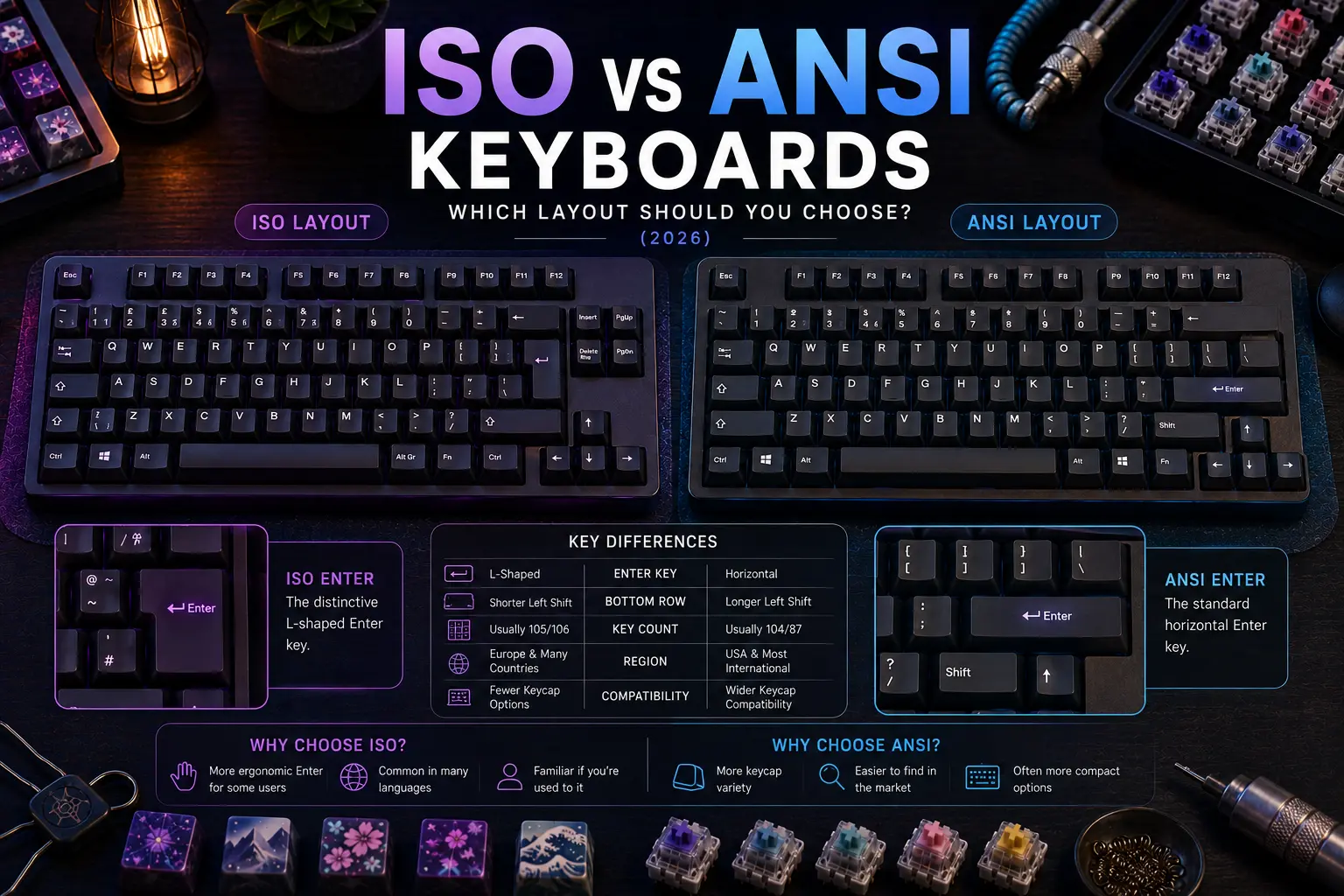
European buyers rarely get to have the same keyboards as US buyers, and ISO-layout support is a major differentiator between the two brands. Keychron ships nearly its entire lineup in ISO-UK, ISO-DE, ISO-Nordic, and ISO-ES variants — Q1, Q2, Q3, Q5, K2 Pro, K2 Max, V1 Max, K3 V3 all have ISO versions available. The ISO vs ANSI keyboard layout guide explains the layout differences.
NuPhy's ISO support is significantly more limited. The Air75 V2 has ISO-UK and ISO-DE variants; the Halo75 V2 has selected ISO SKUs; the Field75 HE is ANSI-only. For buyers in France, Germany, UK, and the Nordic countries who need native-layout support, Keychron is the safer default by a wide margin. Ordering ISO layouts directly from keychron.com or their EU store is more reliable than waiting for NuPhy to expand ISO SKUs.
Accessories & Ecosystem
Keychron's accessory ecosystem is larger: aluminum cases, brass weights, wrist rests (wood, palm-rest foam, leather), KSA/OSA/Cherry-profile PBT keycap kits, coiled USB-C cables in multiple colors, dampening foam upgrade kits, switch pullers, and custom plates (FR4, POM, brass). The keychron.com accessories tab holds several hundred SKUs.
NuPhy's accessory ecosystem is smaller and more curated: wrist rests matched to specific keyboard series (the Halo wrist rest is specifically tuned to Halo75/96 V2 height), nSA and mSA keycap sets in NuPhy's stock colorways, and NuPhy-specific carrying sleeves for the Air series. The volume is lower but the per-accessory design coherence is higher. Both brands sell high-quality coiled cables, dampening foam, and switch pullers.
Third-party support differs too. Keychron boards have broader support from aftermarket keycap makers, custom plate manufacturers, and modding communities thanks to six years of ecosystem build-up. NuPhy boards increasingly appear in aftermarket keycap drops from GMK and Drop, but the long-tail aftermarket still favors Keychron.
Customer Service & Warranty
Both brands offer 1-year limited warranties on keyboards and have responsive email support. Keychron's larger scale means longer queue times during Q4 holiday season but generally faster RMA processing thanks to US, UK, and EU warehouse presence. NuPhy operates with a smaller support team but tends to respond faster per-ticket, particularly through the Discord community, which is unusually active for a keyboard brand.
Reddit consensus in r/MechanicalKeyboards and r/NuPhy through 2025–2026 rates NuPhy slightly higher on customer communication, and Keychron slightly higher on warranty claim resolution. Neither has a systemic QC or warranty problem; both compare favorably against GMMK, Drop, Corsair, and Razer on post-purchase support.
Who Should Buy Keychron?
Keychron is the correct default for: Mac-first users who want any layout, size, or budget tier; buyers who value QMK/VIA firmware freedom; ISO-layout buyers in Europe; ergonomic-split and Alice-layout seekers; buyers shopping under $100 for a full premium-tier experience; heavy typists who want full CNC aluminum in the $199–$229 range; Hall Effect gamers who want wireless, Mac support, and competitive latency at a reasonable price; programming workflow users who benefit from deep remapping.
Keychron is also the correct default for first-time premium mechanical keyboard buyers, simply because the V Max line at $99 delivers 90% of the Q Max experience at half the price, and the downgrade path (B Pro at $45) exists for buyers on tight budgets. No NuPhy equivalent exists under $99.
Best Keychron starter picks in 2026: V3 Max or V1 Max (budget mainstream), K2 Max or K Pro (wireless mainstream), Q1 Max (premium flagship), K2 HE (gaming/productivity hybrid), K3 V3 (ultraportable low-profile).
Who Should Buy NuPhy?
NuPhy is the correct default for: design-first buyers who treat the keyboard as part of a desk aesthetic; work-from-home users where the keyboard will appear on Zoom and Instagram backgrounds; iPad and MacBook users who want the thinnest possible mechanical companion (Air75 V3); content creators whose brand benefits from a coherent visual identity on-desk; buyers who specifically want the Gateron Aloe / Moss / Wisteria switch characteristics; users who prioritize acoustic tuning and typing sound polish above firmware openness; buyers ready to pay 10–20% premium over Keychron for the NuPhy design language.
NuPhy is also the correct default for buyers specifically targeting the 75% standard-profile wireless premium segment where the Halo75 V2 genuinely competes with (and in some reviewer rankings, beats) the Keychron Q1 Max at 35% lower price.
Best NuPhy starter picks in 2026: Air75 V2 or V3 (ultraportable low-profile), Halo75 V2 (premium 75% wireless), Halo96 V2 (premium 96% with numpad, see the 96% keyboard layout guide), Gem80 (premium TKL), Field75 HE V2 (competitive esports).
Final Verdict: The Honest Answer
Neither brand wins every category, and the honest answer depends on what a buyer values most. Keychron wins decisively on: catalog breadth, Mac compatibility consistency, ISO support, firmware openness on mainstream SKUs, sub-$100 value, Alice/ergonomic-split coverage, and Hall Effect value (K2 HE beats Field75 HE V2 for any non-competitive-esports use case). NuPhy wins decisively on: design coherence, acoustic tuning, low-profile battery life (Air V3), and out-of-box premium-feel per dollar spent in the $120–$170 segment.
Reviewer consensus from Tom's Hardware, Trusted Reviews, Notebookcheck, Gadgetoid, and RTINGS rates both brands as the two most-recommended mainstream mechanical keyboard brands of 2026, which is the scoreboard that matters. The firmware convergence of 2025 (NuPhy adopting QMK/VIA on Air V2, Halo V2, Gem80, and Kick75) neutralized Keychron's historic moat in that area. The polling-rate arms race of 2026 (NuPhy Field75 HE V2 at 8K wired, Keychron Q1 Ultra at 8K wireless) put both brands at the frontier.
Where Keychron vs NuPhy ultimately resolves: Keychron is the brand you recommend to anyone, and NuPhy is the brand you recommend to someone who has specific aesthetic priorities and a 10–20% budget cushion. For the undifferentiated "first premium mechanical keyboard" buyer in 2026, Keychron wins by default. For the buyer who has already owned a Keychron and wants something visually distinctive for their second board, NuPhy wins by default. See also the broader Keychron vs GMMK vs Drop comparison for context on how both brands sit in the wider premium landscape.
Price & Where to Buy
Keychron products are available through keychron.com with the LEXA referral program, through Amazon with broad ASIN coverage, and through Best Buy and select regional retailers. Direct links with verified 2026 ASINs include the Keychron Q1 Max Assembled Red on Amazon, the Keychron Q3 Max Banana on Amazon, the Keychron Q5 Max Brown on Amazon, the Keychron K2 HE on Amazon, the Keychron K4 HE on Amazon, the Keychron V5 Max Banana on Amazon, the Keychron K2 Pro Brown on Amazon, and the Keychron Q1 V2 Blue Grey on Amazon. Direct store links with the LEXA tag include Keychron Q1 Max, Keychron Q10 Pro Alice, and Keychron K2 HE bundle.
NuPhy products are available through nuphy.com with frequent seasonal discounts, through Amazon with strong mainstream-SKU coverage, and through select Apple-adjacent specialty retailers. Verified 2026 listings include the NuPhy Air75 V2 Wisteria on Amazon, the NuPhy Air75 V2 Grey Brown on Amazon, the NuPhy Halo75 V2 Black Raspberry on Amazon, the NuPhy Halo96 V2 Lemon Black on Amazon, the NuPhy Halo96 V2 Mint White on Amazon, the NuPhy Field75 HE Magnetic White on Amazon, and the NuPhy Halo75 V1 on Amazon. Direct store links include NuPhy Air75 V2, NuPhy Air75 V3, NuPhy Halo75 V2, NuPhy Halo96 V2, NuPhy Field75 HE V2, and the NuPhy HE keyboards collection.
For buyers coming from budget brands, the best budget keyboard brands under $100 guide provides a wider context.
Frequently Asked Questions
Q: Is Keychron better than NuPhy?
A: Neither brand is objectively better — they serve different priorities. Keychron wins on breadth, Mac compatibility, QMK/VIA firmware openness, ISO support, and sub-$100 value. NuPhy wins on design coherence, acoustic tuning, and premium low-profile portability. For a first premium mechanical keyboard, Keychron is the safer default. For a second or third board where aesthetic matters, NuPhy often wins.
Q: Is NuPhy overpriced compared to Keychron?
A: NuPhy boards cost 10–20% more than Keychron equivalents at similar feature sets. Whether that premium is justified depends on how a buyer values design language, colorways, and out-of-box acoustic tuning. The premium is real and consistent; whether it's worth it is subjective. At the ultra-premium tier above $200, Keychron Q Max and Q Ultra actually cost more than NuPhy's Halo V2 because Keychron uses full CNC aluminum where NuPhy uses aluminum top plus ABS bottom.
Q: Which is better for Mac users: Keychron or NuPhy?
A: Keychron remains the safer default for Mac users because every single model in the lineup ships with a physical OS toggle, included Mac keycaps, and Windows/macOS dual-profile saves. NuPhy has closed the gap significantly by 2026 — the Halo75 V2 ships pre-set to Mac mode with dedicated Dictation, Focus, Mission Control, Spotlight, and screenshot keys, and Gadgetoid argued NuPhy has actually surpassed Keychron on out-of-box Mac polish. For any-model Mac compatibility, buy Keychron; for the specific Halo V2 or Air V3, NuPhy's Mac experience is equal or better.
Q: Does NuPhy support QMK/VIA?
A: Yes, starting in 2025. NuPhy confirmed that Air75 V2 and all subsequent Air models ship with QMK/VIA, and extended the same firmware to Halo V2, Gem80, and Kick75. The exceptions remain: Halo IO Edition, Air HE, Node75, and WH80 use the proprietary NuPhyIO 2.0 browser app; Field75 HE uses Field Console because VIA does not natively handle analog Hall Effect. For mainstream NuPhy buyers in 2026, QMK/VIA support is standard.
Q: Which brand has better wireless?
A: Both brands deliver 1000 Hz wireless over 2.4 GHz on mainstream wireless SKUs, which is excellent for all productivity and office use. In 2026 the flagship polling race sits at 8 kHz on both sides — Keychron Q1 Ultra at 8 kHz wireless, NuPhy WH80 at 8 kHz wireless, NuPhy Field75 HE V2 at 8 kHz wired. Battery life favors NuPhy in the low-profile category (Air V3 claims 1200 hours backlight-off versus Keychron K3 V3's ~240 hours), while full-size wireless battery is roughly comparable between Halo V2 and Keychron K Max.
Q: Keychron Q1 or NuPhy Halo75?
A: Keychron Q1 Max wins on build quality (full CNC aluminum vs aluminum top plus ABS bottom on Halo75 V2), long-term durability, and thockier sound signature. NuPhy Halo75 V2 wins on price (~35% cheaper), design polish, out-of-box Mac shortcut mapping, and lighter weight. Buyers with $200+ budget who prioritize build should buy the Q1 Max; buyers with $130 budget who prioritize aesthetics should buy the Halo75 V2. Both are outstanding at their respective price tiers.
Q: Can I use any MX switch on Keychron and NuPhy?
A: Yes, with caveats. Both brands use hot-swap PCBs with 5-pin MX sockets on standard-profile boards (Keychron Q, K Pro, K Max, V Max; NuPhy Halo V2, Gem80, Kick75), which accept any standard 3-pin or 5-pin MX-compatible switch from Gateron, Cherry, Kailh, Akko, TTC, Outemu, and others. Low-profile boards from both brands (Keychron K3/K7/K11, NuPhy Air series) use Gateron low-profile 2.0 mounts and accept only low-profile switches — standard MX switches do not fit. Hall Effect boards (Keychron K2 HE, NuPhy Field75 HE V2) require proprietary magnetic switches and do not accept standard mechanical MX switches.
Q: Which brand should a first-time mechanical keyboard buyer choose?
A: Keychron by default. The V3 Max at $99 delivers a gasket-mount, QMK/VIA, tri-mode wireless 75% experience that matches keyboards costing twice as much, with full Mac support and broad switch availability. NuPhy is the better second-keyboard pick once a buyer knows their layout preferences, budget ceiling, and aesthetic priorities — the Halo75 V2 at $130 is a phenomenal upgrade from any generic membrane keyboard, but it asks a design-conscious buyer rather than a functional-first buyer.
Conclusion
Keychron and NuPhy are the two brands that absorbed most of the mainstream premium mechanical keyboard market between 2022 and 2026, and the cross-shop between them is one of the most searched questions in the hobby. The honest verdict after reviewing the 2026 lineup of both brands, their firmware shifts, pricing patterns, build-quality execution, and reviewer consensus is that both are excellent — but they are excellent at different things.
Keychron is the safer default recommendation for nine out of ten buyers. The breadth of catalog means Keychron almost certainly has the exact keyboard needed — any layout, any size, any firmware tier, any budget. Mac compatibility is consistent across the entire lineup. Firmware is QMK/VIA-open on mainstream SKUs. ISO support is broad. Ergonomic and Alice layouts exist. Sub-$100 value is unmatched. Hall Effect gaming is available with wireless and Mac support via the K2 HE. The V3 Max and V1 Max at $99 remain the best value in premium-tier mechanical keyboards at any price.
NuPhy is the correct pick for the tenth buyer — the one who prioritizes design coherence over firmware flexibility, aesthetic polish over budget optimization, and out-of-box acoustic tuning over long-term customization. The Halo75 V2, Gem80, and Air75 V3 are among the most-photographed and most-reviewed keyboards of 2025–2026, and the brand has genuinely matured into a Keychron alternative rather than a novelty option. The 10–20% price premium over Keychron is real, and so is the design value buyers receive in exchange.
The final recommendation by profile: Mac-focused productivity buyers choose Keychron Q Max or K Pro / K Max. Competitive gamers choose Keychron K2 HE (mixed use) or NuPhy Field75 HE V2 (esports-only). Programmers and developers choose Keychron V Max or Q Max for firmware freedom. Office and work-from-home users split — Keychron K Pro for consistency, NuPhy Halo V2 for aesthetic. Portability seekers choose NuPhy Air75 V3. Premium-aesthetic enthusiasts choose NuPhy Gem80 or Halo V2. First-time buyers under $100 choose Keychron V3 Max without hesitation. Both brands will serve the buyer well; the question is simply which set of priorities wins.